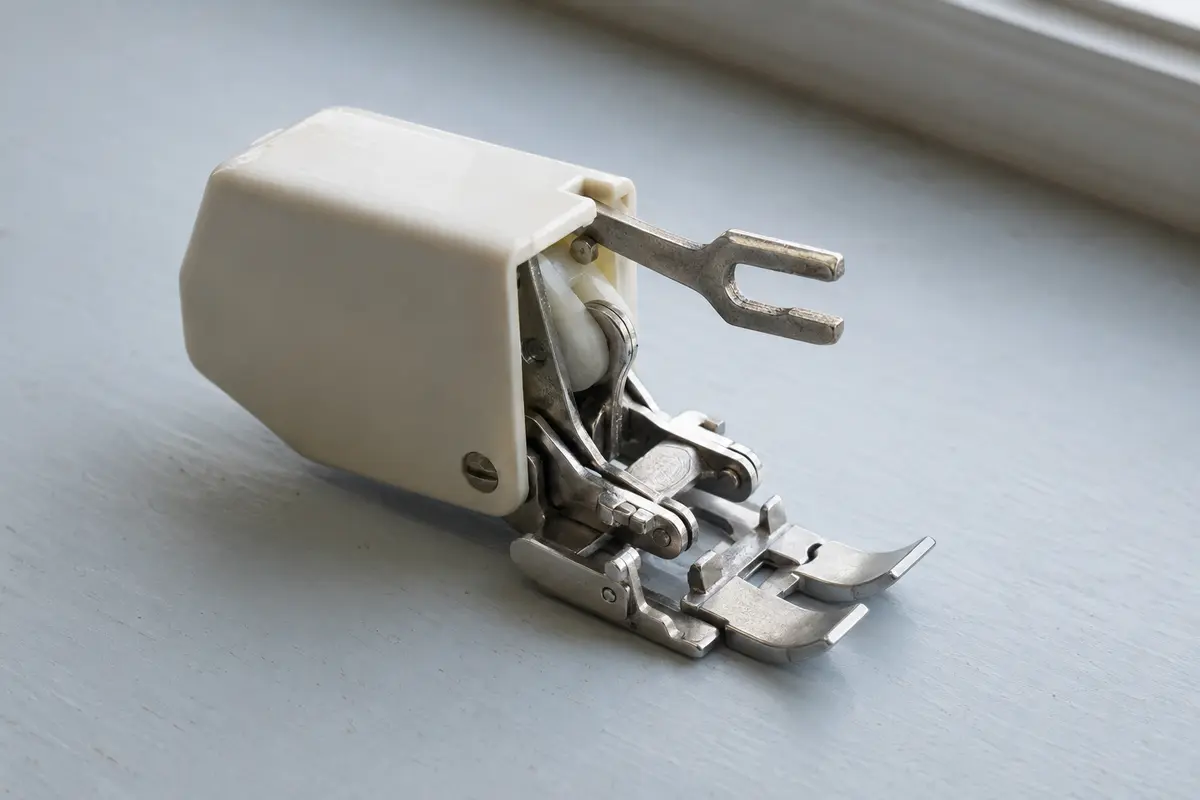
A bulky presser-foot attachment with an upper feeding mechanism that helps move the top layer of fabric at a pace closer to the feed dogs below.
The problem
Layers rarely travel equally
Regular feed dogs act from beneath. Friction from the presser foot can hold the upper layer back, causing creeping, ripples, or misaligned checks.
The response
Feed from above and below
A walking foot lifts and advances with the machine's needle-bar motion, helping the fabric sandwich move more evenly.
A domestic walking foot attachment. The forked operating arm fits over the needle-clamp screw so the attachment can lift and advance its upper-feed mechanism in step with the machine. Attachment design and compatibility vary by model.
Where it earns its space
Walking feet are especially useful for straight-line quilting, attaching binding, sewing long seams through multiple layers, matching stripes, and handling materials that tend to stick or shift.
Where it is not the answer
It is not designed for free-motion quilting, tight decorative curves, or every zigzag stitch. Check the foot's needle opening and the manufacturer's stitch limitations before sewing.
How to attach it safely
Most walking feet replace the regular foot and holder. Their fork or operating lever must sit over the needle-clamp screw so the mechanism moves with the needle bar. Install with the machine off, then turn the handwheel manually to check clearance.
Walking foot or dual feed?
A walking foot is a removable mechanical attachment. Integrated dual feed is built into certain machines and is often slimmer, quieter, and easier to engage. Both aim to control the upper layer; compatibility and project type determine the better option.
Better results
Prepare the layers before relying on the foot
Baste long or visible seams
Pin, clip, spray-baste, or hand-baste as the materials allow. Start from a consistent reference point and sew matched sections in the same direction so small movement does not accumulate into a large mismatch.
Support the project weight
Keep a quilt, coat, or vinyl panel level with the machine bed. Material hanging from the table can pull sideways even when the upper and lower feeds are coordinated. Reposition the bulk before it begins steering the seam.
Use moderate, steady speed
The attachment must complete its lifting and advancing motion during every stitch. Racing over thick joins can make it bounce, while pulling at a slow speed can deflect the needle. Pause and level the foot at abrupt height changes.
Before you attach one
Walking foot FAQs
Can I use a walking foot for every stitch?
No. Many walking feet are safest with straight stitches and a limited selection of wide stitches. Check the foot opening and your machine instructions before selecting zigzag or decorative stitches.
Do I still need to pin or clip layers?
Usually, yes. A walking foot reduces layer shifting but does not replace sensible basting, pinning, or clipping on long seams and quilt sandwiches.
Why is my walking foot noisy?
Walking feet have moving linkages and often sound louder than ordinary snap-on feet. Stop if you hear striking, grinding, or irregular knocking, and recheck installation and needle clearance.
Can a walking foot sew leather or vinyl?
It may help feed sticky or layered materials, but needle choice, thread, machine power, and material thickness still matter. A non-stick or roller foot may work better for some surfaces.
Is a walking foot the same as an even-feed foot?
The names are commonly used for the same type of removable upper-feed attachment. Integrated dual-feed systems pursue a similar goal but are built into compatible machines.