

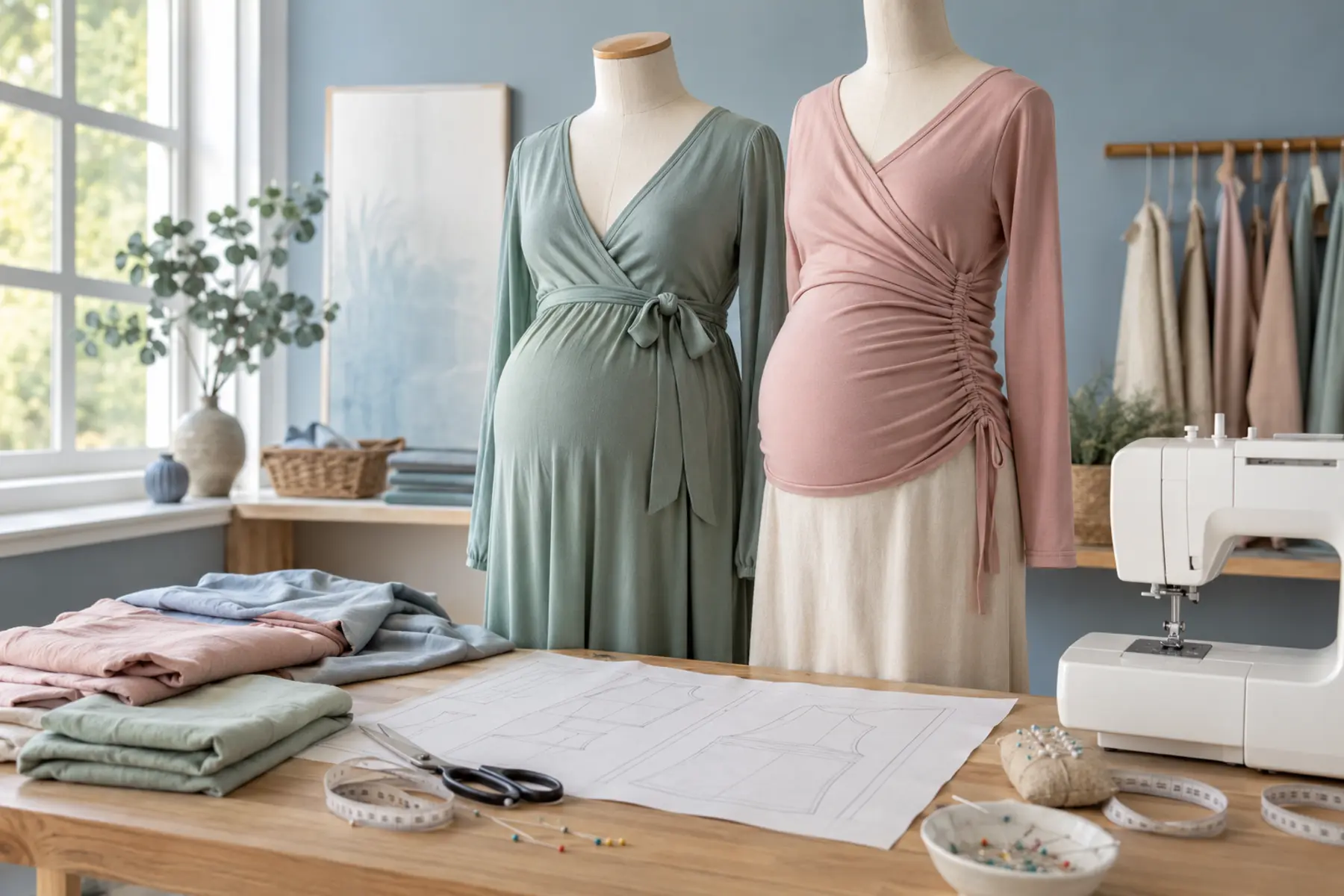
Sewing maternity clothes gives you something that can be surprisingly difficult to find in shops: clothing that fits your body, your pregnancy, your climate and your everyday routine at the same time. A good maternity sewing pattern does not simply make an ordinary garment larger around the stomach. It creates room where the body is changing while keeping the shoulders, neckline, sleeves and upper back properly fitted.
The most useful patterns also have a life beyond pregnancy. A wrap dress can become a nursing dress. A gathered-waist top may remain comfortable during the early postpartum months. A pair of trousers with an adjustable panel can continue to fit while your body changes again. Choosing patterns with this longer useful life makes a handmade maternity wardrobe more practical and keeps you from spending hours on garments you will only wear briefly.
This guide covers maternity sewing pattern ideas for different stages and needs, along with suitable fabrics, useful design features and fitting considerations. It is intended to help you decide what to make, whether you use a commercial paper pattern, a downloadable PDF pattern or adapt a familiar pattern you already own.
What makes a sewing pattern suitable for maternity wear?
A maternity pattern needs to account for more than a growing bump. During pregnancy, the bust may increase, the ribcage may expand, the waistline changes and the front of a garment needs additional length as well as width. Simply cutting a larger ready-to-wear size can make the shoulders too broad and the neckline too loose without providing the right amount of room at the front.
Look for patterns that create space through one or more intentional features: gathering at the side seams, pleats below the bust, an empire waist, a wrap front, ruching, stretch fabric or an adjustable panel. Longer front pattern pieces are also important because the bump lifts the front hem. If a pattern adds width but no length, the finished top or dress may look level on the hanger but rise noticeably at the front when worn.
Comfortable maternity garments should not rely on a tight band pressing across the middle of the stomach. Supportive stretch panels can feel secure, but they still need adequate recovery and the correct amount of negative ease. For woven garments, shaped seams and controlled gathers usually create a better result than adding a large amount of fabric everywhere.
12 practical maternity sewing pattern ideas
The best maternity sewing project depends on when you expect to wear it, how quickly your body is changing and whether you want the garment to remain useful after birth. The following ideas cover casual clothing, workwear, sleepwear and nursing-friendly options rather than treating every maternity wardrobe as a collection of loose dresses.
1. Side-ruched maternity T-shirt
A fitted knit T-shirt with ruching at the side seams is one of the most useful maternity basics. The extra front length is gathered into the side seams, creating space for the bump without making the back loose or oversized. This style can work from the second trimester through late pregnancy when the pattern provides enough front length.
Choose a soft cotton jersey or cotton-modal jersey with four-way stretch and good recovery. A fabric that stretches but does not recover may become baggy by the end of the day. If this is your first knit garment, use a stable medium-weight jersey rather than very thin rayon jersey, which can curl and shift while being cut.
This is an approachable project for a confident beginner. The most important steps are stabilising the shoulder seams, distributing the side gathers evenly and using a stretch stitch, narrow zigzag or overlocker for the main seams. A twin needle can provide a neat hem on a regular sewing machine.
2. Empire-waist maternity top
An empire-waist top is fitted around the shoulders and upper chest, with the lower section beginning just below the bust. Gathers or small pleats in the front skirt provide room without requiring the entire top to be oversized. This is a useful option for someone who prefers woven fabrics or wants a top that looks more structured than a T-shirt.
Lightweight cotton lawn, double gauze, rayon challis and soft linen blends can all work, depending on the pattern. The fabric should drape away from the seam rather than standing stiffly over the stomach. Check that the under-bust seam sits comfortably and does not become too tight as the ribcage expands.
An empire top can remain useful postpartum, particularly if it includes buttons, a crossover bodice or another form of nursing access. Avoid making the front skirt excessively wide. Controlled fullness usually looks better and is easier to layer beneath a cardigan or jacket.
3. Wrap maternity dress
A wrap dress is adaptable because the waist can be tied to suit the wearer rather than fixed at one measurement. A true wrap pattern also makes it easier to adjust the fit through pregnancy and can provide nursing access later. However, not every ordinary wrap dress automatically accommodates a full-term bump. The front pieces still need enough length and coverage.
For a knit wrap dress, consider cotton jersey, ITY knit or a soft ponte with suitable stretch. For a woven version, choose a fabric with fluid drape, such as rayon challis or a lightweight crepe. Pay close attention to neckline stability. Clear elastic, stay tape or a narrow binding may be needed to prevent the wrap edge from stretching and gaping.
This pattern is most useful when the overlap remains secure while sitting and moving. Before finishing the dress, test the coverage with the intended undergarments and consider adding an internal tie or discreet snap if the pattern does not already include one.
4. Maternity leggings with an over-bump panel
Leggings are a practical project when the fabric and fit are chosen carefully. An over-bump version uses a deep stretch panel attached to the main leggings. The panel should feel supportive without being restrictive and should remain in place when the wearer walks, sits or bends.
Use an opaque knit with four-way stretch, strong recovery and enough weight to avoid becoming sheer. Athletic knit, cotton-spandex jersey or a suitable ponte may work if it meets the pattern's stretch requirement. Always test the fabric's stretch percentage before cutting because sizing cannot compensate for a fabric that is substantially less stretchy than the pattern expects.
The panel can be made from the same fabric or a softer coordinating knit. Some wearers prefer an under-bump waistband, especially late in pregnancy, so it is worth choosing a pattern that includes both options if you are unsure which will feel better.
5. Adjustable maternity trousers or lounge pants
Woven maternity trousers are more challenging than leggings but can be much more versatile for work or daily wear. Useful designs include a partial stretch waistband, an over-bump knit panel, an under-bump curved waistband or an adjustable elastic system hidden inside the waistband.
For casual trousers, linen blends, cotton twill and soft woven fabrics with a little elastane can provide comfort without looking like sleepwear. For office trousers, a stretch suiting fabric may be more appropriate. The crotch curve and rise still need to fit correctly, so do not rely on a stretch panel to solve every fitting issue.
If your measurements are changing quickly, make a test version before cutting expensive fabric. It is often easier to perfect the trouser portion early in pregnancy and leave the waistband or panel adjustable than to fit the entire garment later.
6. A-line maternity tunic
An A-line tunic offers more room than a standard top but does not need to look shapeless. The shoulders and upper chest can remain fitted while the side seams gradually widen. A centre-front pleat, inverted pleat or modest amount of gathering can provide additional room over the bump.
This is a helpful project for beginners because it can be made in a stable woven fabric and does not require a complicated waistband. Cotton lawn, linen-rayon blends, double gauze and lightweight chambray are suitable choices. Side vents make a longer tunic easier to sit and move in.
To keep the hem level, the front pattern piece usually needs extra length. This becomes more important later in pregnancy. If you are adapting a non-maternity tunic, make a toile and assess the hem while wearing it rather than judging the pattern flat on the table.
7. Maternity shirt dress with an inverted front pleat
A shirt dress can provide a polished option for work or occasions while remaining practical after birth. Look for a pattern with an inverted pleat, gathers or added volume beginning above the bump. A full button front can later provide nursing access, which extends the garment's useful life.
Choose a lightweight fabric that holds details such as a collar and button placket but still drapes comfortably. Cotton lawn, Tencel twill, chambray and linen-viscose blends can work well. A stiff quilting cotton may make the added front volume stand away from the body.
Buttons near the fullest part of the bust and stomach need enough overlap to prevent pulling. If the pattern has a separate button band, interfacing should support it without making it rigid. Hidden snaps can be added between buttons if necessary.
8. Maternity maxi dress
A maternity maxi dress is comfortable in warm weather and can work for everyday wear, photographs or events depending on the fabric. An empire seam, crossover bodice or gathered upper front gives the bump room while keeping the upper body shaped. A skirt cut with too much fullness can become heavy, so balance comfort with fabric weight.
Knit maxi dresses are forgiving and often quicker to sew. Woven maxi dresses can feel cooler but need adequate ease and careful fitting around the upper body. Whatever fabric you choose, check the finished length while wearing the shoes you expect to use. Pregnancy can change both the front hem position and the way you balance, so an overly long skirt can become a safety concern.
For a special-occasion version, prioritise comfort at the neckline, armholes and under-bust seam. A dress that photographs well but presses against the ribcage will not be enjoyable to wear for several hours.
9. Nursing-friendly maternity top
A garment that works during pregnancy and nursing offers much better value than a maternity-only top. Nursing access may come from a crossover bodice, a lift-up overlay, concealed openings beneath a yoke or a button front. The most discreet construction is not necessarily the easiest to use, so consider whether the opening can be managed comfortably with one hand.
Stretch knit is common for crossover and layered designs, while buttons and yokes work well in woven fabrics. Test how far the neckline or opening needs to move without becoming permanently stretched. If the pattern uses a low crossover neckline, an internal modesty panel can improve coverage during pregnancy without preventing later access.
This type of top is usually an intermediate project because the layers and openings must be assembled in the correct order. Clearly mark the right and wrong sides of each piece before sewing, especially when the fabric looks similar on both sides.
10. Maternity and nursing nightdress
Sleepwear is an excellent maternity sewing project because comfort matters more than a highly structured fit. A nightdress can use an empire seam, soft gathers and a crossover or buttoned upper section. It should be loose enough for sleeping without having so much fabric that it twists around the body.
Cotton jersey, modal jersey and lightweight cotton fabrics are common choices. Consider temperature as well as softness. Pregnancy and postpartum temperature changes can make a heavy synthetic fabric uncomfortable even when it feels smooth in the shop.
Avoid scratchy seam finishes, hard fasteners and narrow elastic directly beneath the bust. If the garment will be used in hospital or during early recovery, pockets and easy nursing access can be more valuable than decorative details.
11. Maternity robe
A robe requires very little specialised maternity shaping, but a few pattern choices make it more practical. A generous front overlap, secure internal tie and belt loops at more than one height allow the robe to adjust as the body changes. A knee-length or midi robe is easier to move in than a very long version.
Double gauze, cotton lawn, lightweight waffle fabric and soft jersey are suitable depending on the season. Large patch pockets are useful, but position them after trying on the nearly completed robe because a standard pocket placement may sit awkwardly against the bump.
A handmade robe can be used throughout pregnancy, at the hospital, while nursing and long after the maternity period. This makes it a good choice when you want a relatively simple project with a long practical life.
12. Maternity dungarees or overalls
Maternity overalls provide adjustable straps and a relaxed fit, but they still require thoughtful shaping at the side seams. Patterns may use knit side panels, buttoned side openings or a curved bib with extra front length. The design should allow the wearer to sit comfortably without the bib pulling upward.
Soft denim, stretch corduroy, linen blends and midweight cotton twill can work well. Avoid very heavy rigid denim unless the pattern is specifically drafted for it. Adjustable straps and more than one side-button position help the garment adapt during pregnancy.
This is usually an intermediate project because it may involve hardware, topstitching, pockets and side adjustments. It can, however, remain wearable postpartum if the side shaping is not too specialised.
Which maternity patterns are easiest for beginners?
The easiest first projects are generally garments with few pieces, forgiving fit and no complicated fastenings. A knit T-shirt with side ruching is manageable if you are comfortable sewing stretch fabric. If you prefer woven fabric, an A-line tunic, simple empire-waist top or robe may be less intimidating.
Avoid choosing a project solely because the pattern envelope labels it “easy.” Read the construction details. A simple-looking nursing top may contain several overlapping layers, while a loose woven tunic may only require darts, side seams and basic neckline finishing. Your existing skills should guide the choice.
For a first maternity garment, use reasonably priced fabric with the same characteristics required by the final pattern. Making a test version from a completely different fabric will not reveal how the intended garment will fit.
How to choose the right size for a maternity sewing pattern
Use the pattern company's measurement chart rather than your usual ready-to-wear size. Take current high-bust, full-bust, hip and any other measurements requested by the pattern. Because pregnancy changes are not identical for everyone, follow the pattern's specific sizing instructions instead of assuming you should add one or two sizes.
For tops and dresses, the high-bust measurement often gives a better starting point for fitting the shoulders. You can then make a full-bust adjustment if needed. Choosing a size from the full bust alone may make the shoulders, neck and armholes too large.
Check the finished garment measurements and the amount of ease. A maternity pattern may include significant front volume while remaining relatively fitted elsewhere. If your measurements fall between sizes, grade gradually between them rather than cutting the larger size throughout.
Take measurements again before each new project. A size selected in the first trimester may no longer be appropriate several weeks later, particularly around the bust and ribcage.
Can you adapt a regular sewing pattern for pregnancy?
Some regular patterns can be adapted successfully, particularly simple knit tops, loose dresses, tunics and wrap garments. The usual changes involve adding width and length to the front while preserving the original shoulder and back fit. Extra width may be controlled with side ruching, gathers, pleats or a seam beneath the bust.
Not every pattern is a good candidate. Highly fitted woven dresses, tailored jackets, garments with fixed waistbands and designs with complex front seams can require substantial redrafting. In these cases, beginning with a properly drafted maternity pattern is usually safer and faster.
When adapting a pattern, make a toile and assess it from the front and side. Check the bust, the fullest part of the bump, the front length and the hem balance. Do not make all adjustments at the side seam because this can distort the armhole and make the garment swing toward the front.
Best fabrics for maternity clothes
The best fabric depends on the garment, but comfort, breathability and recovery deserve more attention than appearance alone. Knit fabrics are useful because they stretch with the body. Cotton-spandex jersey, modal jersey, ponte and selected athletic knits can suit tops, dresses, leggings and panels. Always match the fabric's stretch percentage and direction to the pattern requirements.
For woven garments, choose fabrics that feel soft and have enough drape for the design. Cotton lawn, rayon challis, double gauze, chambray, Tencel twill and linen blends are common options. Very stiff fabric can turn gathers into unwanted bulk, while an extremely slippery fabric can make a simple project unnecessarily difficult.
Pre-wash fabric using the same method you intend to use for the finished garment. Maternity clothes are worn and washed frequently, and shrinkage after sewing can make a carefully fitted garment unusable.
Features that make maternity clothes useful postpartum
If you want a garment to last beyond pregnancy, look for adjustability and access rather than simply extra room. Wrap fronts, button plackets, crossover bodices and concealed nursing layers may allow breastfeeding. Drawstrings, elastic adjustments and ties help garments adapt as measurements change.
Removable or foldable bump panels can extend the life of trousers and skirts. Empire-waist dresses, robes and A-line tunics often remain wearable without any alteration. Side ruching is more visibly associated with maternity wear, but a softly gathered top can still work afterward if it does not have excessive front length.
Postpartum comfort varies, and not every wearer plans to breastfeed. The best long-term feature is therefore the one that suits the person's actual routine. A loose button-front shirt dress may be valuable for one person, while another may get more use from adjustable lounge trousers and a soft robe.
Common maternity sewing mistakes to avoid
One common mistake is adding width without adding front length. Another is sizing up the entire pattern, which can create poorly fitting shoulders and armholes. Choosing fabric without checking its stretch and recovery can also ruin an otherwise suitable pattern.
Do not place tight seams, rigid waistbands or bulky fasteners where they press against the stomach. Be cautious with heavy fabric and excessive gathering, especially beneath an empire seam. The finished garment should provide room without feeling weighted at the front.
Finally, do not complete every seam before trying the garment on. Fit can change during the time it takes to finish a project. Baste important side seams, waist panels and wrap positions first, then try on the garment before permanently stitching and finishing them.
A sensible mini maternity wardrobe to sew
You do not need to sew a completely new wardrobe. A small group of garments that work together is usually more useful. A practical starting plan could include two side-ruched or empire-waist tops, one pair of leggings, one adjustable pair of trousers, one casual dress and one robe or nursing-friendly nightdress.
Choose a limited colour palette so the tops work with both bottoms and can be layered with clothes you already own. Begin with the garment you need immediately rather than sewing in order of difficulty. If you are already in late pregnancy, a nursing-friendly garment or robe may remain useful longer than a highly fitted maternity top.
Frequently asked questions
Do I need a special maternity sewing pattern?
For fitted tops, dresses, trousers and skirts, a maternity-specific pattern is usually the most reliable choice because it includes additional front length and shaped room for the bump. Very loose garments, robes and some wrap styles may work from regular patterns, but their finished measurements and front coverage still need to be checked.
When should I start sewing maternity clothes?
Start when your regular clothes begin to feel restrictive or when you have enough current measurements to select a useful size. Sewing one or two adjustable garments early is often more practical than making an entire wardrobe before you know which fits and styles feel comfortable.
Are PDF maternity patterns better than paper patterns?
Neither format is automatically better. PDF patterns offer immediate access and often include layered sizes, but they require printing and assembly unless a copy-shop file is provided. Paper patterns avoid home assembly but may be less convenient if you need to blend between sizes. The drafting, instructions and size range matter more than the format.
What stitch should I use for maternity knit fabric?
Use a stitch that can stretch with the fabric, such as a narrow zigzag, lightning stitch or another stretch stitch recommended by your machine manual. An overlocker is convenient but not essential. Test the stitch on a fabric scrap and stretch the seam before sewing the garment.
How much fabric should I buy for a maternity pattern?
Follow the fabric requirements for your selected pattern, size and fabric width. Maternity garments may require additional length or fullness, but the amount varies substantially by design. Buy a little extra if you plan to make fitting adjustments, match a directional print or pre-wash a fabric that may shrink.
Final thoughts
The most successful maternity sewing patterns solve a specific problem. They may add comfortable room without changing the shoulder fit, create an adjustable waist, provide nursing access or remain wearable after pregnancy. A garment does not become maternity-friendly merely because it is loose.
Start with one pattern that matches your current needs and a fabric you will genuinely enjoy wearing. Check the finished measurements, make a test version when the fit is complex and leave final fitting decisions until you can try the garment on. With thoughtful pattern and fabric choices, a small handmade maternity wardrobe can be comfortable, personal and useful well beyond a single stage of pregnancy.