
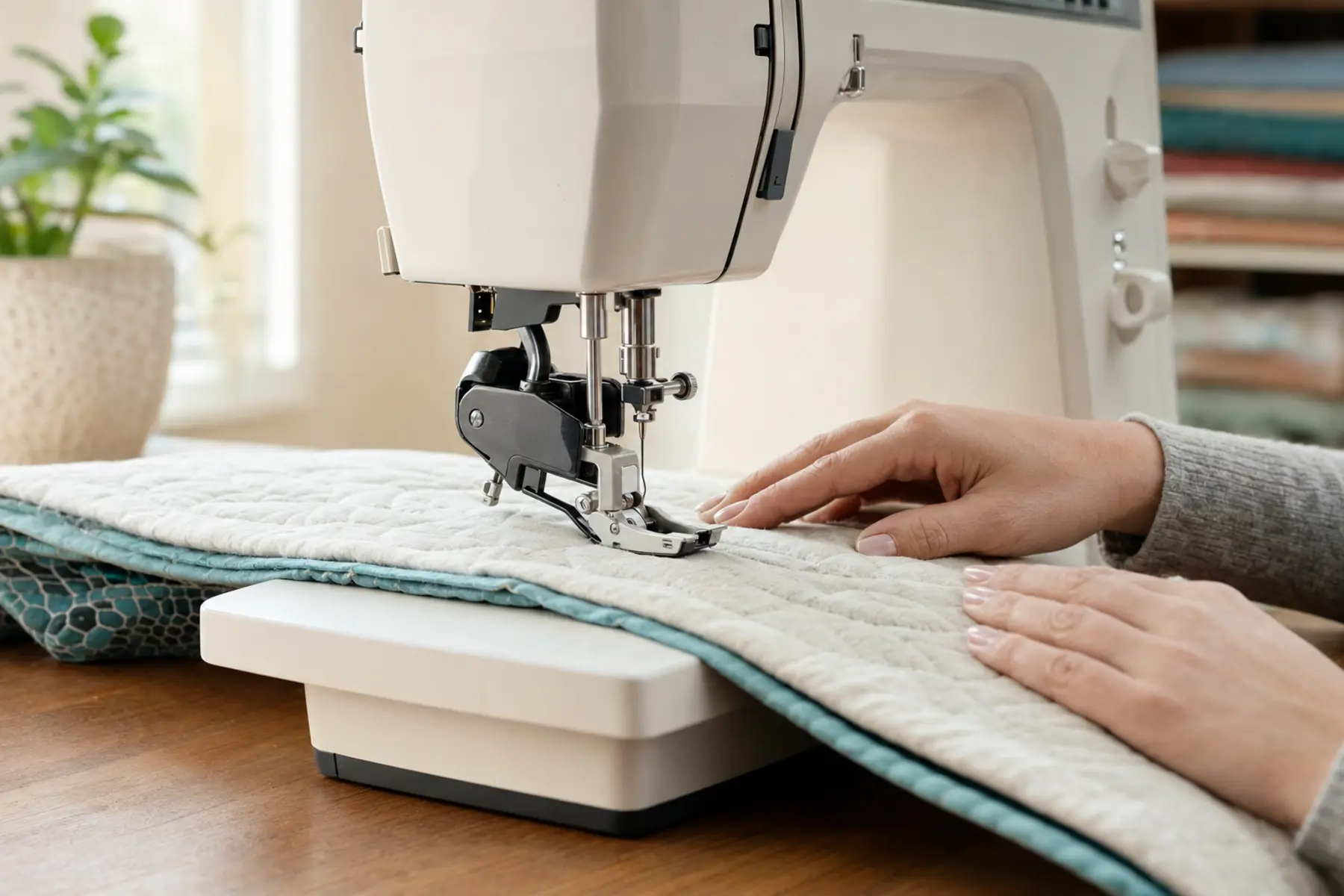
A walking foot is often presented as a simple solution for quilting, leather, vinyl, canvas, slippery fabrics, and bulky seams. That description is partly true, but it hides an important distinction: a domestic walking foot attachment is not the same as a machine built around a walking-foot feeding system.
This guide explains the feeding systems themselves. It does not rank products or recommend specific models. For buying decisions, the site’s separate quilting and leather guides will handle machine selection by project type.
What does “walking foot sewing machine” mean?
A regular domestic sewing machine mainly feeds fabric using the feed dogs beneath the presser foot. A walking-foot system adds movement from above so the upper layer is less likely to lag behind the lower layer.
The phrase may refer to three different things:
How does a walking foot move fabric?
When several layers pass under a regular presser foot, the feed dogs grip the bottom layer while friction under the foot resists the top layer. The lower layer can advance slightly faster, creating creeping, ripples, mismatched edges, or shifted quilt blocks.
A walking foot attachment alternately presses, lifts, and steps across the fabric surface. It does not usually pull with the same independent force as an industrial feed system, but it helps the upper layers move in rhythm with the feed dogs.
Built-in dual feed uses a machine-specific upper-feed unit. Industrial machines may use alternating presser feet, needle feed, or compound feed, depending on the design.
Walking foot attachment vs true walking-foot machine
How is built-in dual feed different?
Built-in dual feed is designed as part of the machine rather than attached to the needle bar. Depending on the model, it may engage through a dedicated mechanism behind the presser foot and work with compatible feet.
Dual feed is usually slimmer and quieter than a bulky walking foot attachment, which can improve visibility around the needle. It may also disengage quickly when ordinary sewing resumes.
However, built-in dual feed is still a domestic feeding system. It should not be confused with an industrial compound-feed machine intended for repeated heavy work.
What is a walking foot useful for?
Straight-line quilting
A walking foot helps the quilt top, batting, and backing travel together. This reduces tucks, ripples, and shifting while sewing straight or gently curved quilting lines.
Matching stripes, checks, and seam intersections
Upper feeding can reduce the tendency for one layer to creep, helping matched patterns and crossed seams remain aligned.
Slippery or grippy fabric combinations
Layer shifting can occur when one surface slides while another grips. A walking foot can help with some laminates, coated fabrics, light vinyl, velvet, and mixed-texture layers, provided the machine and needle are otherwise suitable.
Bulky but compressible layers
Batting, fleece, light foam, and padded fabric may feed more evenly when pressure is applied and released in a walking motion.
What a walking foot does not solve
It does not make a weak motor stronger.
It does not create extra presser-foot clearance.
It does not prevent needle deflection in very dense material.
It does not replace the correct needle, thread, stitch length, or presser-foot pressure.
It does not make every domestic machine suitable for upholstery or thick leather.
It does not replace stabiliser where fabric needs structural support.
When the machine stalls, the needle bends, the handwheel resists, or the foot cannot climb the stack safely, the limitation is broader than feeding alone.
Walking foot quilting vs free-motion quilting
Walking-foot quilting keeps the feed dogs engaged and lets the machine control stitch length while the fabric moves in the normal direction. It is suited to straight lines, grids, channels, gentle waves, and quilting in the ditch.
Free-motion quilting works differently. The feed dogs are lowered or covered, a free-motion foot is installed, and the user moves the quilt in any direction. Stitch length depends on the relationship between machine speed and hand movement.
For broader context, see what a quilting sewing machine is. The dedicated free-motion technique and buying guides should remain separate because they answer different questions.
Can a walking foot sew leather, vinyl, and canvas?
A walking foot can improve feeding, but material thickness, density, surface finish, seam construction, needle system, thread size, presser-foot lift, and machine power still determine whether the job is realistic.
A domestic attachment may be useful for garment leather, faux leather, light vinyl, or modest layered projects. Thick belts, saddlery, heavy upholstery, dense bag seams, and multiple webbing layers often require a machine designed for that work.
The broad leather sewing machine guide will compare machine options. The domestic vs industrial leather comparison will focus on capacity and workload rather than repeating this feeding-system explanation.
Walking foot vs even-feed foot vs roller foot
A roller or non-stick foot addresses surface drag. A walking foot primarily addresses relative movement between layers. The best choice depends on what is causing poor feeding.
Which stitches can you use with a walking foot?
Many walking foot attachments are intended for straight stitches and modest zigzag widths. Wide decorative stitches, dense satin stitches, reverse-heavy patterns, and side-motion stitches may exceed the opening or interfere with the walking mechanism.
Before sewing, turn the handwheel slowly through one complete stitch cycle with the machine switched off. Confirm that the needle clears the foot and plate at the selected width and needle position. Follow the attachment manual rather than assuming every stitch is safe.
Do you need a walking foot?
Check compatibility before fitting an attachment
Confirm the machine uses the correct shank and attachment type.
Check whether an adapter is required.
Use only stitch widths and needle positions approved for the foot.
Attach the walking lever to the correct needle-clamp area.
Turn the handwheel manually before powering the machine.
Test on the complete material stack, not one layer.
Stop if the needle strikes the foot, plate, or fabric stack.
Use the exact machine model and shank type when you compare walking-foot attachments on Amazon. A similar-looking foot is not proof of compatibility.
Frequently Asked Questions
Walking foot sewing machine questions
Is a walking foot sewing machine the same as a walking foot attachment?
No. A walking foot attachment fits onto many domestic sewing machines and helps move the top fabric layer. A true walking-foot machine has an integrated feeding system designed to move material from above and below, often with more power and consistency.
Do I need a walking foot for quilting?
A walking foot is useful for straight-line quilting because it helps the quilt top, batting, and backing move together. It is not used for free-motion quilting, where the feed dogs are lowered or covered and the fabric is moved by hand.
Can a walking foot sew leather?
A domestic walking foot attachment may help with thin, flexible leather, but it does not turn a domestic machine into an industrial leather machine. Thick or dense leather may require stronger feeding, more presser-foot lift, a suitable needle system, and more piercing power.
What is the difference between dual feed and a walking foot?
Dual feed is built into some domestic machines and moves the top layer through a dedicated upper-feed mechanism. A walking foot attachment is removable and driven by the needle-bar movement. Both aim to reduce layer shifting, but their design and compatibility differ.
Can I use decorative stitches with a walking foot?
Many walking foot attachments are intended mainly for forward-moving stitches. Wide decorative stitches, reverse-heavy patterns, or side-motion stitches may be restricted. Check the attachment and machine manual before use.
A walking foot improves feeding, not every part of the machine
For layered domestic sewing, a walking foot attachment or built-in dual feed can make a noticeable difference. For repeated heavy leather, upholstery, canvas, and bag work, the feeding system must be considered alongside motor power, needle system, presser-foot lift, thread capacity, workspace, and construction.
The right question is not simply whether a machine has a walking foot. It is whether the entire machine is designed for the material, thickness, seam structure, and workload you expect it to handle.