
Handheld sewing machines are often marketed as simple alternatives to regular sewing machines, but that description creates unrealistic expectations. Their small size makes them portable, yet the same compact design also limits fabric control, feeding strength, stitch security, and the range of work they can handle.
This guide explains the mechanism, threading sequence, stitch formation, realistic uses, common failures, and the difference between a handheld machine and a conventional domestic machine. It does not compare models or recommend products. That commercial intent belongs in the separate best handheld sewing machine guide.
What is a handheld sewing machine?
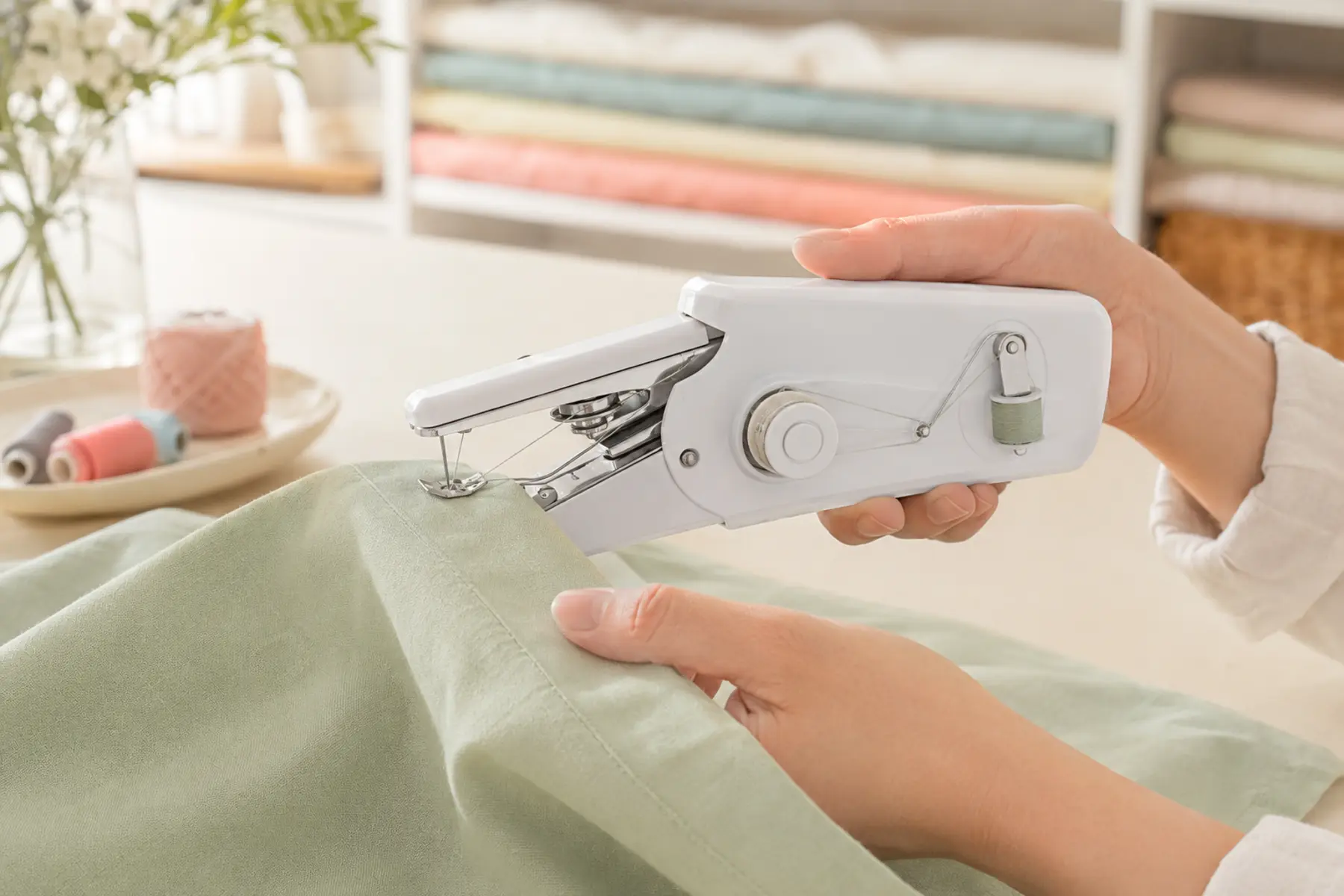
A handheld sewing machine is a small, portable device designed for short seams, hems, emergency repairs, and light craft work. Most models are held in one hand while the other hand supports and guides the fabric. Power may come from batteries, an external adapter, or a manual squeezing action, depending on the design.
Unlike a full-size sewing machine, the handheld device usually has a much smaller feeding area, limited tension control, a narrow presser mechanism, and little support for the fabric. These differences matter because sewing quality depends not only on the needle moving up and down, but also on how the fabric is held, advanced, and kept flat during stitch formation.
How does a handheld sewing machine form a stitch?
Many handheld machines form a chain stitch using one continuous thread. The needle carries the thread through the fabric, and a small hook or looper beneath the fabric catches the loop. As the fabric advances, the next loop passes through the previous loop, creating a chain along the underside.
This is different from the lockstitch made by most domestic sewing machines. A lockstitch uses an upper thread and a bobbin thread that interlock inside the fabric. Because a handheld chain stitch depends on one thread passing through the previous loop, the final loop must be secured carefully. If the thread is cut too close or the last loop is pulled loose, the seam can unravel quickly.
Which parts make the machine work?
The exact shape varies, but most handheld sewing machines include a needle, a small presser plate or fastening plate, a thread tension control, a thread guide, a spool pin, and a feed mechanism. A rotary wheel or internal motor drives the needle movement. Some models include a safety lock to prevent accidental operation.
The presser section holds the fabric against the feeding surface while the needle moves through it. The tension control regulates how freely the thread leaves the spool. If tension is too loose, loops may look large and untidy. If it is too tight, the thread may break or the fabric may pucker. Because the adjustment range is limited, threading accuracy and fabric choice often matter more than repeatedly turning the tension control.
How is a handheld sewing machine threaded?
Threading usually begins at the spool pin. The thread passes through one or more guides, around or between the tension components, through a guide close to the needle, and finally through the needle eye. The direction of the needle eye and the order of the guides vary between models, so the printed diagram should be followed exactly.
A missed tension guide may allow the thread to feed too freely, while threading the needle from the wrong direction can prevent the hook from catching the loop. Leave a generous thread tail after threading. A very short tail can pull out as soon as the first stitch forms.
How do you sew with a handheld sewing machine?
Raise the fastening plate or presser section and position the fabric so the intended stitch line sits beneath the needle. Lower the plate to hold the fabric. Keep the fabric flat and supported rather than allowing its weight to pull downward.
Begin slowly. Allow the feed mechanism to advance the fabric while your free hand keeps the seam aligned. Do not pull the fabric away from the device or force it through faster than the stitch cycle. A steady pace gives the hook time to catch each loop.
When the seam is complete, stop with a generous thread tail. Raise the needle, release the fabric carefully, and secure the final chain loop according to the manual. On many chain-stitch models, this means pulling the final loop through, drawing the thread tail into it, and tying or locking the thread before trimming.
What can a handheld sewing machine realistically sew?
A handheld machine is most useful when portability matters more than finish quality or speed. It may handle a loose trouser hem, curtain edge, lightweight seam repair, simple craft fabric, or temporary fix without requiring a full sewing setup.
Stable woven fabrics are generally easier than knits because they do not stretch while the machine feeds. Short, accessible seams are easier than enclosed areas or thick intersections. The device also works better when the fabric can remain relatively flat. Trying to manoeuvre a bulky garment, heavy curtain, or dense bag around a small handheld machine often creates more difficulty than the repair itself.
What are the main limitations?
The compact body provides very little surface to support the fabric, so maintaining an even seam allowance can be difficult. Feed pressure is modest, stitch options are limited, and the user must coordinate the device, fabric, and thread with both hands. Long seams can become inconsistent because small changes in angle or pulling force affect the stitch line.
Thick denim hems, multiple layers of canvas, dense upholstery, leather, elastic fabrics, and bulky seam intersections can exceed the machine's feeding and piercing ability. A handheld machine may also struggle when batteries weaken because reduced motor power affects needle penetration and stitch consistency.
It is best understood as a portable repair tool, not a miniature replacement for a domestic sewing machine.
Why do handheld sewing machine stitches unravel?
Chain stitches are secure while the chain remains intact, but they can unravel from the end when the final loop is not locked. Simply cutting the thread beside the fabric leaves the end vulnerable. Pulling the wrong tail can release one loop after another.
Leave several inches of thread, identify the final loop on the underside, and secure it using the method in the manual. If the machine repeatedly drops loops before the end of the seam, the problem may be threading, needle orientation, low power, poor tension, or fabric being moved too quickly rather than the finishing method alone.
Common problems and what to check first
Handheld sewing machine vs regular sewing machine
A regular sewing machine is better when seam strength, accuracy, repeated use, stitch variety, or fabric control matters. Its machine bed supports the work, feed dogs move the fabric consistently, the presser foot applies controlled pressure, and the lockstitch is easier to secure.
A handheld machine makes sense when the repair is short, the fabric is light, access to a full machine is inconvenient, and a practical temporary or simple finish is acceptable. It should not be chosen merely because a regular machine seems intimidating. The beginner guides on setting up a sewing machine and using one for the first time explain the full-size process in manageable steps.
When is a handheld machine the right tool?
If portability is the main requirement, you can compare handheld sewing machines on Amazon. Check the stitch type, power source, fabric limits, and securing method rather than treating every compact model as equivalent.
Frequently Asked Questions
Handheld sewing machine questions
Does a handheld sewing machine use a bobbin?
Many handheld sewing machines form a single-thread chain stitch and do not use a separate bobbin in the same way as a conventional domestic machine. Some designs vary, so the threading diagram for the specific model should always be checked.
Why does the stitch unravel so easily?
A chain stitch can unravel when the thread tail is not secured correctly. Leave a generous tail, pull the final loop through, and tie or lock the thread according to the machine instructions instead of simply cutting it close to the fabric.
Can a handheld sewing machine replace a regular sewing machine?
Usually not. A handheld machine is best for quick repairs, simple hems, and light portable work. It offers less control, fewer stitch options, and weaker feeding than a full-size sewing machine.
What fabric works best in a handheld sewing machine?
Light to medium woven fabrics are generally the easiest. Very stretchy, slippery, dense, heavily layered, or bulky materials are more likely to feed unevenly or produce weak stitches.
Why is my handheld sewing machine skipping stitches?
Skipped stitches can result from an incorrectly inserted needle, poor threading, unsuitable fabric, low battery power, weak thread tension, or fabric being moved too quickly. Reset the machine and test on stable woven cotton.
A handheld machine is a specialised convenience tool
Its value comes from portability and speed of access, not from matching the control or versatility of a full-size sewing machine. For light repairs and short seams, it may be useful. For durable construction, accurate stitching, difficult fabrics, and regular sewing, a conventional machine remains the more capable tool.
Understanding the single-thread chain stitch also explains the most common complaint: a seam that looks complete can still unravel unless its final loop is secured properly.