
The real question is not whether a machine has “quilting” in its name. It is whether the machine can handle the kind of quilting you plan to do.
Someone piecing small patchwork blocks has very different needs from someone free-motion quilting a king-size quilt. This guide separates those needs so you can judge whether a regular machine is enough or a quilting-focused model would genuinely help.
1. What is a quilting sewing machine?
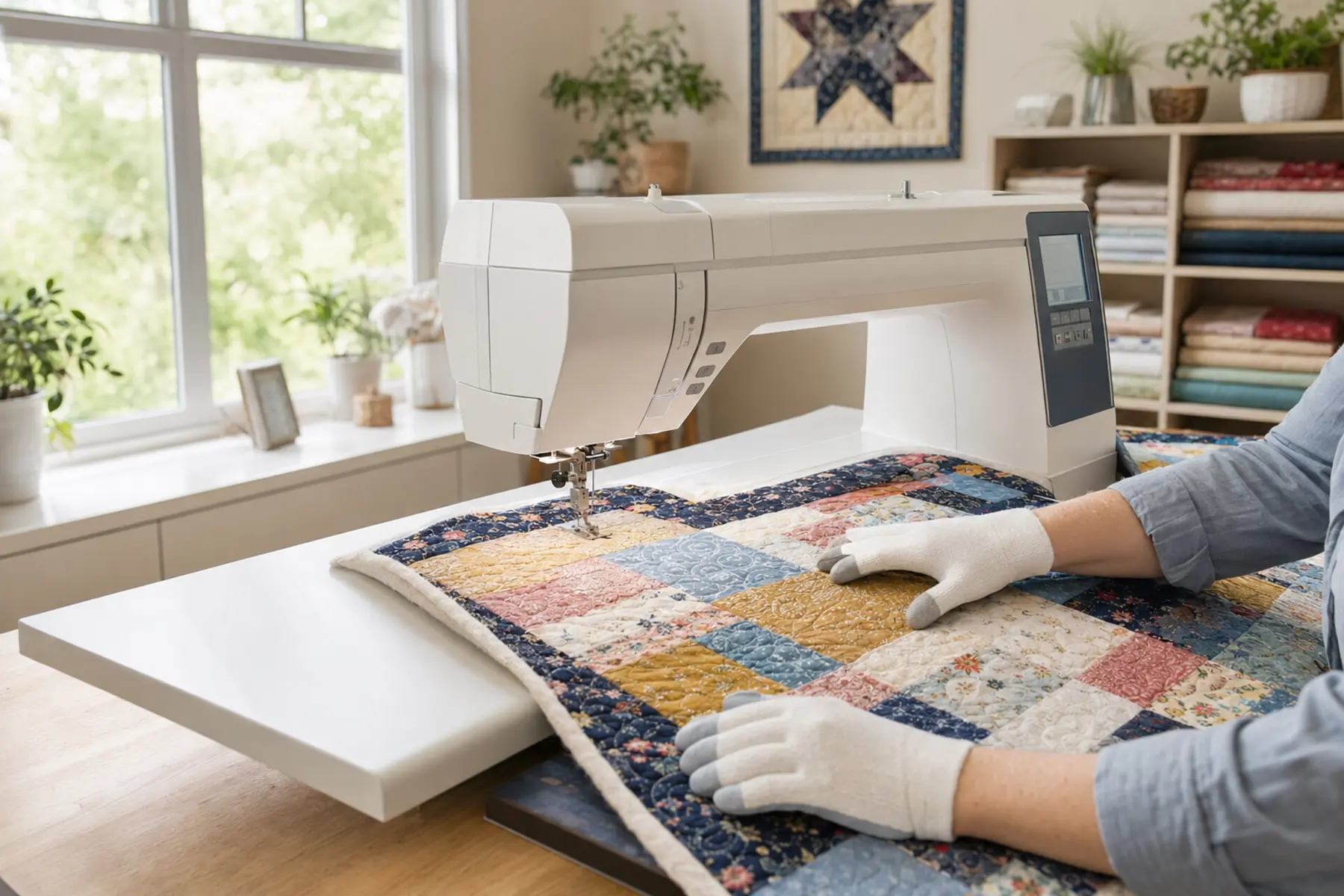
A quilting sewing machine is a domestic, mid-arm, or long-arm machine built with features that support quilt construction. Those features may include a wider throat area, an extension table, walking-foot or dual-feed capability, drop feed dogs, adjustable presser-foot pressure, needle-down control, speed limiting, strong lighting, and accessories for free-motion quilting.
It may sew ordinary utility stitches too. What makes it useful for quilting is not a unique “quilting stitch,” but the way it handles fabric layers, workspace, accuracy, and motion control.
2. Separate piecing needs from machine-quilting needs
Quilt making usually has two machine-intensive stages: piecing the quilt top and quilting the layers together. These stages place different demands on a machine.
For accurate patchwork, review seam allowance and straight-line sewing control. Those skills matter more than owning a machine marketed specifically for quilting.
3. Quilting machine vs regular sewing machine
4. Understand why throat space matters
Throat space is the area between the needle and the right side of the machine. During quilting, much of the quilt must pass through this space. A larger opening reduces compression, dragging, and repeated re-rolling.
For piecing, throat space is less important because you are working with smaller units. For quilting a full quilt sandwich, especially dense free-motion designs, it can become one of the most noticeable limitations.
5. Look at feeding control, not just stitch count
Quilting places multiple layers under the presser foot. If the top layer moves faster than the backing, the quilt can pucker or shift. A walking foot or built-in dual-feed system helps move the top and bottom layers together during straight-line quilting.
Adjustable presser-foot pressure can also help when the quilt sandwich is bulky or when lighter patchwork pieces are being distorted. Decorative stitch count is far less important than stable feeding.
6. Check whether the machine supports free-motion quilting properly
Free-motion quilting requires the feed dogs to be lowered, covered, or otherwise disengaged so the quilter controls stitch direction and movement. The machine should accept a compatible free-motion foot and maintain smooth stitch formation at variable speeds.
Needle-down control is especially useful because it keeps the needle in the fabric while you pause and reposition your hands. A speed limiter can help beginners avoid abrupt acceleration.
7. Domestic, mid-arm, and long-arm quilting machines are not the same
A domestic machine remains the most flexible choice for many home quilters because it can piece, sew ordinary projects, and quilt smaller or medium-size work. A long-arm machine solves a different problem: moving over a large quilt on a frame.
8. Features that genuinely help with quilting
Consistent straight stitch at slow and moderate speeds
Enough throat space for your usual quilt size
Extension table or level work surface
Walking foot or built-in dual feed
Drop-feed or free-motion capability
Needle-down function
Adjustable speed control
Adjustable presser-foot pressure
Bright lighting around the needle area
Easy access to bobbin and tension controls
Compatible quarter-inch and free-motion feet
For a clear understanding of machine controls, see learning the parts of a sewing machine and computerized sewing machine features.
9. When a regular sewing machine is enough
A regular machine may be completely suitable when you mainly piece blocks, make small quilts, quilt simple straight lines, or use quilting as one part of broader sewing. It should have a dependable straight stitch, acceptable feed, compatible feet, and enough room for the project.
Many beginners improve results more by learning seam accuracy, basting, layer support, and controlled feeding than by upgrading immediately.
10. When a dedicated quilting machine becomes worthwhile
A quilting-focused machine becomes more valuable when your current machine repeatedly limits your work rather than your technique.
Large quilts are difficult to fit through the throat space
You frequently free-motion quilt and need smoother speed control
Your current machine cannot lower or cover the feed dogs
Layer shifting remains a recurring issue despite correct setup
You need a larger supported work surface
You want consistent needle-down and programmable controls
Quilting is your primary use rather than an occasional project
11. Which type of machine should you choose?
12. Test these points before choosing a quilting machine
Sew a straight seam at slow and moderate speed
Test the machine on an actual quilt sandwich
Measure usable throat height and width
Check whether the table supports fabric level with the needle plate
Confirm walking-foot or dual-feed compatibility
Test feed-dog lowering and free-motion foot clearance
Check needle-down behavior and speed limiter response
Inspect lighting and visibility around the needle
Confirm bobbin access is practical with a large project in place
Check local service and replacement accessory availability
After identifying the machine class and workspace you need, you can compare quilting sewing machines on Amazon. Verify usable throat space and included accessories on the individual listing before making a comparison.
Frequently Asked Questions
Quilting sewing machine questions
Do you need a special sewing machine for quilting?
No. A regular domestic sewing machine can piece quilt blocks and quilt smaller projects if it can sew a reliable straight stitch, feed layers evenly, and accommodate the project. A dedicated quilting machine becomes more useful when you regularly handle larger quilts, want more throat space, or need stronger free-motion and feeding features.
What is the main difference between a quilting machine and a regular sewing machine?
The biggest practical differences are usually workspace, feeding support, free-motion capability, speed control, and quilting-focused accessories. A quilting machine is not defined by one stitch. It is designed to make layered quilt construction easier and more controllable.
Is a larger throat space important for quilting?
Yes, especially for machine quilting larger quilts. More throat space gives the rolled or folded quilt more room to pass to the right of the needle. It matters less for piecing small blocks than for quilting a full bed-sized quilt.
Can a beginner use a quilting sewing machine?
Yes. Beginners often benefit from speed control, needle-down, good lighting, a stable extension table, and clear stitch controls. However, they do not need an advanced long-arm machine to begin quilting.
What is the difference between piecing and quilting?
Piecing joins fabric patches to create the quilt top. Quilting stitches the quilt top, batting, and backing together. Piecing mainly needs accurate seam allowances and consistent feeding, while quilting needs better layer control, workspace, and often walking-foot or free-motion capability.
Choose the machine around the quilting stage that limits you
A regular sewing machine can be enough for piecing and smaller quilts. A quilting-focused machine earns its value when you need more workspace, more stable layer feeding, better free-motion control, or a workflow built around frequent large quilts.