
Affiliate disclosure: We may earn from qualifying Amazon purchases at no extra cost to you. Exact industrial bundles, motors, tables and accessories can change, so confirm the complete listing before ordering.
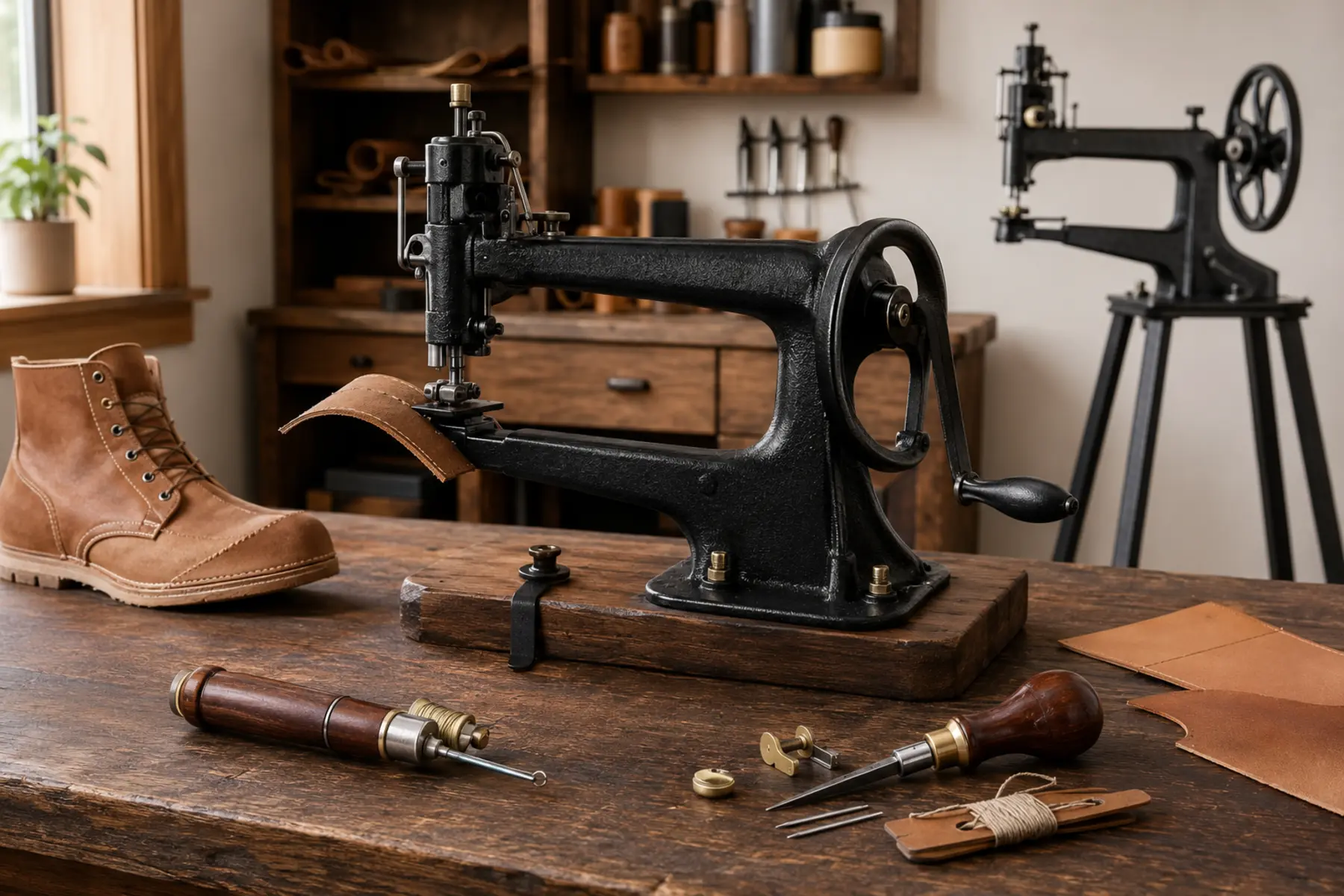
A hand leather sewing machine is useful when portability, repair access, low volume, or the absence of electricity matters more than speed. But the category combines two very different tools: compact lockstitch awls that form one controlled stitch at a time, and cast-metal cobbler patchers that use a hand crank, bobbin, presser foot, and narrow arm to sew longer seams.
That distinction matters more than the word “heavy duty.” A sewing awl is easy to carry and excellent for a torn strap, loose saddle seam, tent, bag, or piece of outdoor gear. It does not feed the work or space the holes for you. A manual cobbler machine can reach around shoes and tubular objects and can stitch a longer repair more quickly, but a low-cost patcher may arrive needing cleaning, polishing, lubrication, mounting, timing, and patient adjustment before it produces an acceptable seam.
This guide recommends four products for those honest use cases. The Speedy Stitcher Sewing Awl is the best portable repair tool. The Tandy Leather Sewing Awl Kit is the supported leathercraft alternative with a simple all-in-one kit. The IRONWALLS Manual Leather Cobbler Machine is the bench-mounted patcher for longer footwear and bag seams. The BEAMNOVA Manual Cobbler Machine with Stand adds a freestanding tripod for users who cannot dedicate a workbench.
None should be presented as a replacement for a powered compound-feed industrial in regular production. The right choice depends on the repair, access, stitch type, clamping, operator effort, setup tolerance, material stack, and desired finish.
Quick choice guide
Choose the Speedy Stitcher Sewing Awl when a repair kit must fit in a vehicle, boat, workshop drawer, saddlebag, or field pack. It stores thread in the handle, accepts straight or curved needles, and forms a lockstitch without electricity. It is slow on long seams and physically demanding in dense leather.
Choose the Tandy Leather Sewing Awl Kit when you want a straightforward leathercraft-branded awl with a wooden handle, thread, needle, wrench, and illustrated instructions. It suits belts, bags, canvas, vinyl, and repair work, but stitch spacing and hole angle still depend entirely on the user's control.
Choose the IRONWALLS Manual Cobbler Machine when shoes, boots, bags, and tubular repairs need a narrow arm and rotating presser-foot direction. It can cover longer seams than an awl, provided you are comfortable cleaning, deburring, mounting, threading, timing, and testing a basic mechanical patcher.
Choose the BEAMNOVA Manual Cobbler Machine with Stand when floor placement is more practical than bolting a head to a permanent bench. Its open arm and tripod expand placement options, but the stand will not be as rigid as a properly anchored base and should not be assumed ready for professional production.
For powered domestic and industrial choices, use the best leather sewing machine guide. Readers comparing dedicated footwear patchers should continue to the top cobbler sewing machines guide. If the actual problem is feeding layered leather under power, see the walking-foot sewing machines for leather guide.
Quick comparison
Showing three products at a time. Scroll vertically to see the remaining models.
| Product image | Title and best fit | Type | Current price |
|---|---|---|---|
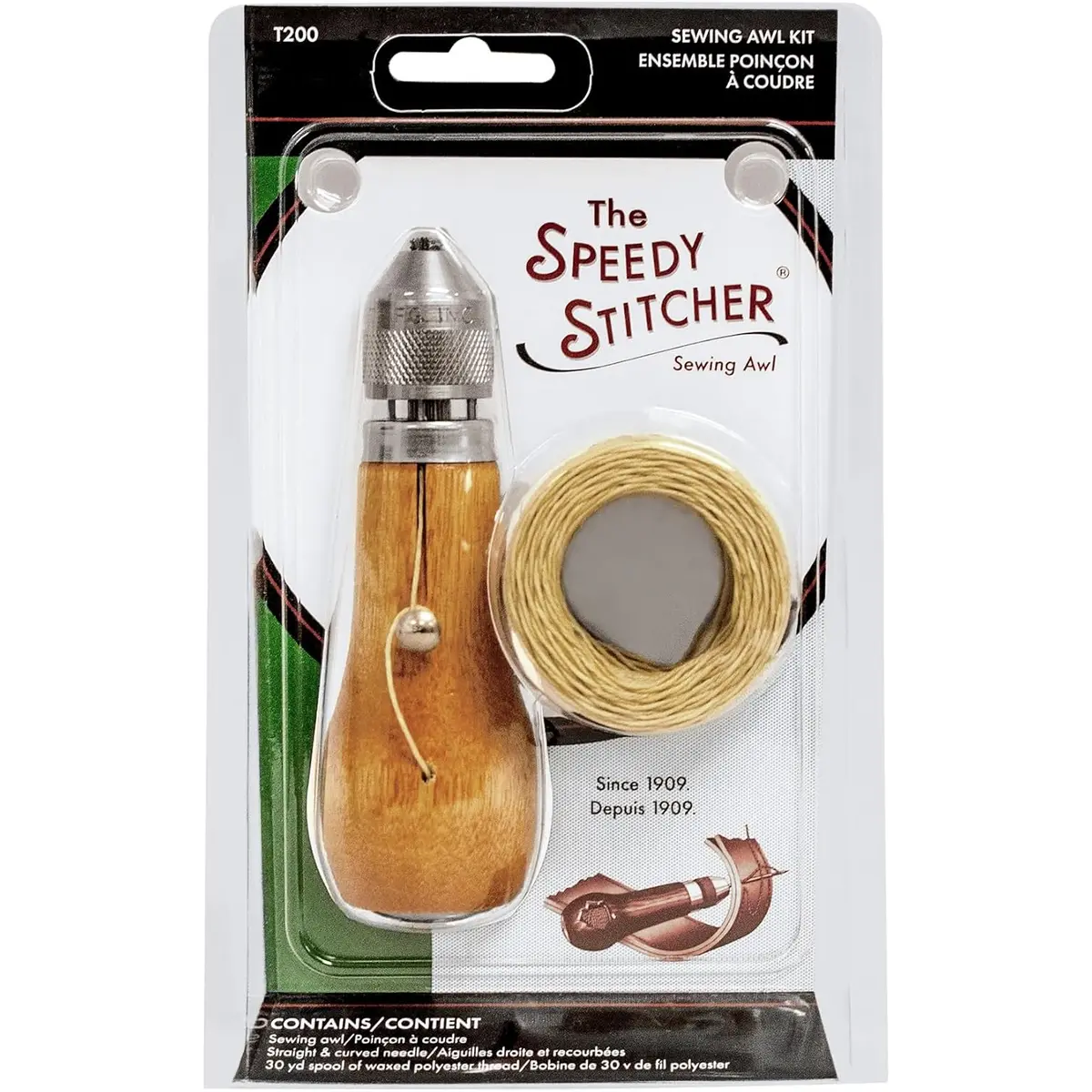 | Speedy Stitcher Sewing Awl Hand-pushed needle forming a lockstitch loop | Portable repairs to straps, saddles, bags, tents, canvas, and outdoor gear | Check price |
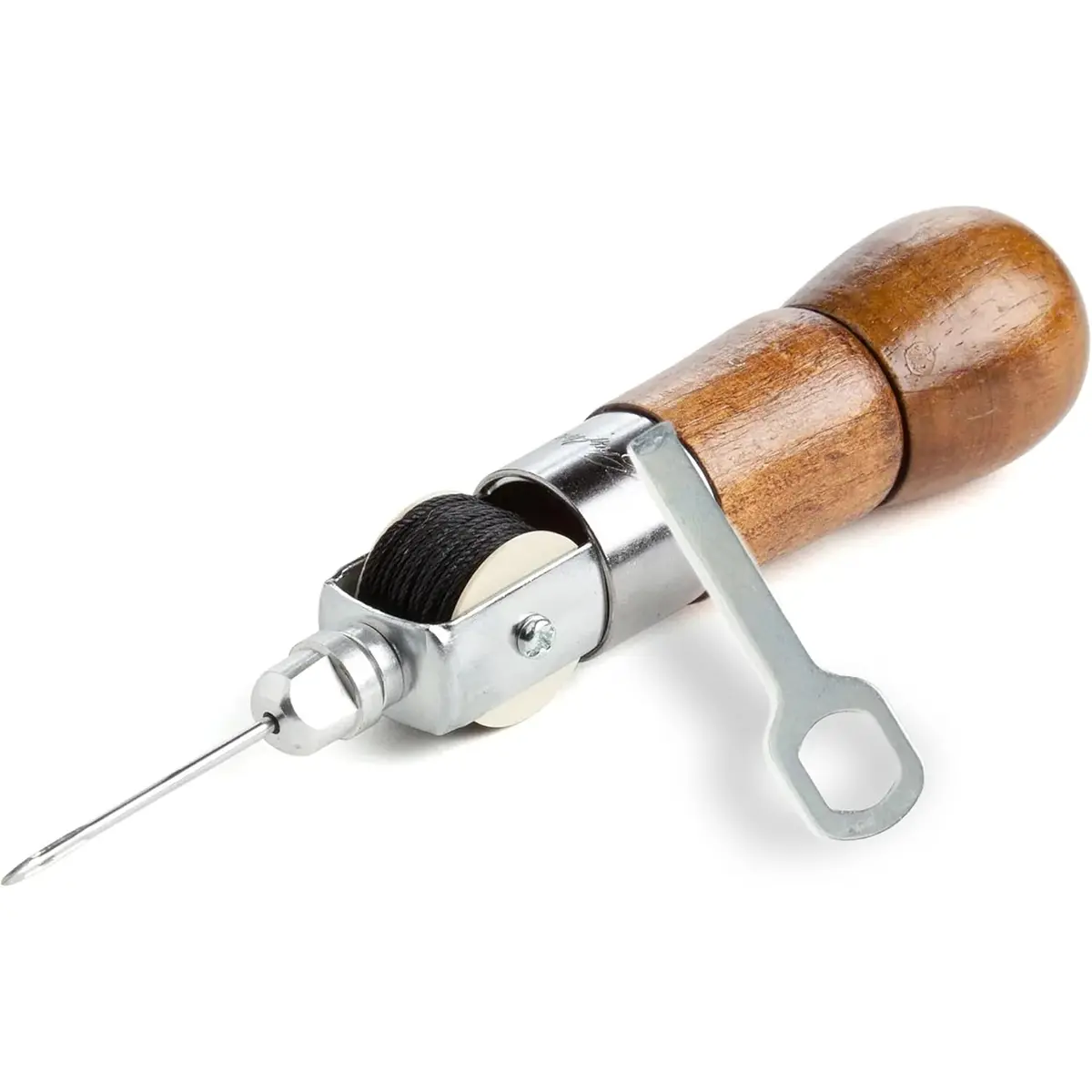 | Tandy Leather Sewing Awl Kit Hand lockstitch awl with replaceable needle | Controlled leathercraft repairs to belts, bags, footwear, canvas, and vinyl | Check price |
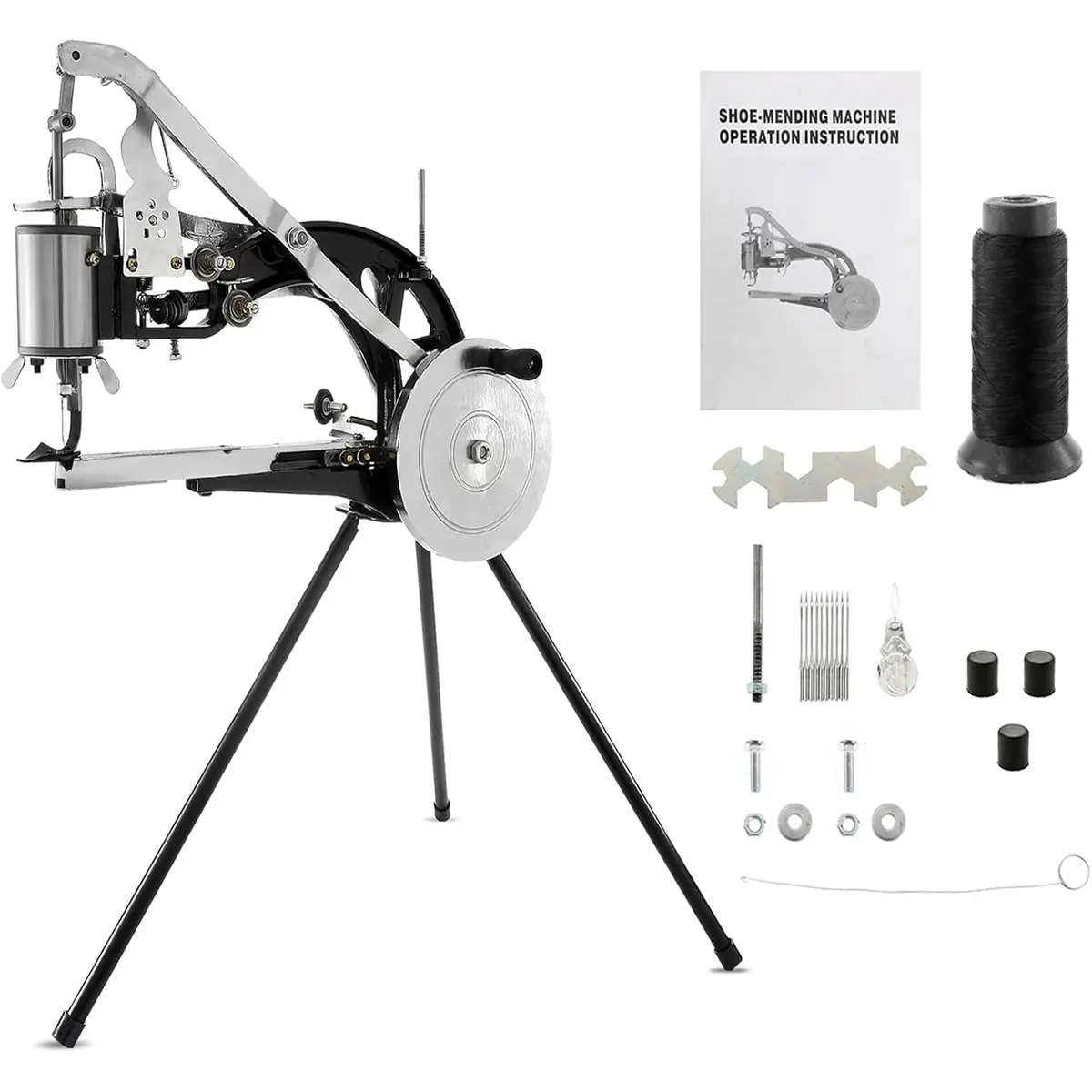 | IRONWALLS Manual Cobbler Machine Hand-cranked patcher with bobbin, narrow arm, and rotating feed direction | Longer shoe, boot, bag, and tubular repairs | Check price |
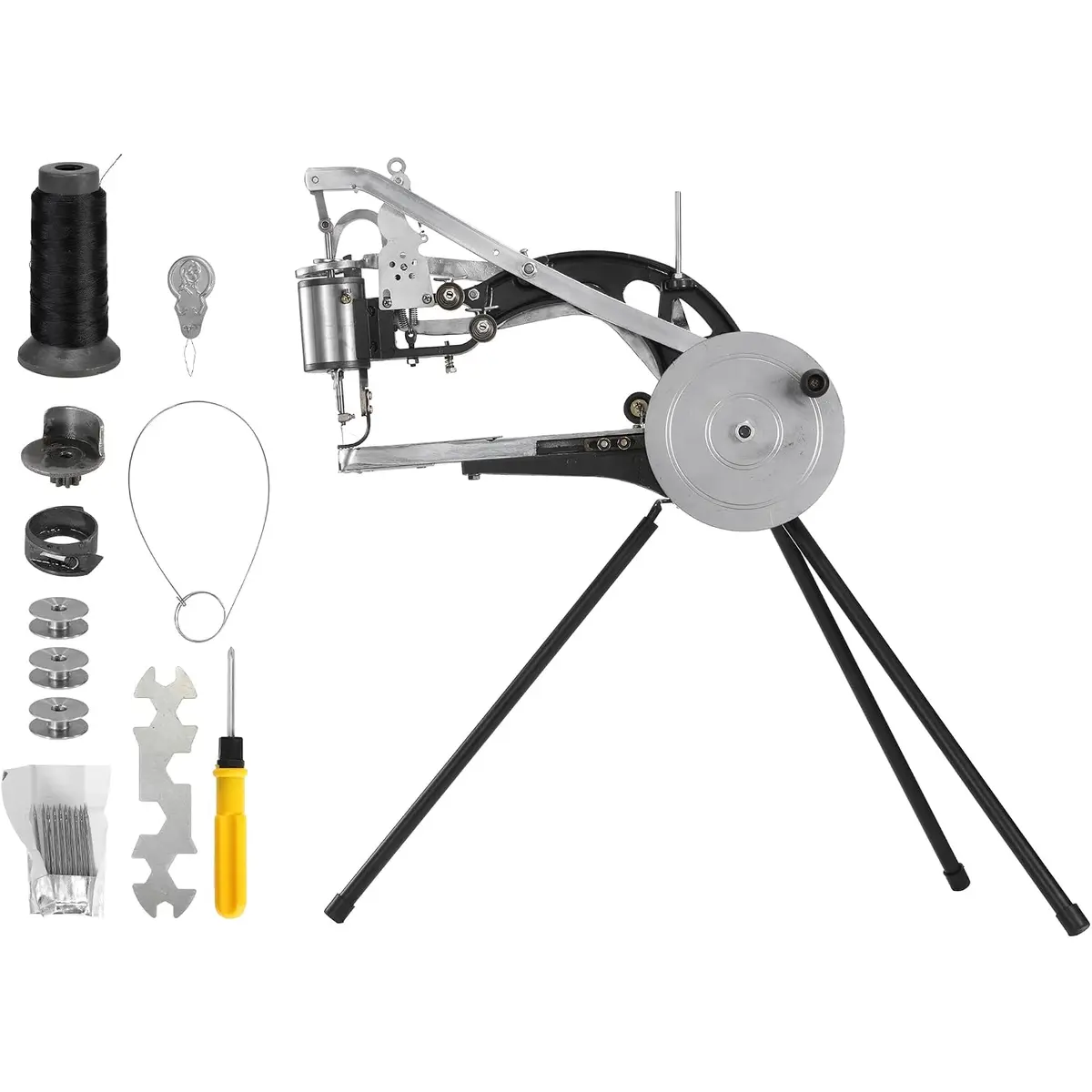 | BEAMNOVA Manual Cobbler Machine with Stand Hand-cranked patcher on freestanding tripod | Shoe and bag repairs where no dedicated bench is available | Check price |
Detailed recommendations
Speedy Stitcher Sewing Awl
Best portable repair tool
The Speedy Stitcher is the most useful first choice for someone who needs a leather repair tool rather than a permanent machine. Its handle stores a bobbin of thread, and the brand states that two needles are stored beneath the chuck lock. The tool can be set up with the supplied thread or rewound for another compatible thread.
Its advantage is simple access. There is no table, motor, belt, shuttle carrier, or stand to assemble. The awl can travel with camping, boating, equestrian, workwear, or vehicle equipment and can repair materials where power is unavailable.
How the lockstitch is formed
Speedy Stitcher's official instructions begin from the back side. The needle and thread pass through the first hole, and enough loose thread is drawn through for the length of the seam plus a tying allowance. At the next hole, the needle passes through and is pulled back slightly to form a loop. The loose thread is passed through that loop, and the awl is withdrawn to create the lockstitch.
The lock should settle between the layers rather than sitting exposed on one face. Achieving that requires equal, controlled tension. Pulling too hard can enlarge or tear a hole, distort an edge, or bury the lock unevenly. Pulling too softly leaves a loose stitch that can abrade.
Straight versus curved needles
A straight needle works well when the repair can be approached directly and the exit point is visible or predictable. A curved needle can help around awkward edges, but the curve changes where the point emerges. Practise on scrap of the same thickness before working near a finished face.
Use only a compatible needle that locks securely in the chuck. A loose or bent needle can rotate, break, or emerge unpredictably. Inspect the point and shaft before each repair.
Best repair situations
The Speedy Stitcher suits a separated bag strap, canvas tent seam, saddle or tack repair, torn outdoor cover, luggage seam, work glove, belt end, and other short areas where the user can support both sides.
It is less suitable for a long decorative row where perfectly uniform spacing is expected. Mark holes first with dividers, a ruler, pricking tool, or template appropriate to the material. If existing holes are intact, reusing them may prevent unnecessary perforation.
Safety and fatigue
The exposed needle is the main risk. Keep the exit side clear of fingers, thighs, and the holding hand. A scrap wood or purpose-made backing surface can receive the point when appropriate. Do not use a metal surface that could damage the needle.
Speedy Stitcher instructs users to remove the needle from the threaded post and store it in the handle after use. Follow that routine, secure the chuck lock, and keep the tool away from children.
Best for: Portable, short repairs to straps, saddles, bags, tents, canvas, luggage, and outdoor equipment.
Skip it if: You need long production seams, automatic spacing, free-arm shoe access, or have difficulty applying controlled hand pressure.
Tandy Leather Sewing Awl Kit
Best supported leathercraft alternative
The Tandy Leather Sewing Awl Kit serves the same fundamental task as the Speedy Stitcher but comes from a long-established leathercraft supplier. The current Amazon record identifies Tandy model 1216 and lists a contoured wooden awl handle, black thread, one needle, a wrench, and illustrated instructions.
This is the better fit for a leather crafter who values a recognisable leatherworking brand and wants a compact kit without buying a cast-metal patcher.
What it does well
The awl produces a lockstitch for leather, canvas, vinyl, bags, belts, saddles, tents, tarps, luggage, gloves, footwear, and similar repair work. The wooden handle provides direct pressure and control. The included wrench supports needle or chuck adjustment according to the supplied instructions.
It has no feed dog or foot, which is an advantage when working around irregular existing holes. The user decides exactly where the next puncture belongs. That same freedom makes it easy to create a wandering seam if holes are not marked.
Prepare the repair before piercing
Clean the area without soaking or damaging the leather finish. Remove failed thread carefully while preserving usable original holes. Align the pieces and hold them with clips, temporary leather-safe tape, adhesive, or a stitching clamp as appropriate.
Mark the seam line and spacing. On a structural repair, copy the original construction rather than adding a line of holes too close to a weakened edge. If the leather is cracked, dry, delaminated, or torn beyond the seam allowance, stitching alone may not restore strength.
Thread and needle compatibility
The included thread makes the kit ready to learn, but it may not match every colour, UV exposure, abrasion environment, or structural load. Replacement thread must pass through the tool, needle eye, and material while forming a clean lock.
Do not enlarge the needle eye, grind a supplied needle, or substitute an unknown needle merely because it fits the chuck. A brittle or poorly secured needle can break under hand pressure.
Where it stops fitting
This remains an awl. It does not turn leather under a rotating presser foot, reach deeply inside a boot, or form a long seam at machine-like rhythm. It is not automatically easier than saddle stitching with two needles for a new handcrafted item. Traditional saddle stitch can offer different appearance, redundancy, and control when holes are prepared in advance.
Choose the Tandy awl for practical lockstitch repair, not as a universal replacement for leather hand-sewing methods.
Best for: Leather crafters who want a branded, self-contained awl for belts, bags, canvas, vinyl, footwear, and gear repairs.
Skip it if: Your priority is long regular seams, shoe-patcher access, or traditional two-needle saddle stitch.
IRONWALLS Manual Leather Cobbler Machine
Best bench patcher for longer repairs
The IRONWALLS machine moves beyond the awl category. It is a hand-cranked cobbler patcher intended for shoes, boots, bags, canvas, clothing, tents, and other repair work. The current listing describes iron and aluminium-alloy construction, use with nylon and cotton thread, and a foot-and-needle assembly that can rotate through 360 degrees to steer around a tall boot or curved object.
The promise is appealing: longer lockstitch seams, narrow-arm access, no electricity, and control through the hand crank. The honest limitation is that this class of inexpensive patcher is often a mechanical project before it is a sewing tool.
Why the narrow arm matters
A flatbed supports panels but blocks a closed shoe or narrow bag from wrapping around the needle area. The patcher's slim arm enters the object, leaving the seam accessible around the edge. Rotating the feeding direction lets the operator turn the seam path without forcing the entire boot or bag around the head.
This is useful for shoe uppers, boot shafts, bag corners, zippers, patches, and tubular work. The actual reach and clearance should be measured against the intended object before purchase.
Commissioning is not optional
The listing says the machine requires assembly and should receive lubricant on moving parts. A cautious setup goes further:
- Inventory the head, base, crank, shuttle, bobbins, needles, fasteners, thread, and instructions.
- Photograph the delivered condition before cleaning or modification.
- Remove shipping preservative without stripping protective finish from unintended areas.
- Check the casting, thread path, needle plate, foot, shuttle race, and guides for sharp burrs.
- Mount the machine rigidly before applying force.
- Lubricate only the required joints with a suitable sewing-machine oil.
- Install the correct needle in the correct orientation.
- Turn the crank slowly by hand and verify needle-to-shuttle clearance through a full cycle.
- Thread and test on scrap at low tension.
- Change one adjustment at a time and record the result.
Do not begin by grinding multiple parts based on a random video. First identify the exact cause of roughness, thread damage, skipped stitches, or binding. Removing metal is irreversible.
Mounting and direction
The machine must not rock, twist, or walk while the crank is turned. A rigid base improves stitch control and protects fingers from a shifting head. Bolt it to a strong bench or a purpose-built stand using appropriate hardware and safe edge clearances.
Follow the listing and instructions for crank direction. The current product material warns against rolling backward because the shuttle can be struck. Reverse rotation is not the same as reverse feeding on a powered industrial.
Who should buy it
The IRONWALLS patcher suits a mechanically confident hobbyist or repairer who expects to clean, mount, adjust, and learn the machine. It can be rewarding for footwear, bags, and awkward seams where an awl is too slow.
It is a poor choice for someone expecting a calibrated, dealer-sewn production machine from the box. Professional repair volume calls for a serviced brand-name patcher with parts and technician support.
Best for: Longer shoe, boot, bag, canvas, and tubular repairs where a rigidly mounted manual patcher improves access.
Skip it if: You are unwilling to perform setup and adjustment, lack a safe mounting surface, or need immediate professional throughput.
BEAMNOVA Manual Cobbler Machine with Stand
Best when there is no permanent bench
The BEAMNOVA package addresses a specific constraint: some users need a manual patcher but cannot bolt one to a workbench. The selected listing includes a tripod-style floor stand, open-arm machine, ten needles, and a coil of nylon thread.
The seller describes use for shoes, boots, bags, belts, raincoats, workwear, leather, canvas, cotton, and rubber. Those are possible application categories, not guaranteed capacities. The exact seam still needs testing.
What the stand changes
A freestanding tripod allows the machine to be placed in a garage, repair area, small shop, or temporary workspace without a dedicated bench. It can also provide clearance below the arm for a boot or bag that would collide with a tabletop.
That flexibility comes at the cost of rigidity. Hand cranking creates rotational force. Guiding a heavy boot creates side load. If the stand flexes, tips, or rotates, stitch placement and safety suffer.
Set it on a level, high-friction floor with clear space around every leg. Tighten all fasteners and check them regularly. Never stabilise a moving stand with a foot close to a pinch point. If the supplied stand cannot remain stable under the real work, use a more rigid mounting solution rather than adding improvised weights that can fall.
The same patcher preparation still applies
The presence of a stand does not remove the need to clean, inspect, lubricate, thread, time, and test the head. Check the needle path, shuttle, bobbin, foot rotation, handwheel direction, thread guides, and stitch formation before using a customer item.
The listing describes a “smooth turntable” and “precision bobbin system.” Treat those as seller language until the delivered unit proves smooth and accurate on scrap. Low-cost cast machines can vary in finish and adjustment.
Included needles and thread are commissioning supplies
Ten needles and a thread coil are useful for initial testing, but they should not determine the long-term setup. Identify the needle system and buy compatible, traceable replacements. Choose thread for the leather, load, exposure, abrasion, needle, and shuttle capacity.
Do not assume the included nylon thread is suitable for UV-exposed outdoor work, structural tack, or a colour-matched visible repair. A repair is only as durable as its leather, edge condition, hole placement, thread, lock balance, and finishing method.
Who should buy it
Choose this package when shoe and bag access justifies a patcher, a permanent bench is unavailable, and the operator accepts the limitations of a freestanding budget setup. It is best viewed as a repair tool for an informed hobbyist, not a turnkey professional station.
Best for: Hand-cranked footwear and bag repairs in spaces where a floor stand is more practical than a bolted bench.
Skip it if: The floor is uneven, the stand cannot be stabilised, or professional production requires maximum rigidity and service support.
How to choose a hand leather sewing machine
A hand leather sewing machine is useful when portability, repair access, low volume, or the absence of electricity matters more than speed. But the category combines two very different tools: compact lockstitch awls that form one controlled stitch at a time, and cast-metal cobbler patchers that use a hand crank, bobbin, presser foot, and narrow arm to sew longer seams.
That distinction matters more than the word “heavy duty.” A sewing awl is easy to carry and excellent for a torn strap, loose saddle seam, tent, bag, or piece of outdoor gear. It does not feed the work or space the holes for you. A manual cobbler machine can reach around shoes and tubular objects and can stitch a longer repair more quickly, but a low-cost patcher may arrive needing cleaning, polishing, lubrication, mounting, timing, and patient adjustment before it produces an acceptable seam.
This guide recommends four products for those honest use cases. The Speedy Stitcher Sewing Awl is the best portable repair tool. The Tandy Leather Sewing Awl Kit is the supported leathercraft alternative with a simple all-in-one kit. The IRONWALLS Manual Leather Cobbler Machine is the bench-mounted patcher for longer footwear and bag seams. The BEAMNOVA Manual Cobbler Machine with Stand adds a freestanding tripod for users who cannot dedicate a workbench.
None should be presented as a replacement for a powered compound-feed industrial in regular production. The right choice depends on the repair, access, stitch type, clamping, operator effort, setup tolerance, material stack, and desired finish.
Awl or manual patcher: the first decision
These tools do not merely differ in size. They create a different repair workflow.
Choose an awl for isolated repairs
A lockstitch awl is appropriate when the seam is short, access is open enough to push a needle through, and the user can control every hole. Common tasks include reattaching a strap, closing a torn canvas edge, repairing a saddle or tack seam, fixing luggage, reinforcing a bag handle, or securing outdoor equipment.
The awl carries an upper thread through the material, forms a loop, and locks it with a second thread path. The operator chooses each hole, pulls each loop, and sets each stitch. This control is useful around an existing repair line, but it also means inconsistent spacing, angle, or tension remains visible.
An awl is not a feed-driven sewing machine. It cannot automatically transport the leather, maintain stitch length, or bury the lock in the centre. Good results come from marking, supporting, piercing, and tensioning consistently.
Choose a patcher for longer or awkward seams
A cobbler patcher uses a needle, bobbin or shuttle, presser mechanism, and hand crank to form repeated stitches. Its narrow arm can enter a shoe, boot, bag, sleeve, or tubular object that cannot lie flat around a conventional bed. The rotating head or presser-foot direction lets the user steer without turning the entire object.
This makes a patcher attractive for footwear and bag repairs. It is still not automatic. One hand turns the crank while the other guides the work, manages pressure, and monitors the thread. On low-cost clone machines, the operator may also become the assembler, polisher, mechanic, and quality-control technician.
Choose neither for production volume
If the business repeats long leather seams every day, a powered compound-feed flatbed or cylinder-arm machine is usually the more productive and ergonomic solution. A manual patcher can be useful for access-specific repairs within a shop, but it should not be chosen to avoid the cost of the correct production machine when throughput is the real goal.
Manual-machine reality check
No electricity does not mean no setup
An awl can work almost immediately after the correct needle and thread are installed. A cast-iron patcher is different. Factory preservative, casting texture, rough thread paths, burrs, an unfinished base, dry joints, incorrect shuttle timing, poor needle orientation, and loose fasteners can all interfere with sewing.
Marketplace claims such as “easy to assemble” describe the seller's view, not a verified commissioning standard. Owners commonly report better results after cleaning, smoothing selected contact surfaces, correcting assembly, lubricating, building a rigid stand, and learning the shuttle. Those modifications require mechanical judgement. Removing material from the wrong surface can permanently change timing or clearances.
Thickness is not a capacity guarantee
A listing may describe leather, rubber, canvas, shoes, bags, or “high sewing thickness.” Those words do not specify leather temper, total seam stack, thread size, needle, presser clearance, or stitch formation.
The machine must do more than puncture the stack. It must feed or be guided across it, form a balanced lockstitch, avoid cutting the thread, keep the needle clear of the shuttle, and maintain acceptable spacing. Dense sole leather may be harder than a thicker stack of soft upholstery leather.
Operator effort is part of the purchase
With an awl, the hand pushes the needle through every hole and tensions every stitch. Dense leather can strain the palm, wrist, elbow, and shoulder. A patcher reduces repeated direct piercing effort but still requires cranking, steering, and controlling an awkward object.
Work at a height that keeps the wrist neutral and the shoulder relaxed. Take breaks before fatigue affects needle control. Use a clamp, stitching pony, or other safe support when appropriate. Never aim a needle toward the holding hand or brace the exit side against the body.
How we selected these manual leather tools
The four products and their distinct roles come from the site's approved Amazon master shortlist. Current product identity, included components, manufacturer or brand instructions where available, marketplace claims, and credible setup experience were checked on July 22, 2026.
Selection was based on repair access, stitch method, manual control, setup burden, support, portability, and honest workload. Ratings and review counts did not determine inclusion. Two awls were retained because they represent the simplest portable lockstitch repair case. Two patchers were retained because one prioritises bench-mounted rigidity and the other includes a floor stand.
This is a research-based guide and does not claim personal hands-on testing. Exact thickness claims are not repeated as universal capacity because leather and seam construction vary. Manufacturer instructions take priority over marketplace summaries and owner modifications.
All four sheet ASINs currently resolve to the intended product identities. Bundle contents, sellers, thread, needles, stands, finish, instructions, and availability can still change, so the exact offer must be checked before purchase.
How to prepare a leather repair
The tool cannot compensate for damaged material or a poorly planned seam. Begin by deciding whether the repair is cosmetic, load-bearing, safety-related, or historically valuable.
Inspect the leather
Check for cracks, powdery fibres, delamination, water damage, stretching, missing material, corrosion around hardware, and old adhesive. If the leather tears when gently flexed near the seam, new stitches may simply create another perforated failure line.
Safety-critical saddlery, climbing equipment, vehicle restraints, protective gear, and load-bearing straps should be assessed by a qualified repair professional. A hand stitch that looks closed is not proof of restored rated strength.
Preserve or replace the original holes
Reusing sound original holes reduces new perforation and can preserve the intended seam line. However, enlarged, torn, or closely spaced holes may no longer hold. A patch, reinforcement, skived insert, or different seam position may be needed.
Do not place a fresh line so close to the damaged line that a thin strip of leather remains between them. That strip can tear away like a perforated edge.
Hold the layers without hidden damage
Pins are usually inappropriate because holes remain. Use clips, a stitching pony, leather-safe temporary adhesive, double-sided leather tape, or existing construction features as appropriate. Test adhesives because solvent, colour change, residue, and needle gumming can create new problems.
Stitch consistency with a manual awl
Mark the seam line before stitching. Dividers can follow an edge, while a ruler or template can establish straight spacing. A pricking iron or overstitch wheel may mark positions, but the tool and spacing should fit the repair rather than creating unnecessary holes.
Keep the awl at a consistent angle. The visible entry points can look regular while the exits wander if the wrist changes direction. Support the work so the exit face can be checked frequently.
Form each loop at a similar size, pass the thread through without splitting it, and pull the lock to a consistent depth. If the lock sits on one face, adjust the relative tension rather than simply pulling both sides harder.
Avoid piercing the standing thread with the needle. Split thread can fray and weaken. If the needle hits unexpected resistance, withdraw, inspect the path, and try again rather than forcing the point toward the holding hand.
Threading and testing a manual patcher
Follow the exact diagram supplied with the machine. Generic patcher videos can help explain principles, but thread guides, needle orientation, shuttle insertion, bobbin direction, and tension parts may differ.
Use a known needle in the correct system. Install it fully and orient the scarf and groove correctly. Turn the crank slowly and confirm that the shuttle catches the loop without striking the needle.
Begin with moderate, compatible thread rather than the heaviest thread advertised by another seller. Heavy thread magnifies rough thread paths, shuttle clearance problems, and tension limits. Once the machine forms a reliable lockstitch, adjust one variable at a time.
Test on a stack that matches the repair. Sew straight, turn the feed direction, cross a junction, and inspect both sides. Check whether the foot marks the leather, stitch length changes, the lock pulls to one surface, or the thread frays.
Maintenance and storage
Remove leather dust, thread fragments, and lint after use. Inspect the needle, shuttle area, thread path, foot, fasteners, and mount. Lubricate only the required points with the recommended oil and wipe away excess before it reaches leather.
Awls should be stored with needles protected inside the handle or an appropriate case. Keep loose needles, wrenches, thread, and small components together and away from children.
Protect cast patchers from moisture and corrosion. Do not leave thread under high tension for long storage. Cover the machine while allowing any cleaning solvent or oil vapour to dissipate safely. Recheck timing and free movement after transport or stand adjustment.
Safety guidance
Manual tools can puncture and crush even without a motor. The awl concentrates hand force behind a sharp needle. A patcher combines a needle, presser foot, shuttle, gears, crank, and pinch points.
Keep fingers away from the expected needle exit. Wear eye protection during setup, test stitching, deburring, or when needle breakage is possible. Do not wear gloves that reduce control or can catch in a mechanism unless the task-specific safety guidance calls for them.
Never turn the patcher while another person is adjusting the needle, foot, shuttle, or work. Remove the crank or otherwise prevent movement during service where practical. Support heavy boots and bags so they cannot pull the stand over.
Dispose of broken needle fragments in a rigid sharps container or another locally approved puncture-resistant method. Do not leave them in general rubbish where they can injure someone.
When to choose a powered machine instead
Choose a powered walking-foot or compound-feed machine when seams are repeated, long, time-sensitive, or part of a business. A servo motor provides controlled power while both hands guide the work. A proper table and knee lift improve ergonomics and handling.
Choose a cylinder-arm industrial when the products are consistently tubular or three-dimensional. Choose a heavy harness stitcher when dense leather and heavy thread exceed patcher capacity. Choose a domestic machine only for leather within its documented limits and when zigzag or general garment functions matter.
The manual tools here still have value beside powered equipment. An awl can close a field repair that cannot reach the workshop. A patcher can enter an awkward boot after the main panels were sewn elsewhere. Their strength is access and independence, not maximum output.
Frequently asked questions
Is a sewing awl the same as saddle stitching?
No. A sewing awl forms a lockstitch with loops and a locking thread path. Traditional saddle stitch normally uses one thread with a needle at each end passing through prepared holes. The stitches behave and fail differently. Choose the method required by the item and repair.
Can a manual cobbler machine sew thick leather?
It may sew some thick stacks, but thickness alone does not define capacity. Leather density, temper, thread, needle, foot clearance, shuttle timing, and seam construction matter. Test the exact stack after the machine is correctly mounted and adjusted.
Are low-cost cobbler patchers ready out of the box?
Do not assume so. Assembly, cleaning, lubrication, mounting, deburring, threading, needle orientation, shuttle timing, and tension adjustment may be required. A buyer who does not enjoy mechanical setup should choose a serviced machine from a specialist dealer.
Which tool is best for emergency repairs?
The Speedy Stitcher is the strongest fit because it is compact, self-contained, and supported by clear official instructions. Carry suitable spare needles, thread, and a safe way to support the work.
Which option is best for shoe repair?
The IRONWALLS or BEAMNOVA patcher has more suitable narrow-arm access for longer shoe and boot seams. The BEAMNOVA adds a stand; the IRONWALLS is better suited to a rigid custom bench mount. Neither should be treated as a turnkey professional cobbler machine.
Can I motorise a manual patcher?
Some owners modify patchers, but this guide does not recommend adding power to a machine designed and supplied for hand operation. Motorisation changes speed, torque, guarding, stability, injury risk, and stress on the mechanism. Buy a purpose-built powered machine if powered production is required.
Can these repair saddles and tack?
Awls are marketed for saddle and tack repairs, but load-bearing equestrian equipment is safety-critical. Cosmetic or non-structural repairs differ from a girth, stirrup leather, billet, rein, or other component whose failure can injure horse and rider. Use a qualified saddler for structural work.
Why are there no domestic electric machines in this list?
The page's intent is manual, portable, low-volume, or no-electricity work. Electric domestic and industrial leather machines belong to the linked specialist guides. Mixing them here would obscure the manual-machine decision.
Final verdict
The Speedy Stitcher Sewing Awl is the best first purchase for portable, isolated repairs because it is compact, documented, and useful without a bench. The Tandy Leather Sewing Awl Kit is the supported leathercraft alternative for users who prefer a Tandy-branded kit and direct hand control.
The IRONWALLS Manual Cobbler Machine is the more appropriate step for longer footwear, bag, and tubular seams when a rigid bench mount and mechanical setup are acceptable. The BEAMNOVA Manual Cobbler Machine with Stand earns its place when floor-standing placement matters more than maximum rigidity.
Buy an awl for portable control. Buy a patcher for repair access and longer hand-cranked seams. Buy a powered industrial when production, repeatability, ergonomics, and service justify it. No manual tool should be selected on an unsupported “heavy duty” promise.
Research sources
- Speedy Stitcher official setup and stitching instructions
- Tandy Leather product information and current Amazon model 1216 listing
- Current IRONWALLS B0912M6DX3 listing, setup material, and manual patcher owner discussions
- Current BEAMNOVA B0DFW7RBQW listing and brand setup videos
- Current Amazon product records for all four sheet ASINs, checked July 22, 2026
Prices, stock, sellers, included needles, thread, stands, finish, and instructions can change. Verify the exact offer before purchase. This page contains affiliate links; the site may earn a commission from qualifying purchases at no additional cost to the buyer.