
Affiliate disclosure: We may earn from qualifying Amazon purchases at no extra cost to you. Products are selected for utility and reader fit, not ratings or commission.
The best Singer Heavy Duty machine is not automatically the model with the largest number on its front. Much of the mechanical lineup shares the same basic purpose, speed, frame concept, and domestic limitations. The meaningful choice is whether you want a straightforward mechanical machine, whether a bundled walking foot and non-stick foot will actually be used, or whether computerized speed control and convenience features justify more electronics.
For most buyers, the Singer Heavy Duty 4423 is the balanced choice. It provides 23 built-in stitches, a one-step buttonhole, adjustable presser-foot pressure, and speeds up to 1,100 stitches per minute without charging for a large accessory kit or computerized interface. The Singer Heavy Duty 4452 is worth choosing when its even-feed foot, non-stick foot, clearance plate, and heavier needles match your projects. The Singer Heavy Duty 6800C is for a different buyer who genuinely wants a speed slider, automatic thread cutting, lettering, stitch memory, and a much broader stitch library.
These are fast domestic sewing machines. “Heavy Duty” is a Singer product-family name, not an industrial rating. The machines can be useful for denim hems, canvas home décor, bags made from manageable fabric stacks, workwear repairs, and ordinary garment sewing. Repeated upholstery production, saddle leather, thick belts, heavy webbing assemblies, or all-day commercial work can exceed their feed, motor, needle, hook, workspace, and duty-cycle limits.
Quick comparison
Showing three products at a time. Scroll vertically to see the remaining models.
| Product image | Title and best fit | Type | Current price |
|---|---|---|---|
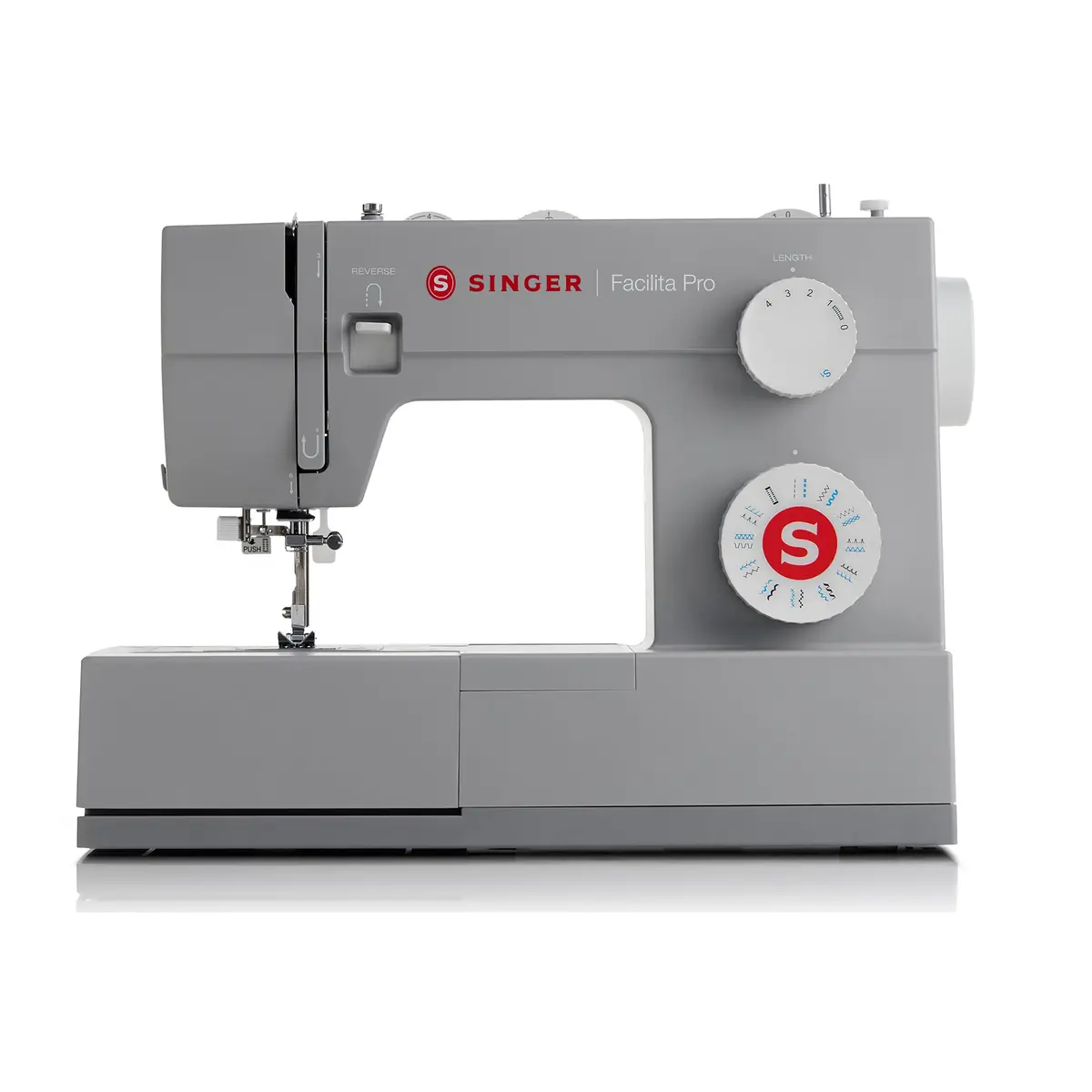 | Singer Heavy Duty 4423 Most home sewists wanting a fast mechanical machine | Mechanical dials and foot controller | Check price |
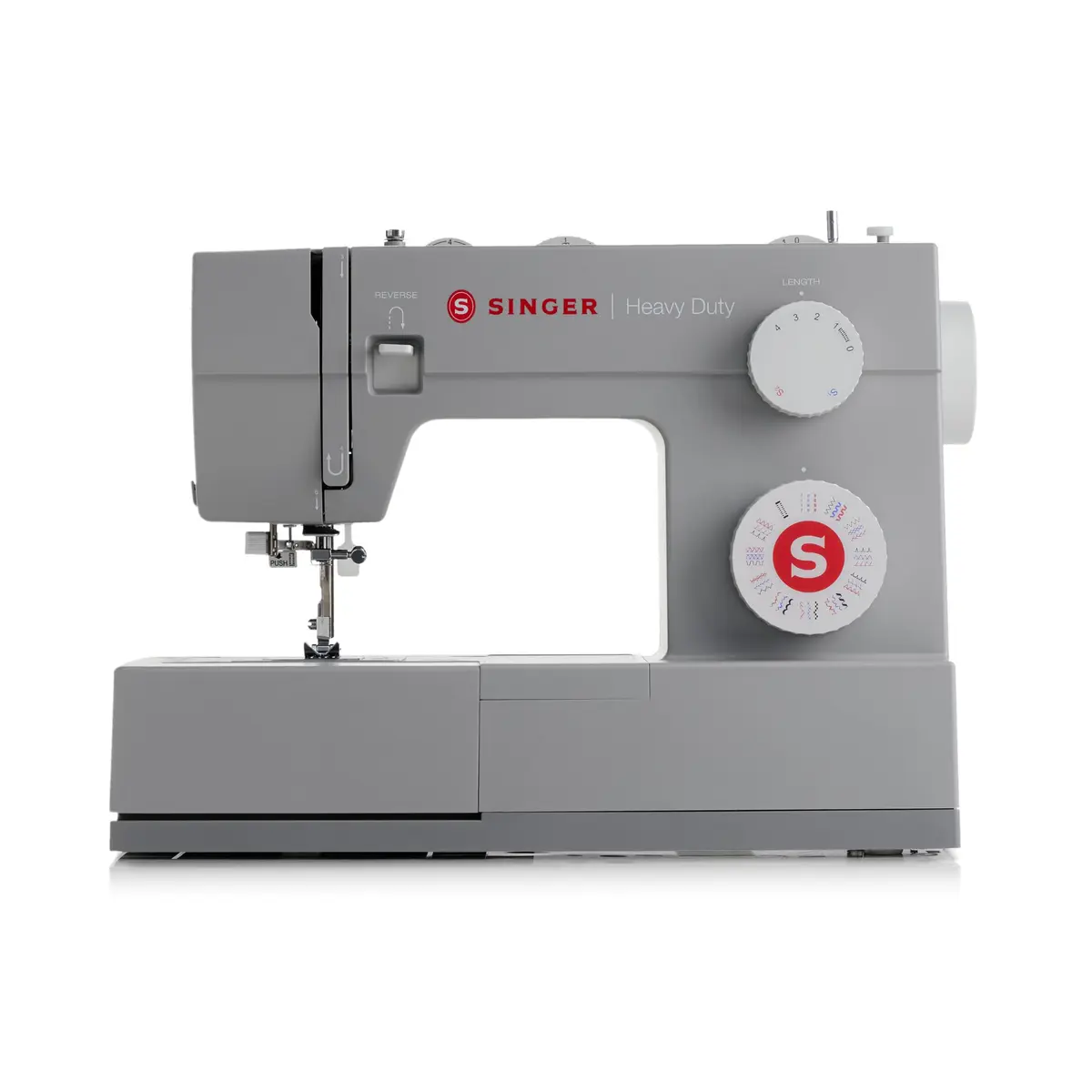 | Singer Heavy Duty 4452 Layered fabric, vinyl, and users who need the accessory bundle | Mechanical dials and foot controller | Check price |
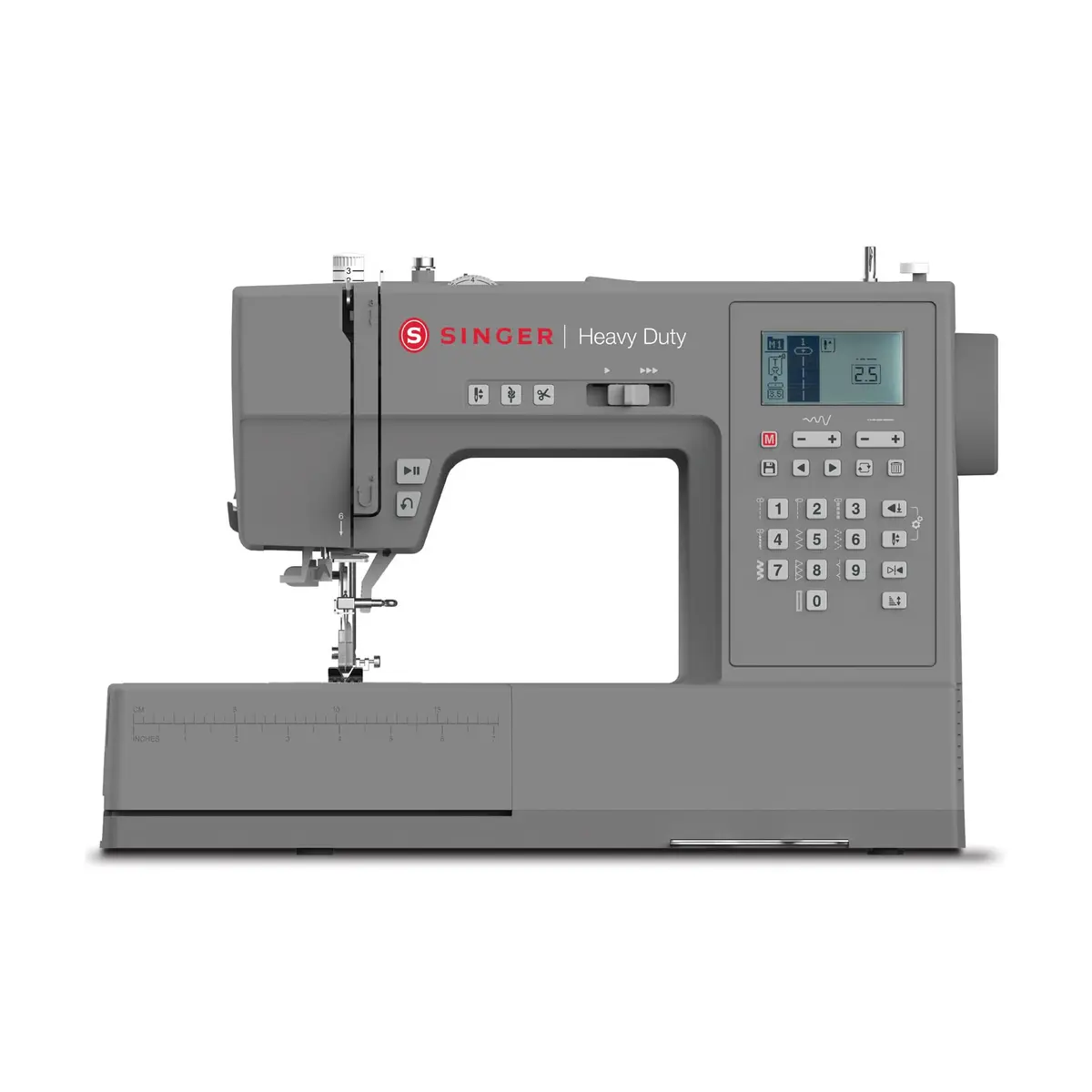 | Singer Heavy Duty 6800C Sewists wanting more speed control and convenience | Computerized selection, buttons, speed slider, and foot controller | Check price |
Detailed recommendations
Singer Heavy Duty 4423
Best overall for most buyers
The Singer 4423 is the most defensible starting point in the lineup. Singer and the selected listing specify 23 built-in stitches providing 97 stitch applications, a one-step buttonhole, a built-in needle threader, adjustable presser-foot pressure, a top drop-in bobbin, and maximum speed of 1,100 stitches per minute.
The current Amazon listing includes an all-purpose foot, zipper foot, buttonhole foot, button-sewing foot, edge or quilting guide, needles, bobbins, basic tools, and soft dust cover. It does not include the 4452's even-feed and non-stick feet in the standard bundle shown.
Why it suits denim hems and home décor
The combination of fast straight stitching, adjustable foot pressure, reverse, and a stable internal frame is useful for curtains, cushion covers, canvas organisers, medium-weight bags, workwear, denim alterations, and ordinary garment construction. Adjustable foot pressure also helps the machine move back toward lighter fabrics rather than being restricted to dense material.
For denim hems, preparation matters more than the machine name. Reduce bulky seam allowances where the pattern permits, use a fresh jeans needle of an appropriate size, match thread to the needle, lengthen the stitch if required, and use a hump-jumper or levelling tool to keep the foot flat at a thick side seam. Hand-position the needle and turn the wheel through the first risky penetration.
Mechanical control is both strength and compromise
The direct dials keep selection simple. A beginner can see the current stitch, length, and width without navigating menus. Mechanical reverse is immediate, and there is no feature library to distract from learning seam allowance and fabric handling.
The foot pedal must control a machine capable of 1,100 SPM. Some beginners may find a fast response harder to manage than a computerized machine with a speed limiter. Practise on scrap and learn the pedal rather than starting on a bulky finished hem. Maximum speed is an available ceiling, not the correct speed for every seam.
What it cannot replace
The 4423 uses a domestic bottom-feed system. When multiple grippy layers, foam, vinyl, or stabiliser meet, the top layer may creep relative to the bottom. An optional even-feed foot can help some projects, but it does not create the alternating feet and needle feed of an industrial compound-feed machine.
It is also a compact domestic platform. Large quilts and broad home-décor panels need external table support. Heavy material hanging from the left side can pull a seam off line even when the motor has enough piercing power.
Who should buy it
Choose the 4423 if you want a fast, uncomplicated mechanical machine for garments, repairs, denim hems, canvas home projects, and mixed everyday sewing. It is especially sensible if you already own specialty feet or do not need them.
Who should not buy it
Skip it if you need a speed slider, lettering, automatic thread cutting, many decorative stitches, or professional handling of upholstery and leather. A buyer who knows they need an even-feed and non-stick foot should compare the total price with the 4452 bundle.
Best for: Most home sewists wanting a fast mechanical Singer for denim hems, home décor, repairs, and general garment work.
Skip it if: You need low-speed limiting, computerized convenience, a larger workspace, or industrial walking feed.
Singer Heavy Duty 4452
Best when the accessory kit saves a second purchase
The Singer 4452 is not recommended because its higher model number proves a stronger mechanism. Singer states that the primary difference between the 4423 and 4452 is the included accessory set. The 4452 also provides 32 built-in stitches and 110 stitch applications, but its practical buying case rests on the even-feed foot, non-stick foot, clearance plate, and heavy-duty needles.
The core features remain familiar: up to 1,100 SPM, a one-step buttonhole, adjustable presser-foot pressure, built-in needle threader, top drop-in bobbin, reverse, metal interior frame, and stainless-steel bedplate.
When the even-feed foot earns its cost
An even-feed or walking foot is useful for straight-line quilting, matching plaids and stripes, sewing slippery layers, and reducing shift across fabric sandwiches. It attaches to the domestic machine and coordinates upper movement through the foot mechanism.
It is slower and bulkier than the standard foot and can limit visibility. It should be installed exactly as the manual directs, with the needle and stitch settings checked by turning the handwheel before powered sewing. It is not required for every seam and should not be treated as permanent proof of industrial feed.
When the non-stick foot matters
Vinyl, faux leather, laminated cotton, oilcloth, and coated fabrics can cling to an ordinary metal foot. The non-stick foot reduces surface drag and may create steadier feeding on manageable stacks. Needle selection, stitch length, presser pressure, and testing still matter because every needle hole is permanent.
The foot does not make the machine suitable for saddlery, belts, or thick upholstery leather. It changes friction at the surface, not the motor, hook, needle system, feed dogs, or duty cycle.
Clearance plate and bulky seams
At a jeans side seam, the front or back of the presser foot can tilt sharply. The clearance plate helps keep the foot level so the feed dogs maintain contact. This is useful for crossing a hump. It does not reduce the number or density of layers, and the operator should stop if the needle deflects or the handwheel requires force.
Price-gap rule
Compare live prices rather than assuming the 4452 always costs more. If the difference is smaller than buying the desired Singer-compatible feet and clearance tool separately, the 4452 is the better package. If you already own compatible accessories, mainly sew ordinary garments, or find the 4423 substantially cheaper, the 4452 offers little mechanical reason to upgrade.
Compatibility should be confirmed by part number and machine model. A generic low-shank foot that physically attaches is not automatically the same as the Singer accessory specified for the machine.
Who should buy it
Choose the 4452 if layered fabric, quilting, vinyl, coated material, and bulky hem transitions are already on your project list. The bundle is its advantage, so value it as a kit rather than as a more industrial 4423.
Who should not buy it
Skip it if the price premium is large, you own the feet, or your sewing is mostly ordinary woven garments. Buyers wanting electronic speed control should move to the 6800C rather than paying for mechanical accessories they do not need.
Best for: Sewists who will genuinely use the included even-feed foot, non-stick foot, clearance plate, and heavier needles.
Skip it if: You are paying mainly for the 4452 badge, already own compatible accessories, or need computerized speed limiting.
Singer Heavy Duty 6800C
Best computerized Singer HD
The Singer 6800C is the correct choice only when its control system is the reason to buy. It adds computerized stitch selection, an LCD, a maximum-speed slider, start-stop operation, programmable needle up/down, automatic thread cutting, lettering, stitch memory, and a broad library of 586 stitch applications.
Singer's current product page lists 6.4 inches of sewing space from the needle to the tower and 4.6 inches of height. That exact model-page figure is more reliable than broad Singer promotional articles that may describe another Heavy Duty model or a different measurement. The 6800C should not be positioned as a large-throat quilting machine.
Speed limiting is the strongest upgrade
A mechanical 4423 or 4452 asks the foot pedal to manage the entire speed range. The 6800C lets the user set a lower maximum, then use the pedal within that limit. This can make topstitching, appliqué, curves, beginners' practice, and crowded garment areas less intimidating.
Needle up/down also supports pivoting at corners, patch pockets, edge stitching, and quilting. Automatic thread cutting reduces reaching for scissors, while start-stop operation provides an alternative to the foot controller for supported techniques.
The stitch library is useful only for the right sewist
Lettering and decorative stitches can add labels, borders, garment details, quilting motifs, and personalised accents. Memory lets the owner combine or repeat selected patterns. These functions have creative value, but they do not increase the thickness the feed system can control.
If 95 percent of the workload is straight stitch and zigzag, the 6800C's menu is unnecessary. A buyer should be able to name the features they expect to use: speed slider, thread cutter, needle positioning, lettering, memory, or decorative patterns.
More electronics change repair and ownership
Computerized controls add convenience and also more electronic components. Diagnosis after a control-board, sensor, button, or display problem differs from servicing a mechanical selector. Local authorised service availability and warranty terms deserve more attention at the higher price.
This does not prove the 6800C is unreliable. It means buyers should not describe mechanical simplicity and electronic convenience as the same ownership experience. Check service access before purchase, protect the machine from unsuitable power conditions, and follow Singer's storage and maintenance instructions.
Workspace and project limits
The 6.4-inch needle-to-tower space is adequate for garments, bags, small quilts, and home décor sections. It becomes restrictive for frequent bed-quilt handling. An extension table can support fabric outside the machine but cannot enlarge the arm opening.
The machine still uses a domestic feed and household bobbin system. Speed control improves precision, not industrial capacity. Upholstery leather, dense webbing, and production canvas remain reasons to buy a different class.
Who should buy it
Choose the 6800C if controlled speed, automated functions, lettering, and decorative sewing will be used regularly. It fits a mixed-project sewist who wants Singer HD styling and faster sewing without giving up computer assistance.
Who should not buy it
Skip it if you prefer mechanical dials, use only core stitches, want the lowest repair complexity, or need a large quilting throat. The 4423 offers a clearer value proposition for ordinary mechanical work.
Best for: Sewists who want speed limiting, needle positioning, automatic trimming, lettering, memory, and broad stitch choice within the Singer HD family.
Skip it if: You mainly straight stitch, avoid computerized controls, need more than 6.4 inches of sewing space, or expect industrial material handling.
How to choose a Singer Heavy Duty machine
The best Singer Heavy Duty machine is not automatically the model with the largest number on its front. Much of the mechanical lineup shares the same basic purpose, speed, frame concept, and domestic limitations. The meaningful choice is whether you want a straightforward mechanical machine, whether a bundled walking foot and non-stick foot will actually be used, or whether computerized speed control and convenience features justify more electronics.
For most buyers, the Singer Heavy Duty 4423 is the balanced choice. It provides 23 built-in stitches, a one-step buttonhole, adjustable presser-foot pressure, and speeds up to 1,100 stitches per minute without charging for a large accessory kit or computerized interface. The Singer Heavy Duty 4452 is worth choosing when its even-feed foot, non-stick foot, clearance plate, and heavier needles match your projects. The Singer Heavy Duty 6800C is for a different buyer who genuinely wants a speed slider, automatic thread cutting, lettering, stitch memory, and a much broader stitch library.
These are fast domestic sewing machines. “Heavy Duty” is a Singer product-family name, not an industrial rating. The machines can be useful for denim hems, canvas home décor, bags made from manageable fabric stacks, workwear repairs, and ordinary garment sewing. Repeated upholstery production, saddle leather, thick belts, heavy webbing assemblies, or all-day commercial work can exceed their feed, motor, needle, hook, workspace, and duty-cycle limits.
Quick verdict
Choose the Singer 4423 if you want the simplest good-value route into the Singer Heavy Duty line. Its direct dials, essential stitches, automatic needle threader, adjustable foot pressure, one-step buttonhole, and high maximum speed cover the broadest home-sewing use case.
Choose the Singer 4452 if you will use the included walking foot on layered fabric or quilting, the non-stick foot on vinyl and coated material, and the clearance plate at bulky seam transitions. Do not pay a large premium if those accessories will stay in the drawer.
Choose the Singer 6800C if a maximum-speed slider, push-button sewing, needle up/down, automatic thread cutter, lettering, stitch memory, and computerized selection would materially improve your workflow. Do not buy it because 586 stitch applications sound more “heavy duty.”
Skip the entire line if your main work is professional upholstery, repeated thick leather, dense marine assemblies, industrial canvas production, or large quilts requiring a wide throat. A domestic metal frame does not turn these machines into a walking-foot industrial or large-workspace quilting platform.
What Singer “Heavy Duty” means in practice
Singer describes the line around a metal interior frame, stainless-steel bedplate on the mechanical models, stronger piercing power than selected standard Singer machines, and higher sewing speed. Those features can make a noticeable difference when moving from a very light entry-level domestic machine.
They do not define an industrial machine class. An industrial lockstitch machine usually has a specialised head, separate table and motor, model-specific needle and thread range, oiling system, replaceable feet and feed components, and a duty cycle designed around one repeated operation. A walking-foot industrial adds coordinated feeding for grippy and layered material. Singer Heavy Duty domestic models retain household bobbins, domestic presser-foot systems, compact workspaces, multipurpose stitch functions, and household foot controls.
This distinction protects both the project and the machine. A Singer HD can hem jeans when the seam is prepared, needle and thread are suitable, and the bulky side seams are approached carefully. That does not prove it can sew an upholstery business's daily queue or a thick leather belt.
The three decisions that actually separate these models
Mechanical simplicity or computerized control
The 4423 and 4452 use physical dials for stitch choice, length, and width. The operator controls speed through the foot pedal. This makes them quick to understand and easy to reset visually, but the high top speed can make a beginner's first pedal movements feel abrupt.
The 6800C adds an LCD, push-button controls, a maximum-speed slider, needle up/down, automatic trimming, programmable functions, and a larger stitch library. The speed slider is the strongest reason to move to the computerized model because it allows the operator to cap the machine below full speed while learning or sewing detailed areas.
Core machine or accessory bundle
Singer's own Heavy Duty collection says the primary difference between the 4423 and 4452 is included accessories. The 4452's even-feed foot, non-stick foot, clearance plate, and size 16 needles can create genuine value, but only for a buyer who needs them.
An even-feed foot helps upper and lower layers advance together during quilting and some layered projects. It is not the same as the integrated compound feed of an upholstery industrial. A non-stick foot can reduce drag on vinyl, faux leather, laminated material, and other tacky surfaces. It does not increase piercing power. A clearance plate helps level the foot at a bulky hump. It does not make an oversized stack safe.
Useful stitches or feature-count padding
The 4423 has enough stitches for ordinary garment and home sewing: straight, zigzag, stretch, decorative options, and a one-step buttonhole. The 4452 increases the selection to 32 built-in stitches. The 6800C expands into hundreds of applications, lettering, mirroring, elongation, and memory features.
More stitches matter when the owner uses decorative work, appliqué, monograms, heirloom techniques, or customised garment details. They do not improve a basic straight seam through denim. Choose the stitch library for creative scope, not as a proxy for strength.
How we selected these Singer Heavy Duty machines
The three models and their exact Amazon records come from the site's approved shortlist. Current Singer specifications, official lineup comparisons, selected Amazon listings, accessories, support information, and ASIN identity were checked on July 22, 2026.
The 4423 earns the main recommendation because it gives the mechanical platform's most useful balance. The 4452 stays only because the included feet and clearance tool can solve specific projects. The 6800C represents the computerized branch of the family. Near-identical colourways, retailer editions, and models whose difference is mostly stitch count were excluded to avoid false choice.
Selection was not based on review volume. Each model had to answer a different buying question. We also considered reasons to skip each model, the cost of accessories already owned, the limits of the domestic feed system, and whether a different machine class would solve the work more honestly.
This is a research-based guide and does not claim personal hands-on testing. Manufacturer specifications are treated as facts for the exact model. Seller bundles, prices, and marketplace descriptions can change and must be rechecked before publication.
Why we excluded the other Singer HD models
The Singer 4411 is a simpler mechanical model, but the 4423's one-step buttonhole and built-in needle threader create a more complete recommendation for most buyers. The savings would need to be substantial and the buyer's needs very basic for the 4411 to deserve a separate slot.
The 4432 is close to the 4452 in core stitch specification. The 4452 remains in this guide because its identified accessory bundle gives it a specific reason to buy. Adding both would overstate the mechanical difference and repeat most of the same verdict.
Colour editions can be attractive, but a new colour does not change feed, workspace, motor control, or machine class. Retailer bundles should be assessed by exact included items and price rather than treated as separate machines.
The 6600C and 6700C sit within the computerized branch, but the 6800C represents the buyer who wants the fullest convenience package in this approved shortlist. A lower computerized model may be a valid live-price alternative when its missing functions do not matter, but it does not need another near-duplicate review block here.
What these machines can realistically sew
Denim and workwear
All three can handle ordinary denim construction and hems when the stack is within domestic limits. Use the correct jeans needle, suitable thread, and a longer stitch where appropriate. Flatten or grade bulky allowances if the construction permits, level the foot at humps, and avoid pulling from behind.
Canvas and home décor
Curtains, cushions, aprons, organisers, light-to-medium canvas bags, and covers are reasonable projects. Support large panels so their weight does not distort feeding. Dense corners with folded straps, foam, binding, and multiple canvas layers should be tested as a complete stack.
Quilting
The 4452's even-feed foot helps with straight-line quilting, while compatible feet can extend the other models. These are compact domestic machines, so bed quilts require external support and frequent repositioning. The 6800C's 6.4-inch space is not a large-throat solution.
Vinyl and faux leather
The 4452's non-stick foot makes it the clearest bundle for tacky surfaces. Test stitch length and needle because holes remain permanent. Do not use tiny stitches that perforate a tear line. These machines are not recommendations for repeated thick leather seams.
Stretch fabrics
Built-in stretch stitches expand garment use, but a sewing machine does not trim and wrap an edge like a serger. Needle choice, stabilisation, differential behaviour, and fabric recovery still affect results.
Setup for thick seam transitions
- Make a sample with the same fabric, interfacing, lining, thread, needle, folds, and seam allowances as the project.
- Install a fresh needle of the correct type and size. Ensure it is fully seated and oriented as the manual specifies.
- Thread with the presser foot raised so the thread enters the tension system.
- Select a practical stitch length. Very short stitches can jam dense material or weaken leather-like surfaces through perforation.
- Adjust presser-foot pressure only when the fabric and manual call for it. Record the normal setting before changing it.
- Support the project on the table. Do not let a curtain, bag, or quilt pull sideways.
- Approach a bulky hump slowly. Stop with the needle up, level the presser foot with a clearance tool, then hand-position the first penetration.
- Stop if the needle bends, the handwheel resists sharply, the motor stalls, or the machine knocks. Do not force the seam.
- Inspect both faces for skipped stitches, loose loops, puckering, layer shift, needle damage, and surface marks.
- Return settings to normal before the next lightweight project.
Support, warranty, and maintenance
Check that the seller and machine qualify for Singer's current warranty in your country. Marketplace stock can be sold by third parties, and voltage or regional editions may differ. Save the receipt, photograph the model and serial labels, and register the machine if required.
Before the return window closes, test straight stitch, zigzag, reverse, buttonhole, bobbin winding, needle threader, foot control, and the accessories important to you. On the 6800C, also test the display, speed slider, buttons, needle position, memory, and thread cutter.
Clean lint from the bobbin and feed area at the intervals in the manual. Use only the bobbin class, needles, and maintenance method specified for the exact model. Do not oil points that Singer identifies as maintenance-free, and do not remove covers for internal work while the machine is connected to power.
Local service matters more than a long headline warranty. Ask whether an authorised technician nearby handles the current mechanical and computerized HD models, what routine service costs, and how warranty transport is managed.
Frequently asked questions
Which Singer Heavy Duty model is best overall?
The 4423 is the best balance for most buyers because it provides the useful mechanical features without relying on a large accessory bundle or computerized interface. The 4452 is better when its specialty feet will be used. The 6800C is better when speed limiting and automation are priorities.
Is the Singer 4452 stronger than the 4423?
Singer identifies included accessories as the primary difference. The 4452 should be bought for its even-feed foot, non-stick foot, clearance plate, heavier needles, and expanded stitch selection, not because the badge proves a different industrial class.
Can the Singer 4423 sew jeans?
Yes, for ordinary denim work within domestic limits. A bulky factory hem may need seam grading, a suitable jeans needle, levelling tool, careful speed, and hand-positioning. Repeatedly forcing dense intersections can damage the needle or machine.
Is the Singer 6800C more powerful than the mechanical models?
Its main advantages are computerized control and convenience. Speed limiting, needle positioning, trimming, memory, and stitch choice do not automatically mean higher material capacity. Compare the exact motor and specifications rather than inferring strength from electronics or model number.
Are Singer Heavy Duty machines industrial?
No. They are domestic multipurpose machines with a metal interior frame, high stated speed, and enhanced piercing power within Singer's household line. They do not provide the table, motor, feed system, needle and thread capacity, or production duty cycle of an industrial machine.
Can a Singer Heavy Duty sew leather?
It can sew some thin, flexible leather or faux leather with the correct needle, foot, thread, stitch length, and testing. The 4452's non-stick foot can reduce surface drag. None of the three is recommended for belts, saddles, holsters, or repeated thick leather production.
Is the 6800C good for quilting?
It can piece and quilt smaller projects, and computerized speed control may help detailed work. Its official 6.4-inch sewing space is not generous for frequent bed quilts. A wide table supports the quilt but does not enlarge the throat.
Should a beginner choose mechanical or computerized?
A mechanical 4423 teaches direct control with fewer menus but asks the foot pedal to manage speed. The 6800C can cap speed and display stitch choices, which some beginners find easier. The better system is the one the learner understands and can access service for.
When should I buy an industrial machine instead?
Choose industrial equipment when the work is repeated for hours, uses upholstery leather or dense canvas assemblies, requires large bonded thread, needs walking or compound feed, or generates income that depends on predictable uptime. Match the industrial subclass to the exact material and seam.
Final verdict
The Singer Heavy Duty 4423 is the best overall choice because it captures the useful mechanical platform without paying for features most buyers may not use. The 4452 is the value upgrade only when its even-feed foot, non-stick foot, clearance plate, and heavier needles match the project list. The 6800C earns its place through speed limiting, automation, lettering, and computerized control, not through a claim of greater industrial strength.
Buy by workflow. Choose mechanical simplicity for general sewing and repairs. Choose the 4452 bundle for layered and tacky materials within domestic limits. Choose the 6800C for electronic control. If the job itself is industrial, move to the correct industrial machine class instead of asking a domestic badge to carry the load.
Editorial and affiliate note
This draft contains Amazon affiliate links. If a reader buys through a qualifying link, the site may earn a commission at no additional cost to the buyer. Models were selected for distinct buyer roles, not review volume, badge hierarchy, or commission. Prices, sellers, colours, included feet, needles, clearance tools, voltage, and warranty eligibility can change. Confirm the exact ASIN and bundle before publication and purchase.