
Affiliate disclosure: We may earn from qualifying Amazon purchases at no extra cost to you. Products are selected for utility and reader fit, not ratings or commission.
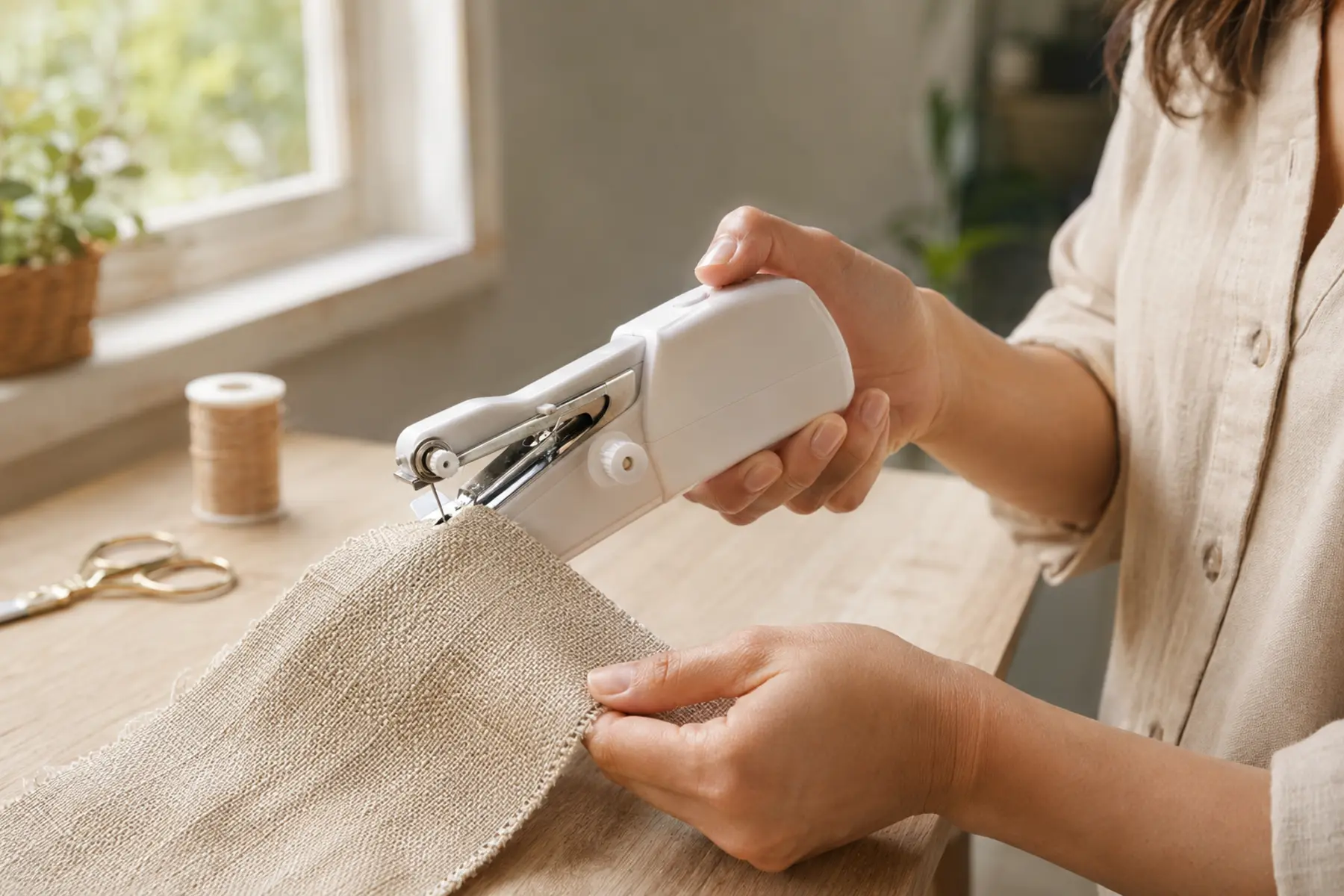
The best handheld sewing machine is not a miniature replacement for a normal sewing machine. It is a narrow-purpose mending tool for a short straight repair when portability matters more than control, stitch choice, or long-term reliability.
That boundary changes the recommendation. Most buyers will be better served by a needle and thread, a compact tabletop machine, or an entry-level full sewing machine. Hand stitching gives more control in a true emergency. A tabletop machine holds the fabric flat, feeds it with both hands free, and forms a more predictable seam. A full machine can backstitch, change stitch length, sew curves, handle buttonholes, and grow with the user.
Only two products from the site's approved shortlist meet the intent of this page. Both are branded SINGER mending devices with verifiable model identities, but they solve different jobs:
- The SINGER Stitch Sew Quick 2 is the better handheld choice when a two-thread stitch, two speeds, and bobbin winding justify a larger device.
- The SINGER Stitch Sew Quick is the smaller option for temporary basting or a quick repair on lightweight fabric, but its single-thread chain stitch must be secured carefully.
Neither belongs in a garment-construction workflow. Neither is a sensible first machine for someone who wants to learn sewing. Buy one only if the ability to carry the tool to a hanging curtain, a piece of bedding, or a small on-the-spot repair is more important than seam quality and ease of control.
Quick decision
Choose the SINGER Stitch Sew Quick 2 if you have already decided that a handheld is necessary and want the less compromised of these two options. It uses upper and bobbin threads, offers normal and faster speed settings, and can wind its bobbin. The two-thread arrangement produces a more secure seam than the single-thread model when it is threaded, tensioned, and finished correctly.
Choose the SINGER Stitch Sew Quick only for temporary basting or occasional lightweight repairs where minimum stored size matters most. Its single-thread chain stitch is easy to undo by design and can unravel from the end unless the final loop is manually secured. That can be useful for temporary work, but it is a liability in a seam expected to survive wear and washing.
Choose neither if you want to make clothes, alter fitted garments, sew stretch fabric, cross thick hems, repair structural seams, learn standard machine technique, or complete more than occasional short repairs. The best mini sewing machines guide covers compact tabletop machines that form a proper lockstitch. The best sewing machines for small spaces guide covers capable machines that can be stored between uses. New sewists should use the sewing machines for beginners guide instead.
Quick comparison
Showing three products at a time. Scroll vertically to see the remaining models.
| Product image | Title and best fit | Type | Current price |
|---|---|---|---|
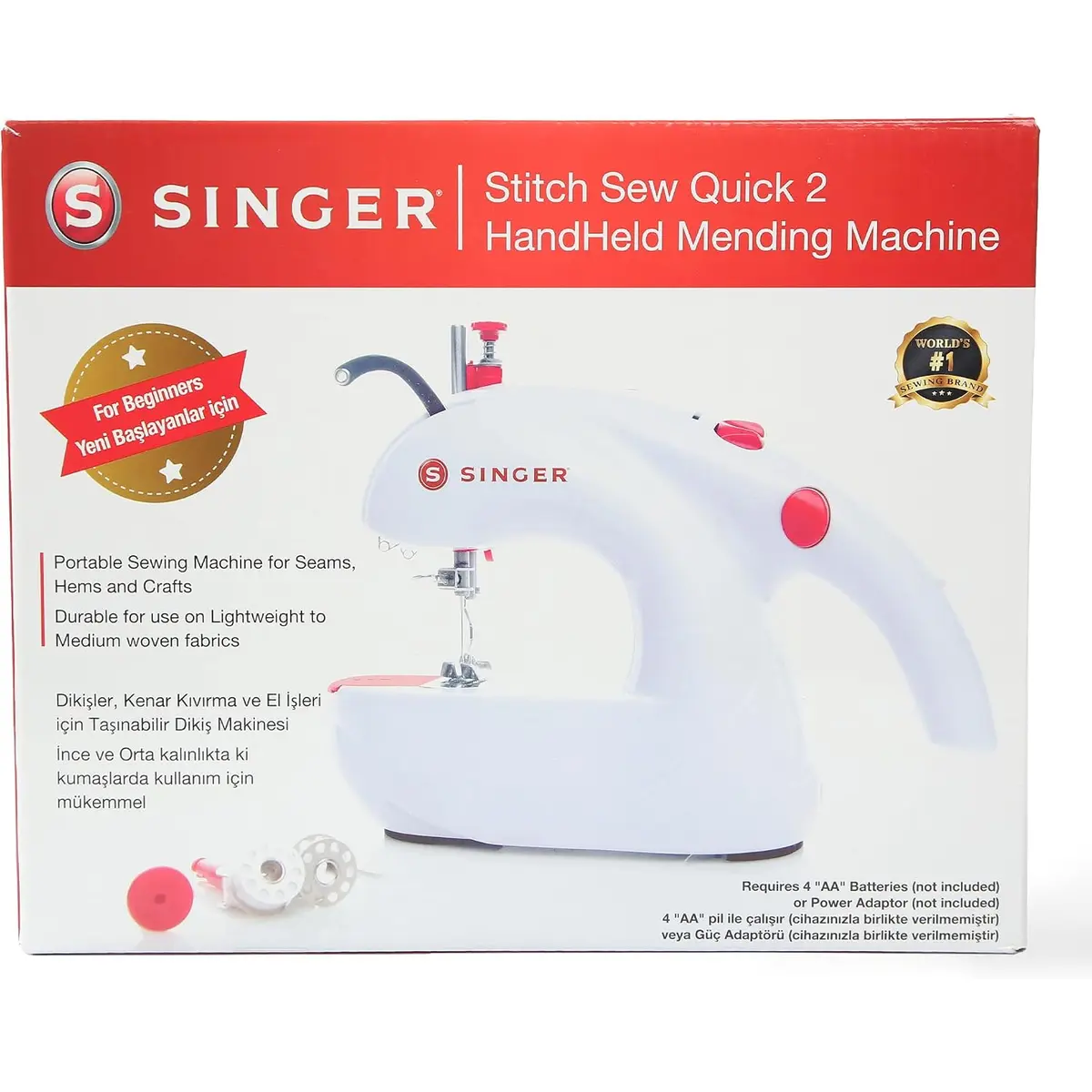 | SINGER Stitch Sew Quick 2 Occasional cordless repairs where a more secure two-thread stitch is worth the extra size and setup | Two-thread straight stitch with upper thread and bobbin | Check price |
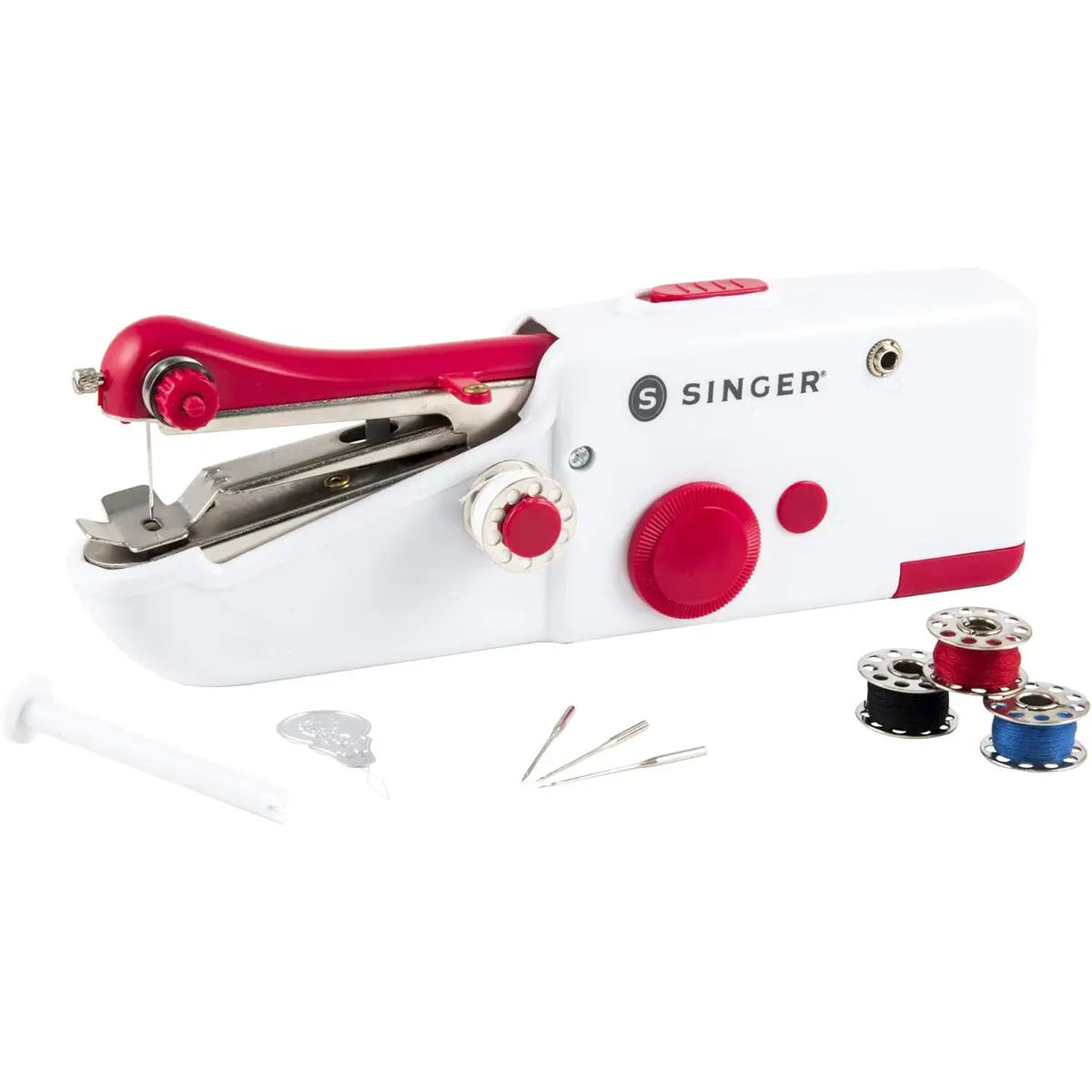 | SINGER Stitch Sew Quick Temporary basting or emergency fixes on lightweight fabric | Single-thread chain stitch | Check price |
Detailed recommendations
SINGER Stitch Sew Quick 2
Best two-thread handheld for occasional repairs
The SINGER Stitch Sew Quick 2, associated with model family 01664 and ASIN B01MQRP6Q8, is the first choice only within the narrow handheld category. It uses two threads, includes normal and faster speed settings, and has an automatic bobbin-winding function. It is cordless and runs on four AA batteries, which are not included.
Why it ranks first
The lower bobbin changes what the tool can reasonably do. Instead of building a single chain that depends on its final loop, the Quick 2 interlocks an upper and lower thread. For a short repair that must remain in place, this is the more defensible stitch system.
The two speed settings also give the user a limited way to match pace to the job. Normal speed is the sensible starting point. Faster speed may help on a long, uncomplicated line once the device is feeding cleanly, but it also gives the user less time to correct drift.
Automatic bobbin winding reduces dependence on pre-wound bobbins. The manual identifies Class 15 metal bobbins for replacement. Use the exact bobbin type specified for the model. A plastic or dimensionally different bobbin may appear to fit but can interfere with stitch formation or the bobbin case.
Real setup is more involved than the product size suggests
The Quick 2 is not a squeeze-and-sew stapler. The upper thread must follow its guides and tension path. The lower bobbin must be seated correctly. Both thread tails should extend behind the needle before the fabric is placed under the presser foot. The needle must be lowered into the starting position, then the presser foot is lowered before the motor starts.
At the end, the manual instructs the user to loosen the upper thread by hand before removing the fabric. This reduces the risk of bending the needle. The needle and presser foot are then raised, the fabric is drawn toward the back, and both threads are cut with adequate tails.
Skipping these steps is a common route to a bent needle, broken thread, or a seam that pulls out. Anyone who finds normal machine threading frustrating should not assume a handheld will be simpler.
What it can repair
The best candidates are short, low-stress, accessible straight repairs in stable woven fabric. Examples include a small open hem in lightweight cotton, a loose section of a curtain edge, a temporary household-textile repair, or a simple craft seam where precision is not critical.
Test the complete setup on a folded scrap that matches the project. Check both sides of the stitch. If the top thread lies flat without being drawn into the fabric, the upper tension may be too tight. If the lower thread lies flat, the upper tension may be too loose. Make only small tension changes and retest.
What it should not repair
Do not use it for a load-bearing bag strap, safety equipment, outdoor technical gear, upholstery under tension, a torn seat seam, a fitted garment crotch seam, or a repair where failure could cause injury or expensive damage. Do not expect it to climb a bulky jeans hem or sew multiple dense layers because a marketplace description uses the word “denim.”
The machine makes a straight stitch only. A straight stitch does not stretch with knit fabric and can pop when the garment is pulled on. It also does not finish a raw edge or replace an overlock stitch.
Handling compromise
The extra mechanism that creates the two-thread stitch also makes the Quick 2 bulkier than the single-thread version. One hand still holds the machine while the other controls fabric. The tool's small contact area gives much less directional stability than a machine sitting flat on a table.
For the straightest result, support the full project on a table even though the tool is handheld. Mark the intended line. Keep the repair area flat. Guide gently without pulling. Stop before reaching pins, thick intersections, zippers, buttons, or hard embellishments.
Who should buy it
Buy the Quick 2 if you need a cordless mending tool for occasional short repairs and specifically value a two-thread stitch. It also suits a household that already owns a normal machine but wants a second tool for an awkward item that is inconvenient to position at the machine.
Best for: Occasional cordless repairs where a two-thread stitch and bobbin winding justify the additional bulk.
Skip it if: This will be your only sewing machine, you need precise garment alterations, you regularly repair thick seams, or you want the easiest possible emergency kit.
SINGER Stitch Sew Quick
Best for temporary basting and very light repairs
The original SINGER Stitch Sew Quick, model family 01663 and ASIN B003BS34FG, is smaller and mechanically simpler. SINGER describes it as a cordless, single-thread handheld mending machine for quick repairs and temporary basting, with the best results on lightweight fabrics. It runs on four AA batteries, which are not included.
Why it remains on this shortlist
The single-thread model earns a place because it is genuinely portable and its removable chain stitch can serve a temporary purpose. A short basting line may hold layers while a permanent seam is planned. The device may also complete a low-stress emergency fix when the user understands that the last loop must be tied off.
This is not a durability recommendation. It is a utility recommendation for a buyer who values minimum stored size and expects to use the seam temporarily.
Securing the stitch is mandatory
The machine does not backstitch in the conventional sense. When the line is complete, raise the needle arm, draw out several inches of thread, and cut it. On the back of the fabric, use the supplied threader or another safe blunt tool to lift the last loop. Pass the thread tail through that loop, pull the knot tight, and trim only after the chain is secure.
Practise this process on scrap until you can identify the last loop. Test the finished seam by gently pulling from both ends. If the chain begins to release, secure it again before using the item.
Feeding and tension are sensitive
The fabric must sit fully under the fastening plate, and the user controls direction and speed with the free hand. Pulling too quickly can lengthen stitches, cause skipped stitches, deflect the needle, or prevent the chain from forming.
The tension dial should be adjusted in small increments. A large change can make the stitch too tight or too loose. A fresh battery set, correct threading, a straight undamaged needle, and suitable lightweight woven fabric should be established before blaming tension.
The portability claim needs context
The device is small enough for a drawer, travel sewing kit, costume case, or household repair box. Batteries make it usable away from an outlet. That does not mean it should be carried with batteries installed indefinitely. Remove batteries for storage and travel, especially if the tool will sit unused, and protect the needle and power switch from accidental contact.
For many travel situations, a small hand-sewing kit is still the better tool. A needle, strong matching thread, thimble, safety pins, and compact scissors occupy less space, need no batteries, and allow a secure knot, invisible hem stitch, button replacement, or controlled repair near a zipper.
Who should buy it
Buy the original Stitch Sew Quick if your main goal is temporary basting or a rare, lightweight, straight emergency repair and you are willing to secure the chain manually.
Best for: Temporary basting and very short fixes on lightweight woven fabric when minimum size matters.
Skip it if: You expect a permanent lockstitch, need predictable tension, want to sew a complete garment, or dislike manually finishing every seam.
How to choose a handheld sewing machine
The best handheld sewing machine is not a miniature replacement for a normal sewing machine. It is a narrow-purpose mending tool for a short straight repair when portability matters more than control, stitch choice, or long-term reliability.
That boundary changes the recommendation. Most buyers will be better served by a needle and thread, a compact tabletop machine, or an entry-level full sewing machine. Hand stitching gives more control in a true emergency. A tabletop machine holds the fabric flat, feeds it with both hands free, and forms a more predictable seam. A full machine can backstitch, change stitch length, sew curves, handle buttonholes, and grow with the user.
Only two products from the site's approved shortlist meet the intent of this page. Both are branded SINGER mending devices with verifiable model identities, but they solve different jobs:
- The SINGER Stitch Sew Quick 2 is the better handheld choice when a two-thread stitch, two speeds, and bobbin winding justify a larger device.
- The SINGER Stitch Sew Quick is the smaller option for temporary basting or a quick repair on lightweight fabric, but its single-thread chain stitch must be secured carefully.
Neither belongs in a garment-construction workflow. Neither is a sensible first machine for someone who wants to learn sewing. Buy one only if the ability to carry the tool to a hanging curtain, a piece of bedding, or a small on-the-spot repair is more important than seam quality and ease of control.
What a handheld sewing machine actually does
A handheld sewing machine combines a small powered needle mechanism, a pressure or fastening plate, a thread source, and a simple feed arrangement in a body held in one hand. The user guides or pulls the fabric with the other hand while the needle forms a straight line of stitches.
This design is portable because it removes the large flat bed, stable chassis, foot controller, and broad feed system of a normal machine. Those missing parts are also why a handheld is harder to control.
On a tabletop machine, both hands can guide fabric on a level surface while the presser foot and feed dogs move it in a repeatable direction. On a handheld, one hand supports the tool and the other must control the fabric, keep it flat, manage the seam allowance, and prevent the fabric from being pulled too quickly. A short visible repair may be possible. A long accurate seam is much more difficult.
Handheld tools also provide no meaningful room for growth. There is no zigzag for edge finishing or stretch, no reliable reverse function for backstitching, no buttonhole system, no adjustable presser-foot selection, no free arm, and no broad table for supporting a project. The product should be judged as a mending device, not as a small sewing studio.
Two-thread lockstitch versus single-thread chain stitch
The stitch type is the most important difference between these two models.
The Stitch Sew Quick 2 uses two threads
The Quick 2 carries an upper thread and a lower bobbin thread. The two threads interlock within the fabric when threading, timing, tension, and needle condition are correct. This is closer to the straight lockstitch made by a conventional sewing machine.
A two-thread stitch is not automatically durable. Short tails, poor tension, an unsuitable needle, skipped stitches, fabric pulled against the needle, or a seam placed under high load can still cause failure. The device also lacks the control and feeding stability of a tabletop machine. Its advantage is relative: it forms a more secure stitch structure than the single-thread handheld.
The original Stitch Sew Quick uses one thread
The single-thread model forms a chain on one side of the fabric. Each loop depends on the next loop. If the final loop is pulled free, the stitch line can unravel quickly.
The manual therefore treats finishing as part of the sewing process. The user must leave a tail, access the last loop from the back, pass the thread through it, and tighten a knot before trimming. Simply cutting the thread when the motor stops can undo the repair.
That property makes the machine plausible for temporary basting. A deliberately removable line can hold layers briefly before permanent sewing. It makes the device a poor choice for a worn trouser seam, a bag handle, upholstery, a child's clothing repair, or any other seam where sudden release would matter.
How we selected these two products
The products, ASINs, and buyer roles come from the site's approved Amazon product shortlist. The research was refreshed on July 22, 2026 using SINGER product guidance, available instruction manuals, exact Amazon model records, and current marketplace identity checks.
Selection was intentionally strict. A product had to have a traceable model identity, a clearly described stitch system, an honest portable-repair use case, and a distinct reason to exist beside the other choice. Unbranded single-thread clones, toy-like machines, mini tabletop machines, and products marketed as garment-making replacements were excluded.
No ranking decision was based on the number of reviews or a marketplace star average. This is a research-based guide and does not claim personal hands-on testing. Seller, price, availability, accessories, packaging, warranty, and model condition can change. Confirm the exact model and ASIN before ordering.
A realistic handheld repair workflow
A disciplined setup matters more than the speed promised on the package.
1. Decide whether the repair belongs on a handheld
Inspect the fabric, seam location, layer count, and force placed on the repair. A loose lightweight hem may fit. A torn structural seam does not. If the original seam failed because the fabric is weak, stitching through the same damaged area will not restore strength. Patch or reinforce it with an appropriate method.
2. Read the exact model manual
The one-thread and two-thread machines finish seams differently. Do not use a generic online handheld tutorial unless the device, stitch system, threading path, needle orientation, and bobbin arrangement match the exact model.
3. Install a matched battery set
Switch the tool off before opening the battery compartment. Install four fresh batteries of the same type, age, and charge state, following the marked polarity. Do not mix old and new batteries. Weak or uneven power can make troubleshooting more confusing.
4. Check needle and thread path
Confirm that the needle is straight, fully inserted, and oriented as the manual shows. Thread through every guide and the tension control in the correct order. On the Quick 2, check both upper thread and bobbin setup. Leave the required tail before beginning.
5. Test the exact fabric stack
Use a scrap with the same fabric, number of layers, fold, thread, and needle. A single flat scrap is not a useful test for a doubled hem. Sew slowly, inspect both sides, and pull gently along the seam direction.
6. Mark and support the line
Place the project on a table. Mark the repair with a removable fabric-safe tool. Keep the active section flat and let the table carry the weight. Do not allow a curtain, garment, or bedding panel to hang and pull on the needle.
7. Sew without forcing
Keep fingers clear of the needle and moving mechanism. Guide the material at the rate accepted by the feed. Never tug it to make the device sew faster. Stop before thick seam crossings and reposition only with the motor off.
8. Finish according to stitch type
For the Quick 2, follow the two-thread finishing procedure and leave adequate tails. For the single-thread Quick, capture and knot the final chain loop before trimming. Test the seam before returning the item to use.
Fabric and seam limits
Marketing photos often make handheld sewing look universal. The physical limits are much narrower.
Lightweight woven fabrics are the safest target
Stable cotton, light polyester woven fabric, and similar household textiles give the feed mechanism a predictable surface. Even then, hems with several folded layers should be tested because the thickness at a side seam may be much greater than the open fabric.
Knits require stretch
A handheld straight stitch does not stretch enough for most T-shirts, leggings, ribbing, or activewear seams. The seam can pop as the fabric expands. Hand sewing with an appropriate elastic stitch, a zigzag-capable machine, or a serger is more suitable.
Denim claims are misleading without layer counts
A tool may pierce one thin denim layer and still fail at a jeans hem containing six or more compressed layers. Needle penetration, feeding, seam height, and thread strength all change at the hump. Do not force the machine through a bulky intersection.
Delicate fabric can be damaged
Silk, sheer fabric, coated fabric, leather, vinyl, and loosely woven material can show permanent needle holes, snags, puckering, or feed marks. Test in an invisible area. A handheld's limited pressure and tension control make expensive delicate material a poor learning surface.
Heavy repairs need a different system
Canvas straps, upholstery, luggage, workwear, and leather usually require specific needles, thread, feeding power, stitch length, and reinforcement. A tiny cordless mender is not a heavy-duty machine.
Handheld versus hand sewing
Hand sewing is slower across a long straight line, but it is more versatile in a small emergency kit. The user can choose a backstitch for strength, slip stitch for an invisible hem, whipstitch for an edge, ladder stitch for a closed opening, or a temporary running stitch.
Hand sewing also works in corners and close to hardware where a handheld body cannot sit flat. The stitch can be placed exactly through existing holes, and knots can be buried or reinforced.
A handheld wins only when a short powered line on accessible fabric is genuinely faster and the user has already learned its setup. A new device that must be threaded, tensioned, tested, and troubleshot may take longer than five minutes of careful hand sewing.
Handheld versus mini tabletop machine
A mini tabletop machine occupies more space but gives the project a bed, a stable needle location, a conventional presser foot, and two-handed fabric control. The worthwhile models form a proper two-thread lockstitch and may include foot control, low and high speeds, a light, and limited reverse.
That makes a tabletop machine the better choice for repeated hems, simple craft projects, straight seams, and early sewing practice. It remains less capable than a good full-size beginner machine, but it is a meaningful step above a handheld.
Choose a handheld because the project cannot conveniently come to a table or because stored size is the overriding constraint. Do not choose it merely because it looks easier.
Handheld versus a full sewing machine
A full sewing machine is the correct category for garment construction, regular alterations, quilting, bags, home decor, and skill development. Even a basic mechanical model normally provides a flat bed, reverse, adjustable stitch selection, better fabric feeding, standard feet, service information, and a safer two-handed workflow.
The full machine requires desk space and learning, but handhelds require learning too. The difference is that time spent learning a standard machine transfers to future projects. Time spent mastering a single-thread handheld largely stays with that tool.
Buying checklist
Before ordering any handheld mending machine, verify:
- Exact brand, model number, and ASIN
- Single-thread chain stitch or two-thread stitch
- Required batteries and whether they are included
- Needle system and replacement availability
- Bobbin type for two-thread models
- Threading and seam-finishing instructions
- Tension adjustment method
- Speed settings and power-switch safety
- Fabric and layer limits stated by the manufacturer
- Included threader, needles, bobbins, spool pin, and manual
- Seller identity, return policy, and product condition
- Whether hand sewing or a compact tabletop machine would solve the job better
Ignore bundles padded with dozens of low-value notions if the core machine has the wrong stitch system. A large accessory count does not improve feed control or stitch security.
Safety and storage
Treat the needle as a powered sharp tool even though the machine is small. Switch it off before threading, removing fabric, changing the needle, opening the bobbin area, clearing thread, or installing batteries.
Keep fingers, loose hair, clothing, and jewellery away from the needle and moving parts. Never operate the machine while someone is wearing the garment. Product marketing may suggest on-body repairs, but a powered needle should not be used against a person.
Do not sew over pins. Remove them before they reach the tool. Do not pull fabric against the needle, because lateral force can bend or break it. Wear eye protection when testing an unfamiliar setup or difficult fabric.
Remove batteries before long-term storage. Keep the device dry and protect the needle. Store batteries separately so leakage does not damage the machine. Keep the tool, loose needles, bobbins, and batteries away from children.
Frequently asked questions
Is a handheld sewing machine good for beginners?
Usually not. The small size looks approachable, but one-handed control, sensitive threading, weak feeding, manual seam finishing, and limited troubleshooting can frustrate a new sewist. A stable beginner machine teaches standard threading, seam allowance, reverse stitching, presser-foot use, and fabric guidance.
Can a handheld sewing machine hem trousers?
It may handle a short, low-stress hem in lightweight woven fabric. It is a poor choice for a jeans hem, a blind hem, stretch trousers, or a hem crossing thick side seams. Test the full folded layer count before working on the garment.
Can it sew denim?
Do not treat a listing's denim claim as proof that the tool can cross a real jeans hem. One layer of light denim and a bulky multi-layer intersection are different jobs. The selected handhelds are not recommended for heavy denim construction or structural repair.
Why does a single-thread handheld seam unravel?
A chain stitch depends on linked loops. If the final loop is released, the chain can pull apart. Leave a long thread tail, capture the last loop from the back, pass the tail through it, and tighten the knot according to the model instructions.
Is the Stitch Sew Quick 2 a real lockstitch machine?
It uses upper and bobbin threads to form a two-thread straight stitch. That is more secure than the original model's single-thread chain. The device still lacks the stable feed, table support, reverse control, stitch selection, and precision of a conventional lockstitch sewing machine.
Can a handheld machine replace hand sewing?
Not completely. Hand sewing handles buttons, invisible hems, small corners, controlled reinforcement, and repairs near hardware more effectively. A handheld is useful only for a narrow powered straight line on accessible fabric.
Can I make clothes with one?
No practical garment-making workflow should be based on either selected handheld. Clothing construction requires accurate seam allowances, curves, corners, reinforcement, pressing access, edge finishing, and often stretch or zigzag stitches.
Do batteries come with these SINGER models?
The verified listings state that batteries are not included. Both models use four AA batteries. Verify the exact offer because third-party bundles can change.
Why is the machine running but not forming stitches?
Common causes include incorrect threading, a missed tension guide, wrong needle orientation, an incompletely inserted or bent needle, an incorrect bobbin on the two-thread model, unsuitable fabric, weak batteries, or pulling the material too quickly. Stop, switch off, return to the exact manual, and test again on lightweight woven scrap.
Are generic handheld sewing machines the same?
Many look similar, but internal timing, needle orientation, stitch system, bobbin dimensions, manuals, quality control, and support can differ. Do not assume a tutorial, replacement part, or claim for one model applies to another.
Final verdict
The SINGER Stitch Sew Quick 2 is the better handheld sewing machine for a buyer who specifically needs a cordless tool and wants the additional security of a two-thread stitch. Its dual speeds and bobbin winding make it more useful than a basic single-thread device, but its handling and fabric limits remain substantial.
The SINGER Stitch Sew Quick earns a narrower recommendation for temporary basting and rare lightweight repairs. Its compact form is genuinely portable, but the single-thread chain must be secured by hand and should not be trusted as a structural garment seam.
For most buyers, the right answer is not a handheld at all. Choose a small hand-sewing kit for true emergencies, a mini tabletop lockstitch machine for occasional simple seams, or a full beginner machine for reliable repairs and skill development. Buy a handheld only when its portability solves a specific problem that those better-controlled options cannot.
Research sources
- SINGER official Stitch Sew Quick single-thread handheld product guidance
- SINGER Stitch Sew Quick model 01663 instruction manual
- SINGER Stitch Sew Quick 2 model family 01664 instruction manual and product documentation
- Current Amazon records for ASINs B01MQRP6Q8 and B003BS34FG, checked July 22, 2026
Prices, sellers, batteries, bundles, accessories, warranties, and availability can change. Verify the exact offer before purchase. This page contains affiliate links; the site may earn a commission from qualifying purchases at no additional cost to the buyer.