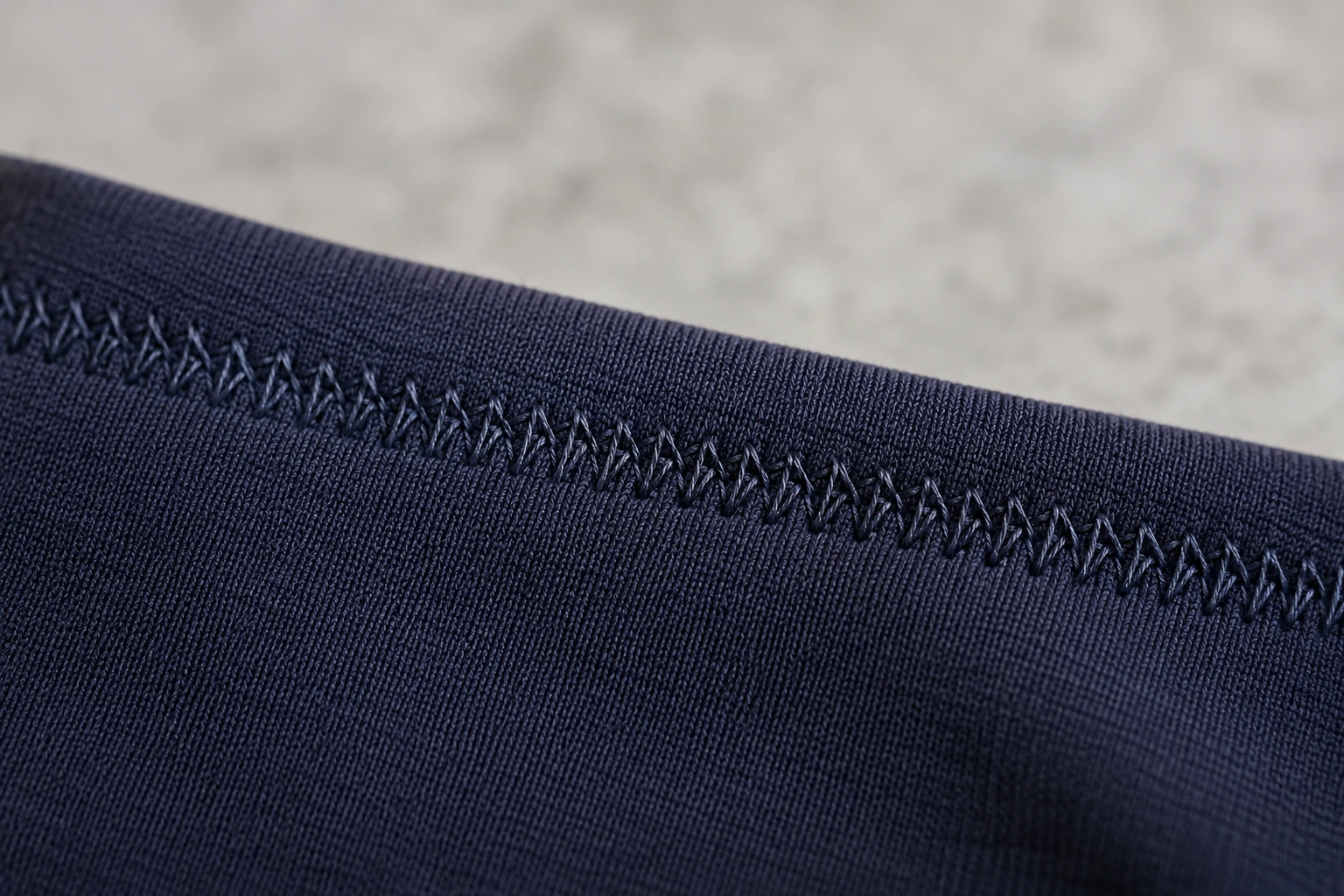
A stitch designed to extend with knit or elastic fabric without snapping in normal wear.
A flexible stretch stitch on navy knit fabric. This reinforced stitch forms with forward and backward needle movements so the seam can extend with knit or elastic fabric. It is designed to resist popping when the material stretches during wear.
01
Choose by seam purpose
Narrow zigzag and lightning stitches suit general knit construction; triple straight stitch is strong but dense.
02
Needle choice still matters
Ballpoint and stretch needles control knit loops and elastic fibers so a flexible stitch can form properly.
03
Avoid overbuilding
Dense patterns can make soft fabric rigid. Use the least bulky option that passes a stretch test.
Useful distinction
The label is not a guarantee
A stitch called stretch can still fail when the needle is wrong, the thread is unsuitable, or the seam is pulled beyond the fabric’s recovery.
Practical guide
Select flexibility without making the seam rigid
A useful stretch seam must extend with the fabric, recover without rippling, and remain comfortable. The densest pattern is not automatically the strongest practical choice.
Narrow zigzag
A small width with a moderate length gives a simple seam room to open under stretch. It is widely available, relatively easy to balance, and easier to remove than complex reinforced patterns. Test how visible the zigzag becomes when the seam is relaxed.
Lightning and reinforced patterns
A lightning stitch produces a straighter-looking flexible seam by moving in small angled steps. Triple stretch stitching is strong but dense, slow, and difficult to unpick. Reserve reinforced patterns for areas that truly need their extra thread and bulk.
Needle, thread, and pressure
Use the needle type recommended for the knit or elastic material and resilient polyester thread for stressed seams. If edges wave, support the fabric without pulling and reduce adjustable presser pressure modestly before assuming the stitch itself is unsuitable.
A realistic stretch test
Sew two project layers across the direction of greatest stretch. Pull the sample as it will be pulled during dressing or use, then release it. Reject settings that pop, remain stretched, tunnel, or create a rigid ridge even if the seam looks tidy while flat.
Avoidable mistakes
Why a labelled stretch stitch still fails
Testing along the stable grain instead of the direction that will stretch in use.
Using a universal needle that skips on elastic fabric.
Choosing a dense reinforced pattern for a soft seam that needs drape.
Stretching the fabric while sewing and creating a permanently wavy edge.
Common questions
Stretch Stitch FAQs
How do I test seam elasticity?
Sew across the direction of greatest stretch, pull it as the garment will be pulled, and check that thread does not pop.
Why is stretch stitching difficult to unpick?
Many patterns sew forward and backward repeatedly, creating dense overlapping thread.
Is lightning stitch always better than narrow zigzag?
No. Lightning looks straighter; narrow zigzag is often easier to balance and remove.
Is cotton thread suitable for high-stretch seams?
It has less give than polyester and may break in stressed areas.