The distance the fabric advances between one needle penetration and the next.
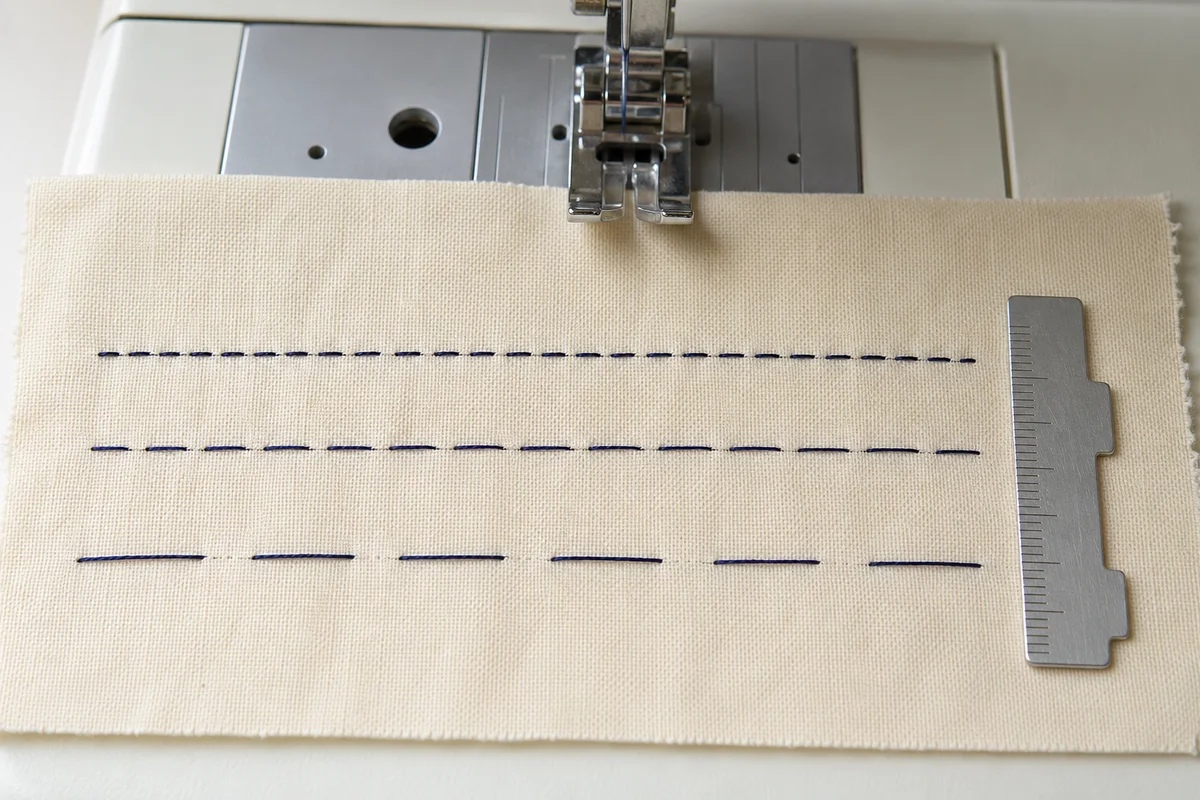
Short, standard and long straight-stitch lengths. Only the distance between needle penetrations changes across these rows. Shorter settings create denser stitching, while longer settings are useful for basting, gathering or visible topstitching.
01
Reliable starting points
About 2.4 to 2.8 mm suits many woven seams. Longer settings work for basting and topstitching; shorter settings help tight curves.
02
Fabric changes appearance
Thick layers can make a normal setting look shorter because thread sinks in. Fine fabric may pucker when stitches are too dense.
03
Length is not tension
Changing spacing cannot correct loops on one surface. Thread balance must be diagnosed separately.
Useful distinction
The number is only a starting point
The visible result on the actual fabric matters more than the screen value because thickness, feed, and thread all affect appearance.
Practical guide
Choose stitch length from seam purpose and material
Stitch length changes seam density, flexibility, appearance, and removability. The correct value is a tested range, not one universal number for every fabric.
Construction seams
A medium length near 2.5 mm is a practical starting point for ordinary woven fabric. Use a slightly longer stitch on thick layers so thread does not become buried, and avoid excessively short stitches on fine fabric because dense perforations and thread can pucker or weaken it.
Curves, corners, and precision
A modestly shorter stitch follows tight curves with smaller directional steps and reduces the need for abrupt pivots. Do not reduce it so far that the seam becomes rigid or difficult to unpick. Slow down and guide the edge consistently.
Basting, gathering, and easing
Long stitches are easy to remove and allow bobbin threads to slide for gathering. Leave long tails and avoid reverse stitching. Two parallel gathering rows control fullness more evenly than one, while temporary fitting seams should sit on the actual proposed seam line.
Topstitching and visible detail
A longer stitch usually looks cleaner with heavier topstitching thread and thick fabric. Test the thread through the selected needle, support project weight, and inspect both sides. Length changes spacing, but tension still controls where the threads interlock.
Avoidable mistakes
When the selected number is misleading
Measuring only the screen value instead of the formed stitches on the project layers.
Using very short stitches to force accuracy on fabric that is already puckering.
Using basting length for a permanent stress-bearing seam.
Changing length to solve loops that are actually caused by threading or tension.
Common questions
Stitch Length FAQs
What length suits an ordinary beginner seam?
Start near 2.5 mm on medium woven fabric, then adjust after testing.
Why are sewn stitches shorter than the selected value?
Heavy layers, drag, pressure, or feed problems can reduce actual advance.
Which length works for gathering?
A long straight stitch, commonly 4 to 5 mm, makes threads easier to pull.
Does a very long stitch weaken a seam?
Yes. Fewer penetrations can reduce strength, so reserve extreme lengths for basting or decoration.