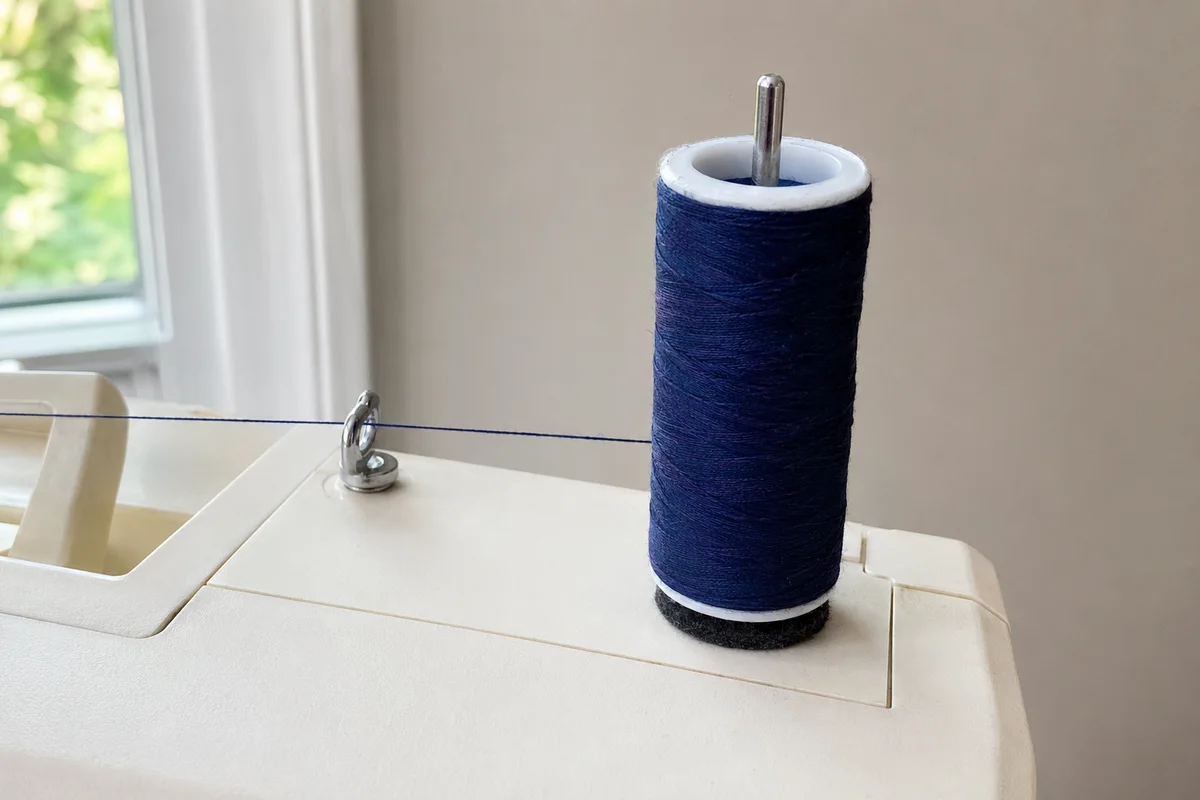
The post that supports the upper-thread spool as thread enters the machine’s guide and tension path.
A vertical spool pin with its felt support pad. The pin holds the thread spool securely while the felt pad cushions its base. Thread leaves the spool and enters the first upper guide before continuing along the machine threading path.
01
Horizontal setup
The spool lies sideways and needs a cap slightly larger than its opening. The cap should stabilize it without clamping it tightly.
02
Vertical setup
The spool stands upright and thread unwinds around it. A felt pad may reduce vibration or prevent scraping.
03
Cross-wound and stacked thread
Cross-wound thread often feeds well over the end; stacked thread usually prefers unwinding from the side. Oversized cones need a separate stand.
Useful distinction
Spool problems mimic tension problems
A snag at the cap or pin creates sudden resistance before thread reaches the tension discs, producing breaks and uneven stitches even when the dial is correct.
Practical guide
Choose spool orientation from how the thread is wound
Smooth stitches begin before thread reaches the tension discs. The pin, cap, felt pad, and thread stand should let the spool unwind without jerks, loops, or sudden resistance.
Horizontal spool setup
Place the spool so thread unwinds in the direction shown by the machine and fit a cap slightly larger than the spool end. Leave enough clearance for free rotation or end feeding. A cap that is too small can let thread catch in the spool notch.
Vertical spool setup
Stack-wound thread often feeds smoothly from the side while standing on a vertical pin. Use the supplied felt pad where recommended to reduce vibration. Do not improvise washers that lift the spool into an unstable position.
Large cones and specialty thread
Large cross-wound cones are designed to feed upward from a separate thread stand. Place the stand behind the machine so thread rises through its guide before entering the normal path. A heavy cone balanced on a domestic pin can drag or fall.
Diagnosing intermittent snags
Watch the spool while sewing a test line. A sticky label, rough cap, trapped tail, crossed strand, or notch can create brief resistance that looks like changing tension. Correct delivery at the source before altering the tension dial.
Avoidable mistakes
Spool setup errors that imitate tension trouble
A small cap leaves a gap where thread repeatedly catches.
A cap pressed tightly against the spool prevents free movement.
A large cone placed directly on a domestic pin feeds unevenly.
The loose starting tail can wrap around the pin beneath the spool.
Common questions
Spool Pin FAQs
Why does thread wrap around the spool pin?
The cap may be missing, too small, or installed with a gap that catches thread. Check cap size and orientation.
Can a large cone sit directly on a domestic pin?
Usually not. Large cones are designed for upright delivery from a separate stand and may be too heavy or unstable.
What is the felt circle beneath a vertical spool for?
It cushions the spool and reduces vibration; it is not a universal tension adjustment.
Why does the spool jerk instead of feeding evenly?
A rough edge, tight cap, sticky label, wrong orientation, or thread caught beneath the spool can interrupt delivery.