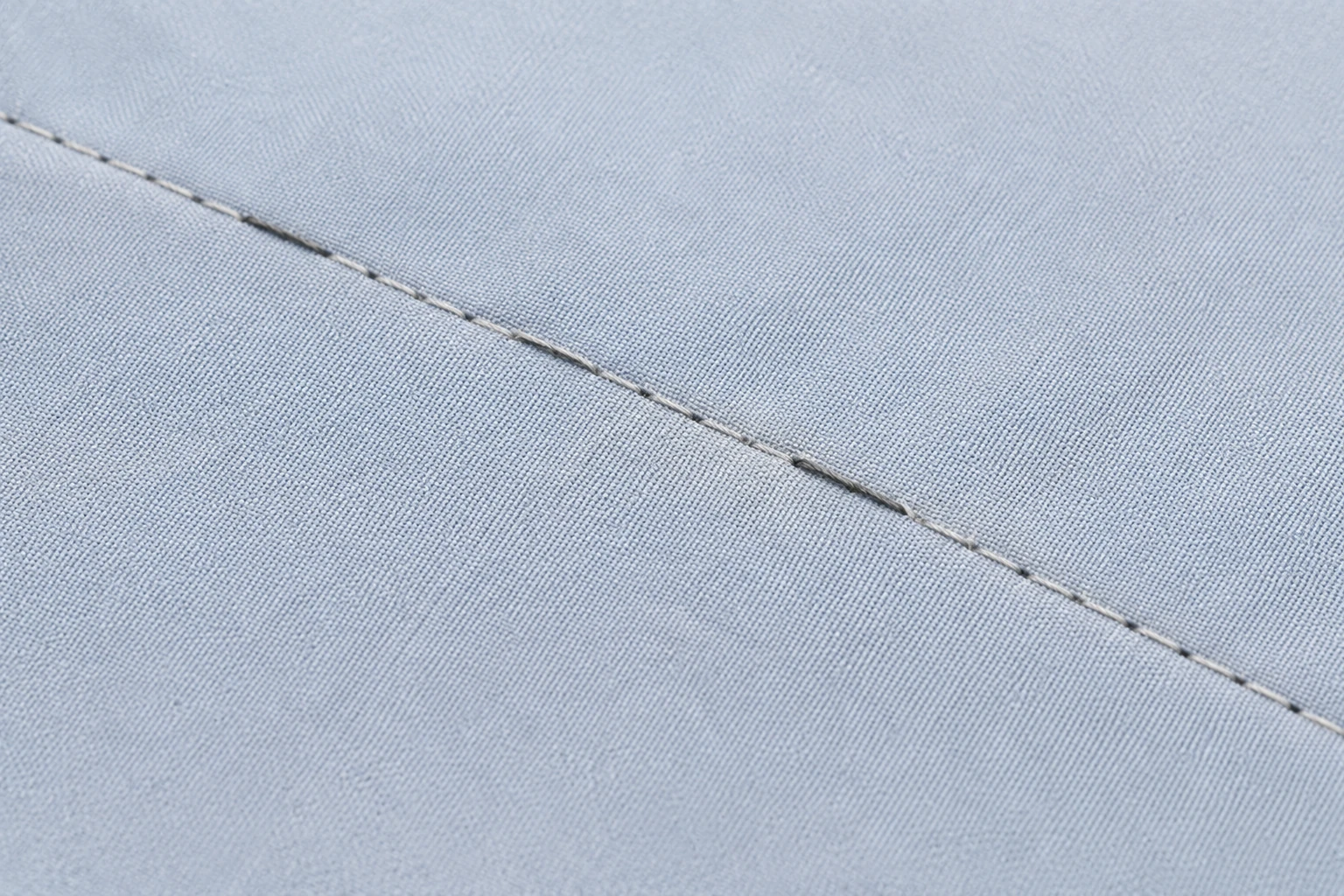
Missing stitch formations that leave gaps in an otherwise continuous seam.
A seam interrupted by skipped stitches. The uneven gaps appear when the hook fails to catch the upper-thread loop during part of the stitch cycle. Needle condition, needle type, installation, thread fit and fabric lift should be checked before machine timing is suspected.
Start here
Replace and reinstall the needle
A new, correct needle solves more skipped-stitch problems than immediate tension or timing adjustment.
01
Match the point to fabric
Ballpoint needles suit many knits, stretch needles control elastic fabrics, and sharp points penetrate dense wovens.
02
Check installation
Use the correct needle system, insert it fully in the specified orientation, and tighten the clamp.
03
Reduce deflection and lift
Avoid pulling fabric, level thick seams, stabilize difficult material, and use appropriate pressure.
Useful distinction
Timing is a later diagnosis
Hook timing should be considered only after needle, thread, threading, pressure, and fabric checks consistently fail.
Practical guide
Diagnose skipped stitches in a fixed order
A skipped stitch occurs at the hook, but the cause often begins with the needle, fabric, or thread. Work from the easiest replaceable component toward machine service.
Step 1: replace the needle correctly
Install a new needle of the system specified for the machine, push it fully into the clamp, orient the flat side as the manual shows, and tighten securely. A needle can be slightly bent or have a damaged point without looking obviously defective.
Step 2: match needle and thread
The thread must pass freely through the needle eye and form a loop behind the needle as it rises. Heavy thread in a small eye can restrict that loop. On knits and elastic fabrics, use the needle type designed to pass through or control the material without lifting it.
Step 3: control fabric lift and deflection
Stretchy, sticky, or thick material can rise with the needle, a movement often called flagging. Keep the presser foot fully lowered, adjust pressure if the machine permits it, stabilize troublesome areas, and level the foot at bulky crossings. Never pull the project from behind.
Step 4: separate setup faults from timing
Test a basic straight stitch on two layers of stable cotton using normal thread and a fresh universal needle. If the machine still skips consistently across positions after complete rethreading, the hook-to-needle relationship or another mechanical issue may need professional inspection.
Avoidable mistakes
Changes that hide the real cause
Increasing upper tension before replacing a suspect needle.
Using a larger needle without checking whether its point type suits the fabric.
Testing only on the difficult project material and never on stable woven fabric.
Assuming one skipped stitch over an extreme seam ridge proves the hook timing is wrong.
Common questions
Skipped Stitches FAQs
Why are skips common on stretchy fabric?
Elastic fabric can rise with the needle and prevent a stable loop. Use a stretch-compatible needle and setup.
Can thick thread cause skipped stitches?
Yes. It may not move freely through a small needle eye.
Why do skips occur over bulky crossings?
The foot tilts and the needle deflects as it climbs. Level the foot and slow down.