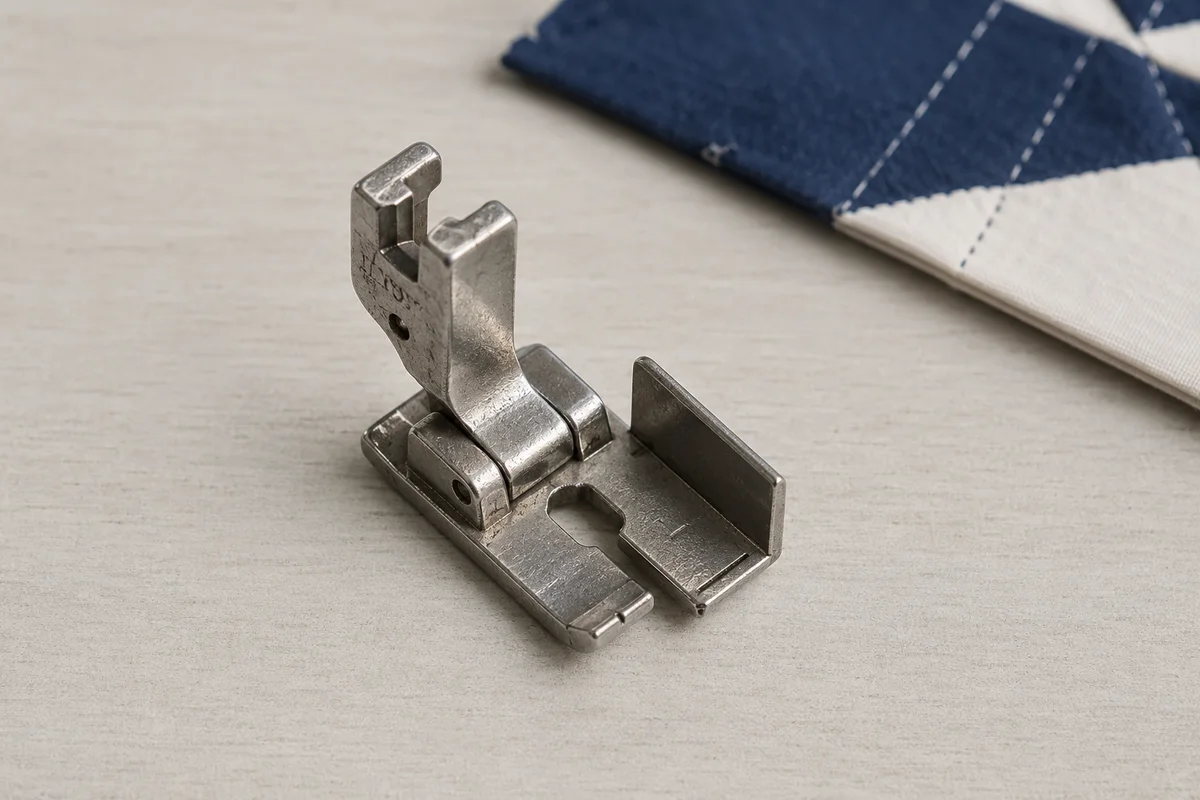
A quilting foot whose edge or guide is positioned one quarter inch from the needle.
A quarter-inch quilting foot with an edge guide. The vertical flange gives the cut fabric edge a repeatable reference while the needle opening supports a narrow patchwork seam. The finished seam should still be tested because needle position, thread and pressing affect its measurement.
01
Verify before piecing
Sew and press a test unit, then measure it. Fabric fold and thread thickness often make a scant quarter inch more accurate.
02
Guided and unguided styles
Some feet use a vertical flange; others use the right toe as the edge reference.
03
Cross bulky intersections
A guide can catch on seam ridges. Slow down and level the foot when it begins to tip.
Useful distinction
The label is not a guarantee
Foot geometry, needle position, pressing, and thread weight all affect the finished measurement.
Practical guide
Calibrate the finished patchwork unit, not just the raw seam
A quarter-inch foot is a repeatable guide, but thread thickness, needle position, pressing, and the fabric fold determine whether the completed unit finishes at the expected size.
Test a measured unit
Cut accurate pieces, sew with the selected foot and thread, press as the pattern instructs, then measure the completed unit. If it is consistently small, use a scant quarter inch by moving the needle slightly toward the edge where the machine and foot allow it.
Guide blade and foot edge
A flanged foot keeps the raw edge beside a vertical guide, while an unguided foot uses the right toe as the reference. Let fabric touch the guide lightly. Pushing against it can distort bias edges and narrow the seam.
Crossing patchwork intersections
Nested allowances create a height change that may tip the foot or catch a guide blade. Slow down, keep the unit flat, and use a height-compensation aid if needed. Do not pull the block through the crossing.
Keep the setup consistent
Changing thread weight, needle position, foot, or pressing direction can alter the finished measurement across many units. Recalibrate after any setup change and keep a labelled test sample with the project.
Avoidable mistakes
Small errors that multiply across a quilt
Assuming the foot label guarantees the finished measurement.
Pressing inconsistently changes how much fabric is taken into each fold.
Pushing fabric against a guide distorts the edge.
Skipping recalibration after changing thread or needle position compounds error across blocks.
Common questions
Quarter-Inch Foot FAQs
What is a scant quarter-inch seam?
A seam a thread or two narrower than a full quarter inch to compensate for fold and thread thickness.
Why are quilt blocks still undersized?
Cutting, pressing, thread thickness, and actual foot width may all contribute.
Should fabric be pushed against the guide blade?
No. Let it touch lightly; pressure can distort bias edges and narrow the seam.
Will every quarter-inch foot fit every machine?
No. Shank height, snap-on dimensions, needle position, and stitch width must match.