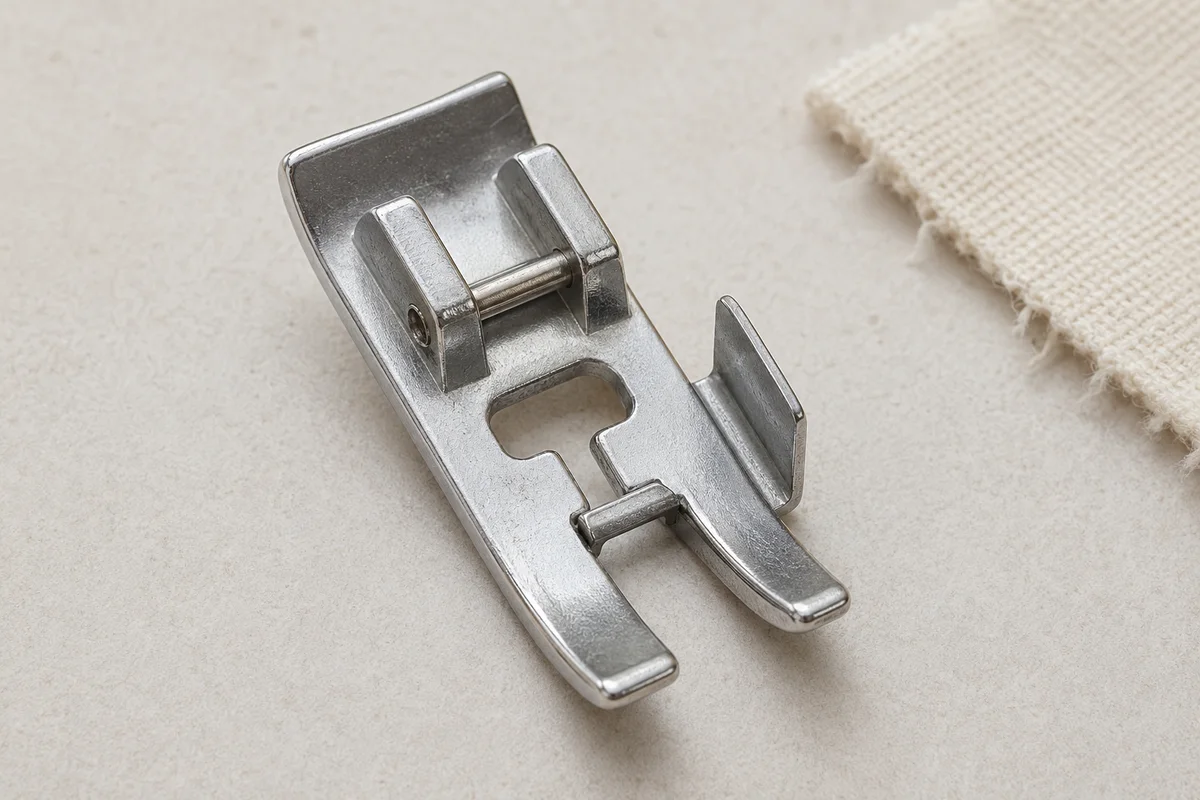
A guided foot that supports overedge stitches as they wrap a raw fabric edge.
A guided overcasting presser foot. The right-side guide follows the raw fabric edge while the central support helps keep overedge thread from drawing the fabric inward. Stitch width and needle clearance must be checked before sewing.
01
Align the guide
Place the raw edge against the vertical guide so the outside needle swing lands just beyond it.
02
Use compatible stitches
Select a recommended overcast or zigzag pattern; a straight stitch may strike the support bar.
03
Handle curves slowly
Pivot in small increments so curved edges remain against the guide.
Useful distinction
The support bar has limits
It keeps loops flat until they slide off, but only when width, length, and stitch choice are compatible.
Practical guide
Use the guide and support bar as a system
An overcasting foot does more than follow an edge. Its guide positions the fabric while a small bar holds the thread open until the finished stitch slides behind the foot.
Choose a compatible stitch
Use the overedge stitch recommended for the machine and foot, or a zigzag that clearly crosses the raw edge. Inspect the foot opening and support bar before sewing. A straight stitch or an excessive width can drive the needle into metal.
Place the raw edge correctly
Trim loose threads and uneven fabric first. Keep the cut edge lightly against the vertical guide rather than pushing it underneath. The outside needle swing should land at the edge or just beyond it so thread wraps without narrowing the allowance.
Prevent curling and tunneling
If the edge rolls upward, lengthen the stitch, reduce unnecessary width or density, and check tension on a scrap. The support bar helps prevent thread from drawing the edge inward, but it cannot compensate for a stitch packed too tightly for the fabric.
Cross seams and curves
At a bulky crossing, slow down and level the foot so the guide does not deflect the layers. On an outside curve, pivot in small increments with the needle down in the fabric. Tight inside curves may be easier to finish with a standard zigzag foot that permits freer steering.
Avoidable mistakes
Situations where the foot is blamed unfairly
A ragged cut edge repeatedly leaves the guide and produces an uneven finish.
The selected stitch swings across the support bar instead of its open path.
Sideways pressure forces the allowance beneath the guide.
A dense stitch cannot slide cleanly off the support bar behind the foot.
Common questions
Overcasting Foot FAQs
Why does thread stick on the support bar?
The stitch may be too short or tight to slide off. Lengthen slightly and check the recommended pattern.
Can it sew ordinary zigzags?
Yes when clearance is safe, though a standard zigzag foot gives more freedom away from an edge.
Why does fabric drift away from the guide?
Uneven trimming, drag, bulk, or sideways pulling may break contact.
Does this foot cut fabric?
No. It guides thread only and does not reproduce a serger knife system.