
← Sewing glossary

Edge finish

Overcast Stitch

A stitch that sews along a raw edge and places thread over or beside it to reduce fraying.

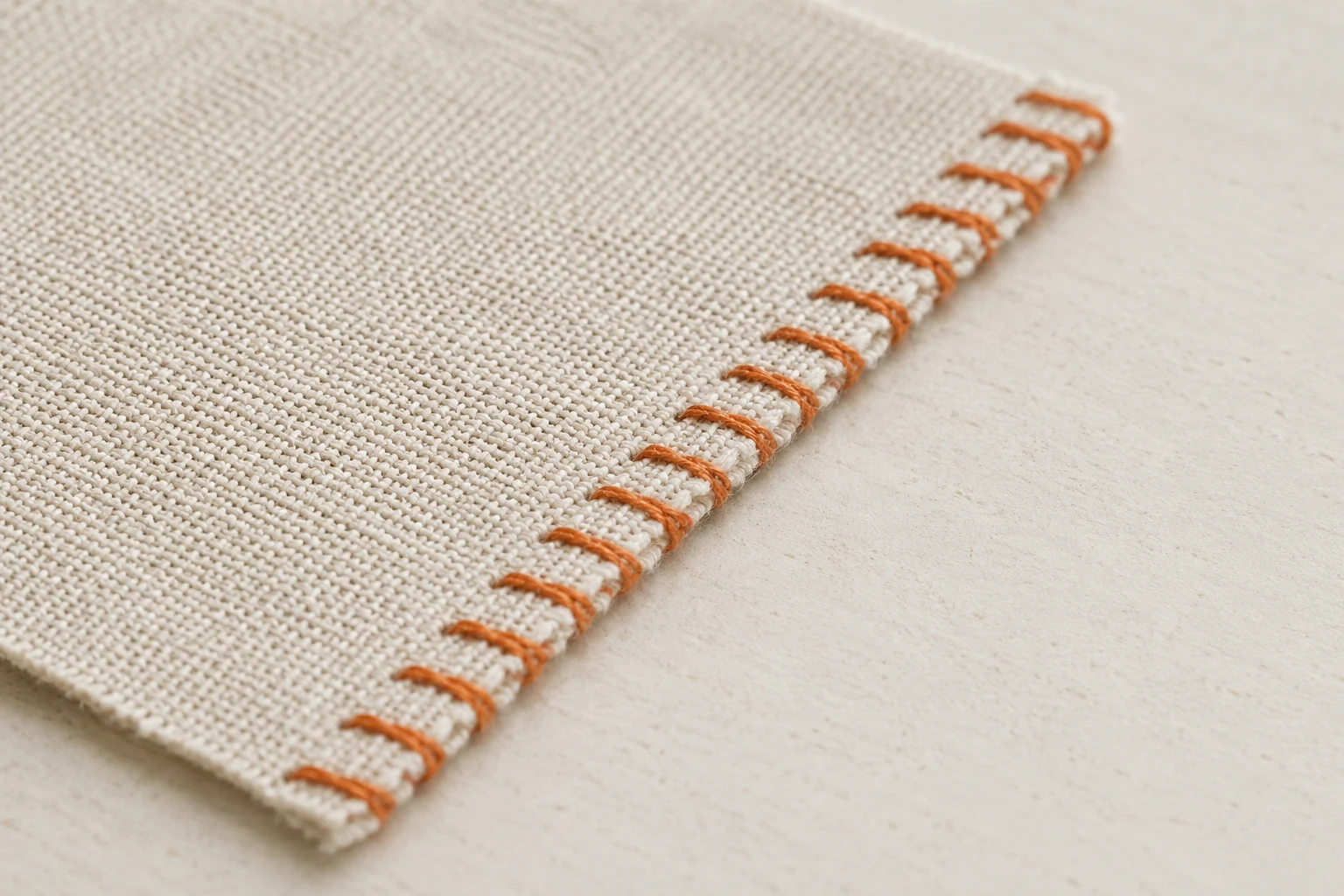
Orange overcast stitches wrapping the raw edge of beige woven fabric to control fraying
Overcast stitching wrapped around a raw fabric edge. The thread reaches across the cut edge to hold loose fibres and reduce fraying. Stitch width, length and edge guidance must be balanced so the finish remains flat rather than curling or tunnelling.
01

Use foot guidance

An overcasting foot supports thread on a small bar and guides the raw edge so loops slide off without tightening the fabric.

02

Prepare the edge

Trim the allowance evenly first; a ragged edge prevents consistent guiding.

03

Choose the pattern

Simple zigzag, three-step zigzag, slant overcast, and reinforced overedge stitches suit different fabrics.

Useful distinction

Overcasting is not serging

It can control fray effectively, but it does not trim the fabric or use loopers to form a true overlock seam.

Practical guide

Choose an edge finish that stays flat and flexible

Overcasting succeeds when thread reaches the raw edge without pulling it into a ridge. Stitch pattern, foot support, density, and fabric stability work together.

Simple zigzag finish

A medium zigzag is a practical choice for many woven allowances. Keep one swing in sound fabric and the other at or just beyond the raw edge. Avoid an unnecessarily short length, which packs thread into the edge and can make it curl.

Three-step zigzag

Three small penetrations across each zigzag spread the thread over a wider area. This can suit elastic, loosely woven fabric, and edges that pucker under a single wide swing. Test whether the added penetrations remain flexible enough for the project.

Dedicated overedge patterns

Slant and reinforced overedge stitches combine edge wrapping with extra seam-side penetrations. Use the recommended foot and verify needle clearance manually. Some patterns are intended only for finishing, while others can sew and finish a light seam in one operation.

Open or closed seam allowances

Finish allowances separately when the seam will be pressed open or when reduced bulk matters. Finish them together for a simple closed seam pressed to one side. Trim evenly before stitching because the machine foot guides an existing edge rather than cutting one.

Avoidable mistakes

Why an overcast edge curls or looks uneven

  • The stitch is too short or wide for the fabric to support.
  • A ragged cut edge repeatedly moves away from the foot guide.
  • Both needle swings land inside the fabric and fail to wrap the raw edge.
  • The finish is treated like serging even though the sewing machine does not trim the edge.

Common questions

Overcast Stitch FAQs

Why does the finished edge curl upward?

The stitch may be too dense or tight, or the foot may lack support. Lengthen it and use the proper foot.

Can both allowances be overcast together?

Yes. This makes a practical closed finish for many casual garments.

Where should the outside needle swing land?

At or just beyond the raw edge so thread wraps it cleanly.

Is three-step zigzag an overcast option?

Yes. Its distributed penetrations work especially well on elastic and pucker-prone fabric.