← Sewing glossary

Essential component

Sewing Machine Needle

The replaceable metal component that carries upper thread through fabric so the hook can catch its loop and form a stitch.

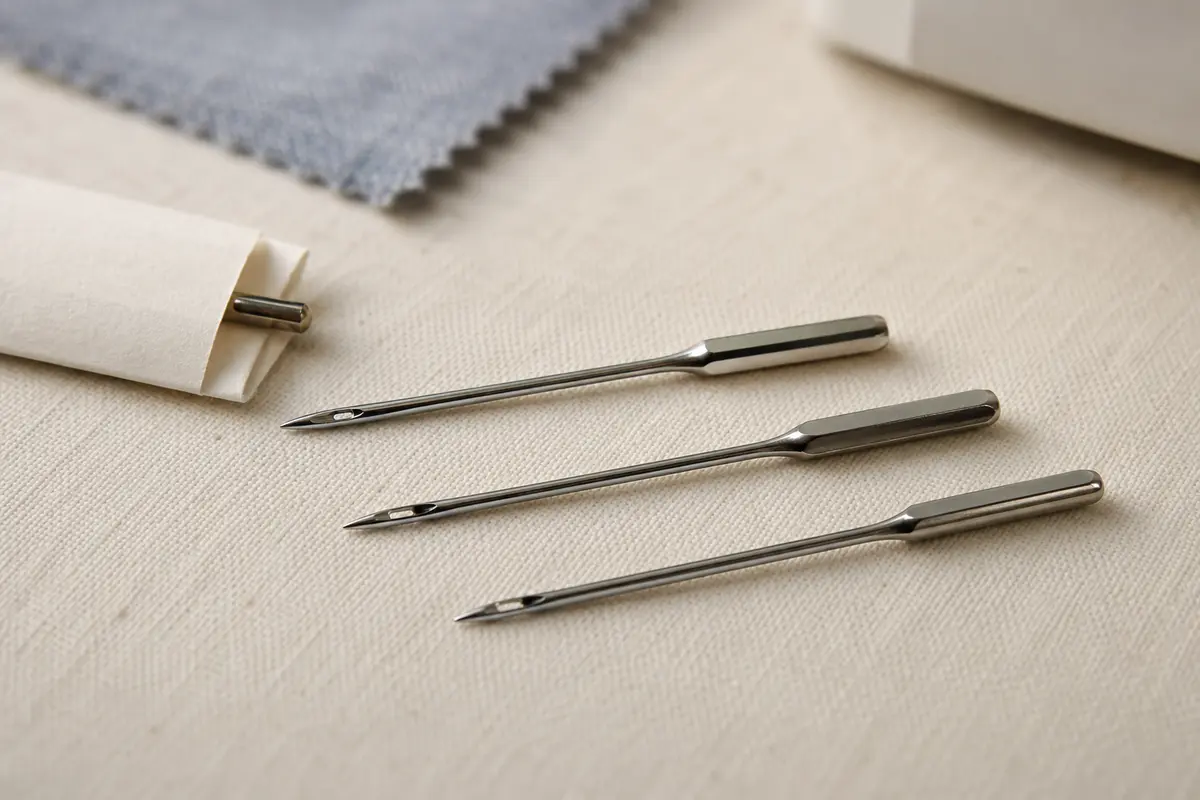
Three domestic sewing machine needles with flat shanks and needle eyes visible on a pale fabric surface
Common domestic sewing machine needles. Household machine needles share a similar shank system but differ in point style, size, and eye shape. The correct needle must suit both the machine and the fabric-thread combination.
01

Match the needle system first

Domestic machines commonly use a specified needle system, but industrial and specialty machines vary. The correct system determines shank dimensions and timing position; type and size come afterward.

02

Choose point and size by material

Universal needles suit many wovens, ballpoint styles enter knit loops, stretch needles help with elastic fabrics, and sharper points suit dense wovens. Use an eye large enough for the thread without oversizing unnecessarily.

03

Install and replace correctly

Turn off the machine, raise the needle bar, loosen the clamp, and insert the new needle fully in the manual’s stated orientation. Replace it after a bend, strike, burr, or unexplained deterioration in stitching.

Useful distinction

New does not always mean correct

A fresh needle can still skip stitches or strike the hook when its system, orientation, point, or size is wrong for the machine and material.

Practical guide

Select the needle as part of a fabric, thread, and machine system

The needle must fit the machine, open a suitable path through the material, and carry the chosen thread without excessive friction. Its point, size, eye, condition, and installation all affect stitch formation.

Match the needle system first

Domestic machines commonly use a flat-shank household system, while industrial and specialty machines may require a different length or shank. Check the manual before considering size or point style. A needle that fits the clamp but has the wrong length can strike the hook or miss it.

Choose size and point for the material

Use a smaller sharp or microtex-style point for tightly woven fine fabric, a ballpoint or stretch option for appropriate knits, and a suitable jeans or leather design for dense materials. Start from the fabric maker and machine guidance, then test the actual layers.

Match the eye to the thread

Thread should pass through the eye without abrasion or crowding. If it frays near the needle, check eye size, thread quality, spool delivery, and burrs before increasing tension. Very thick decorative thread may require a topstitch or specialty needle and slower sewing.

Replace and install it correctly

Change a bent, burred, blunt, or repeatedly used needle and replace it after a severe jam. Raise the bar, orient the shank exactly as instructed, push the needle fully upward, and tighten the clamp securely. Turn the handwheel through one full cycle before powered sewing.

Avoidable mistakes

Needle choices that imitate machine faults

  • A needle installed below the clamp stop changes its meeting point with the hook.
  • Pulling fabric bends the needle toward the plate or hook.
  • Using one universal needle for every material can cause skipped stitches or damage.
  • A needle may be bent even when the bend is difficult to see.

Common questions

Sewing Machine Needle FAQs

How often should a sewing machine needle be changed?

There is no single hour limit for every project. Replace it at the start of demanding work and whenever it becomes dull, bent, burred, noisy, or begins causing damage or skipped stitches.

How can I tell whether a needle is bent?

Roll it on a flat surface or compare it with a new needle, but discard it after any hard strike even when the bend is difficult to see.

What do needle size numbers mean?

Paired sizes such as 80/12 describe the same blade diameter in two numbering systems; a larger number indicates a thicker needle.

Why does thread shred near the needle?

The eye may be too small, the needle may be damaged or installed incorrectly, thread may be poor, or a burr may exist on the plate or hook.