
← Sewing glossary

Machine feature

Needle Threader

A built-in or handheld mechanism that pulls a loop of thread through the needle eye.

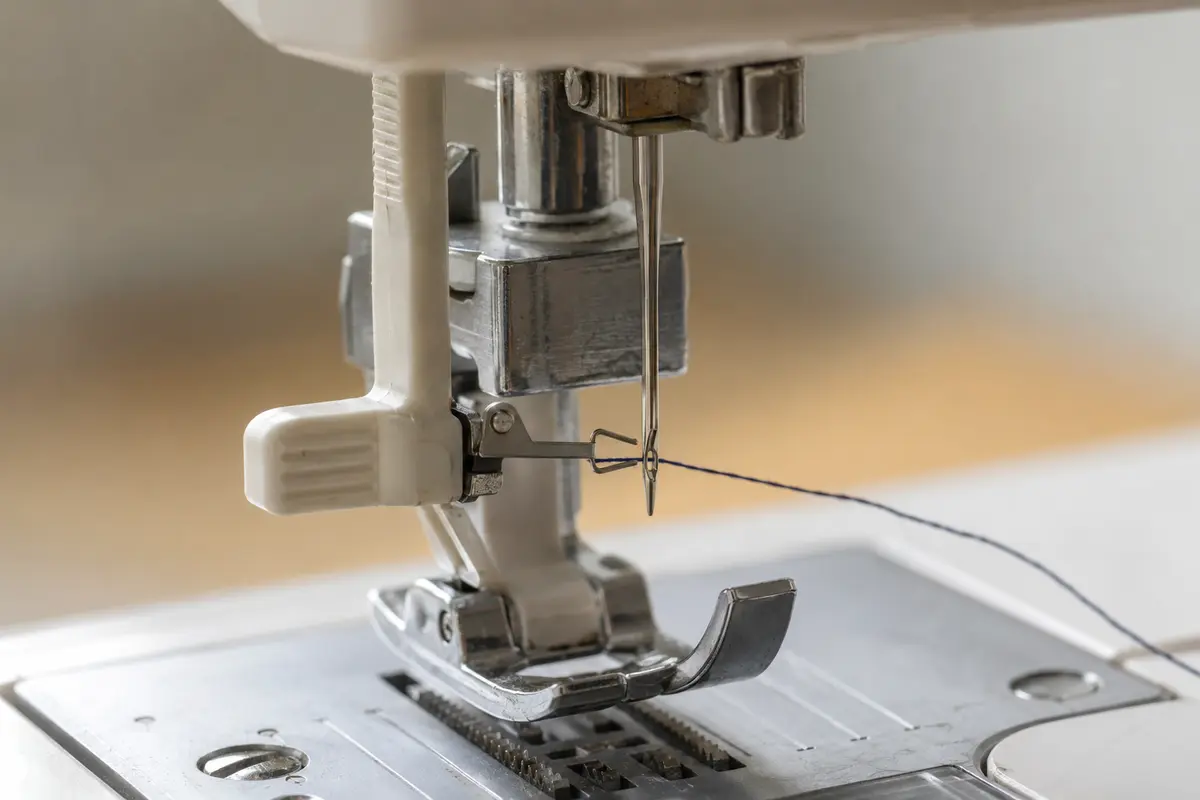
A built-in sewing machine needle threader lowered beside the installed needle above the presser foot
A built-in needle threader in its lowered position. The lever brings a fine hook into alignment with the needle eye. Correct needle height and centre position are essential because the small hook bends easily if it is forced.
01

Built-in sequence

Raise the needle to the specified height, lower the lever, place thread under the guide and hook, then release gently.

02

Compatibility limits

Very small, wing, twin, and some specialty needles may not work with the built-in threader.

03

Protect the hook

Never force the lever. The tiny hook can bend and begin passing beside the eye.

Useful distinction

Precision makes it delicate

The hook must pass through the same tiny eye you are trying to avoid staring at, so alignment and compatible needle size matter.

Practical guide

Align the tiny hook before applying pressure

A built-in threader works only when the needle eye, guide, and fine hook meet at the designed height. Correct sequence protects a mechanism that bends easily.

Set needle height and position

Raise the needle fully using the handwheel or the machine control and use the centre position unless the manual says otherwise. Lower the presser foot if instructed. A needle that is slightly low or not fully inserted can place the eye outside the hook path.

Guide and release the thread

Lower the threader lever gently, place thread beneath the guide and across the hook in the illustrated direction, then release without snapping the mechanism upward. Pull the resulting loop completely through the eye by hand.

Check needle and thread compatibility

Very small needles, twin needles, wing needles, and some specialty systems may not work with the built-in threader. Thick or fuzzy thread may not fit beside the hook inside a small eye. Thread manually rather than forcing an incompatible combination.

Diagnose a hook that misses

Replace and fully insert the needle, confirm centre position, and try again slowly. If the hook passes beside the eye or no longer enters it after these checks, it may be bent or misaligned and require replacement or service.

Avoidable mistakes

How a convenient tool becomes misaligned

  • Forcing the lever when the hook does not enter the eye.
  • Using the threader with an unsupported specialty or twin needle.
  • Holding thread too tightly prevents the hook from drawing a loop.
  • Operating the threader while the needle is below its required height.

Common questions

Needle Threader FAQs

Why does the hook miss the eye?

The needle may be low, installed incorrectly, too small, or the threader hook may be bent.

Can it be used with a twin needle?

Usually not. Most built-in systems are intended for one central needle.

Why is a loop formed but not pulled through?

Thread may have missed the hook, be too thick, or be held too tightly.

Can a bent threader hook be replaced?

Often yes, but some assemblies require technician alignment.