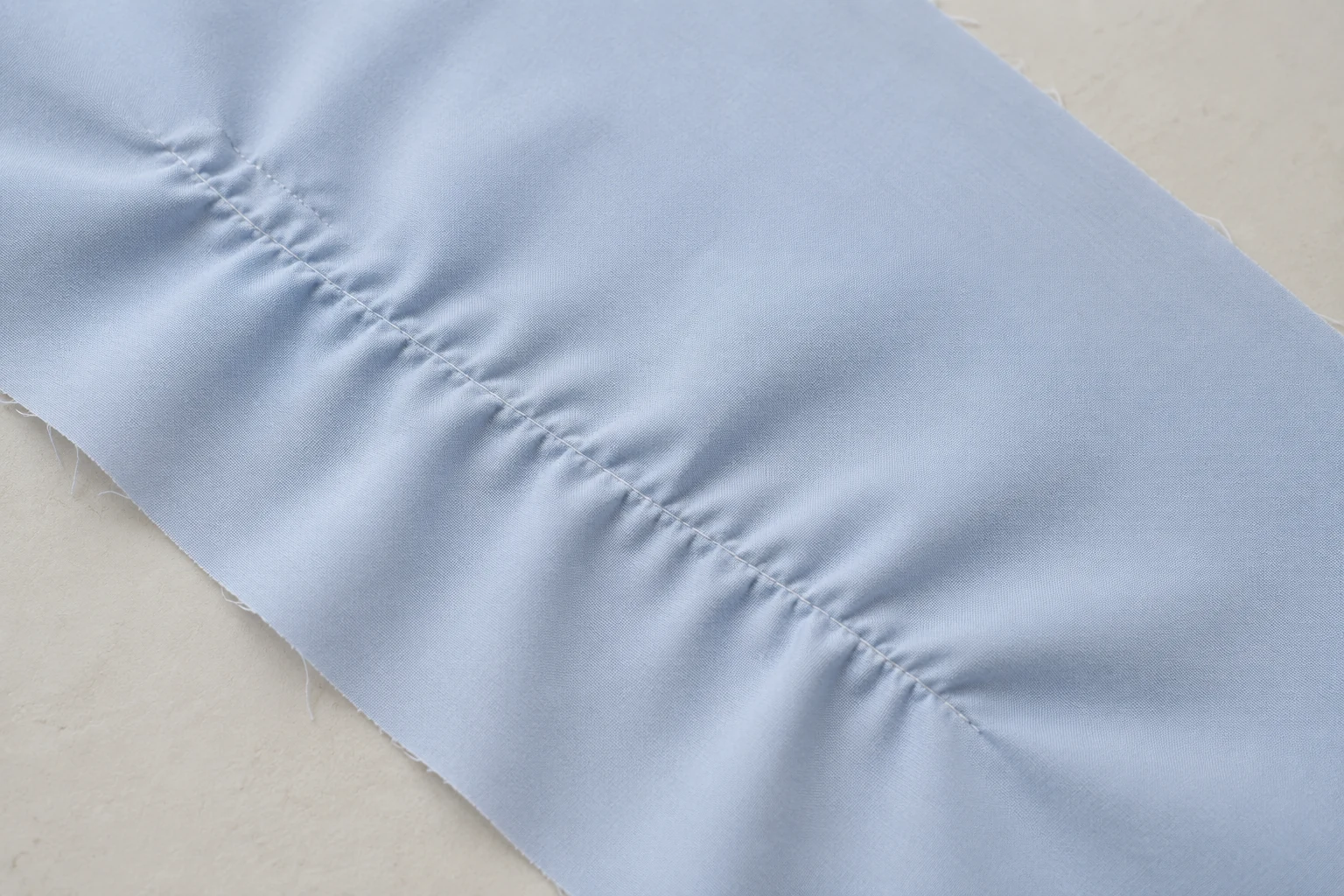
Unwanted ripples or gathers forming along a seam instead of the fabric lying flat.
Visible fabric puckering along a stitched seam. The ripples show how thread tension, dense stitching, uneven feeding or unstable fabric can draw a seam out of shape. The cause should be identified on a test sample before multiple settings are changed.
Start here
Identify which kind of pucker you have
Immediate tight ripples suggest thread or density; mismatched layer lengths point toward feeding; later ripples may come from shrinkage.
01
Tension-related puckering
Verify threading, use finer thread and needle where appropriate, and reduce excessive tension only through testing.
02
Feed-related puckering
Support the project, reduce drag, adjust foot pressure when possible, or use even feeding.
03
Structural puckering
Very short stitches, dense decoration, unstable bias, or missing stabilizer can compress fabric.
Useful distinction
An iron is not a diagnosis
Heat may relax mild handling ripples, but it can also set distortion permanently when the real cause remains.
Practical guide
Identify the pucker before changing settings
Different puckers can look similar after the seam is sewn. Observe when the distortion appears, which layer is shorter, and whether removing the stitches lets the fabric lie flat.
Tension or thread displacement
If the seam relaxes when stitches are removed, the thread may be drawing the fabric together. Rethread first, then test a finer needle and thread combination, a longer stitch, and only a small tension reduction. Judge the result after the sample has rested.
Uneven feeding between layers
When one layer extends beyond the other, the feed dogs may be advancing the lower layer while friction under the foot restrains the top. Support project weight, avoid pushing, reduce adjustable presser pressure where appropriate, or use an even-feed method for long layered seams.
Stitch density and fabric instability
Short stitches place more thread into the same distance and can compress fine fabric. Dense embroidery or satin stitching needs suitable stabilizer. Bias edges and loosely woven fabric may stretch during handling, so staystitching and careful support can matter more than the tension dial.
Shrinkage that appears later
A seam can look smooth during construction and ripple after washing or pressing if fabric, thread, interfacing, or trim shrink at different rates. Pre-treat washable components as they will be cared for and test uncertain combinations with the intended heat and moisture.
Avoidable mistakes
Why random adjustment makes puckering harder to solve
Changing tension, pressure, stitch length, and needle together removes the useful comparison.
Stretching the sample flat while sewing hides a feeding problem until it is released.
Using heavy thread on fine fabric and treating the resulting displacement as tension alone.
Pressing aggressively before checking the unpressed seam can set unwanted ripples.
Common questions
Fabric Puckering FAQs
Why does light fabric pucker at normal tension?
Thread or needle may be too heavy, stitch length too short, or stabilizer may be needed.
Can pressing remove every pucker?
No. Feed or tension puckering usually returns unless the setup is corrected.
Why does only the lower layer gather?
The feed dogs may advance it faster while the foot restrains the top layer.
Does prewashing prevent this problem?
It prevents later shrinkage differences but cannot correct poor feeding or tension.