← Sewing glossary

Serger setting

Differential Feed

A serger control that changes the relative speed of the front and rear feed dogs.

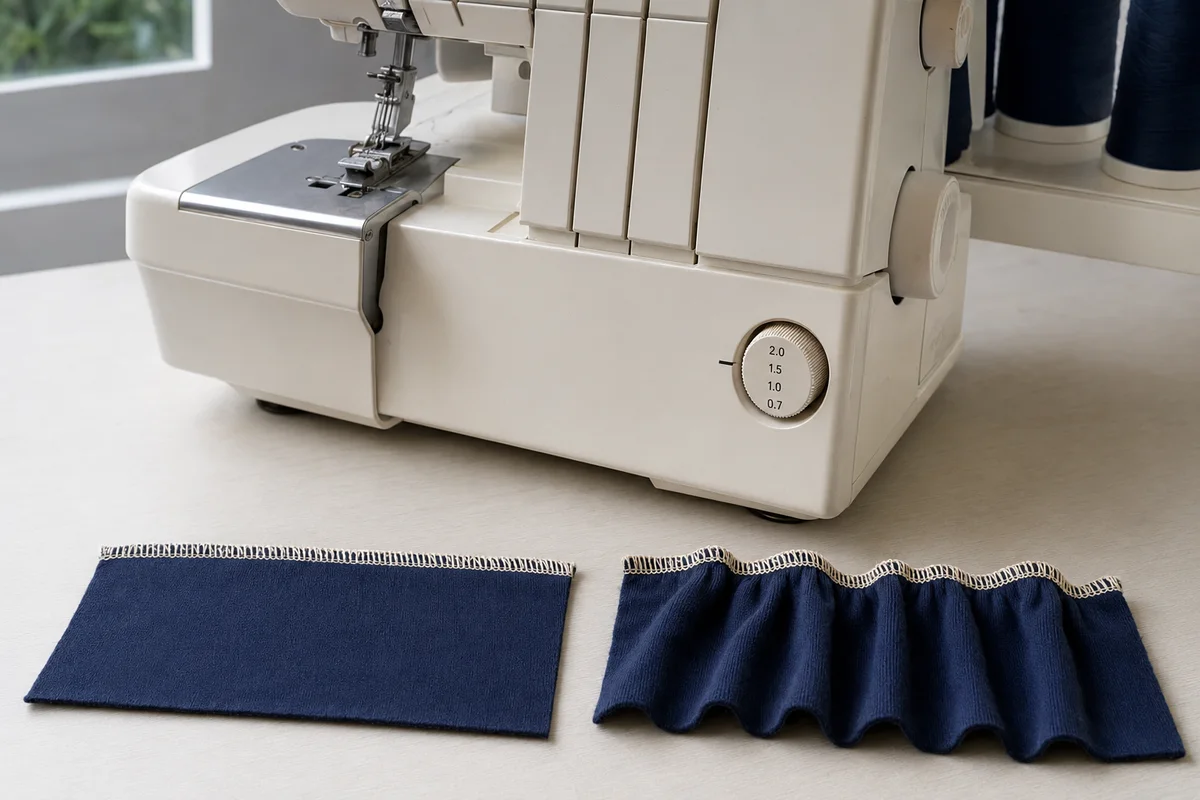
A serger differential-feed dial beside matching navy knit samples showing one flat overlocked edge and one evenly gathered edge
Flat and gathered results from different differential-feed ratios. The differential control changes how quickly the front feed section moves relative to the rear section. A neutral setting keeps the knit flat, while a higher ratio intentionally gathers it.
01

Preventing wavy knits

Increase the ratio so the front dogs deliver more fabric than the rear set removes.

02

Correcting puckered wovens

Move toward neutral or slightly below it, while also checking pressure, stitch length, and cutting width.

03

Creative effects

High ratios can gather; low ratios can intentionally stretch an edge for lettuce finishes.

Useful distinction

Feed is not tension

Differential feed changes fabric movement. Thread tension controls how loops form, so treat the controls separately.

Practical guide

Set differential feed from the fabric response

Numbers are ratios, not universal recipes. The useful setting is the one that lets the actual fabric leave the presser foot flat, unstretched, and without unintended gathering.

How the two feed systems interact

The front feed dogs collect fabric before it reaches the needles, while the rear feed dogs carry the stitched fabric away. Above neutral, the front section moves more fabric forward and counters stretching. Below neutral, the rear section removes fabric faster and deliberately stretches the edge.

A controlled knit test

Cut two scraps on the same grain as the project and serge one at neutral without pulling. If the edge waves, raise the ratio one step and repeat with the same stitch length, cutting width, and pressure. Compare cooled samples on a flat surface rather than judging them while stretched behind the machine.

Puckering on stable woven fabric

A high ratio can compress a fabric that did not need help. Return toward neutral before changing thread tension. Also check whether a short stitch length, tight needle threads, or excessive presser-foot pressure is drawing the seam together.

Using differential feed for gathering

A high ratio and longer stitch can gather a light woven edge for ruffles or easing. It is controlled fullness, not a substitute for gathering threads when an exact finished length is required. Test how much the sample shortens and divide longer pieces into matching sections.

Avoidable mistakes

Settings that create misleading results

  • Pulling the fabric behind the presser foot while evaluating the ratio.
  • Changing differential feed and thread tension at the same time.
  • Testing across one grain direction and sewing the project in another.
  • Assuming the highest number is automatically best for every knit.

Common questions

Differential Feed FAQs

What number is neutral differential feed?

It is commonly marked 1.0, N, or a center line, but scales vary.

Why is a knit still wavy at the highest ratio?

Pressure, stitch length, fabric handling, or extreme stretch may still be contributing.

Can this setting gather without elastic?

Yes, especially on light fabric with longer stitches and a high ratio.

Do ordinary sewing machines have differential feed?

Most do not; it is mainly a serger or overlocker feature.