← Sewing glossary

Industrial machine shape

Cylinder-Bed Sewing Machine

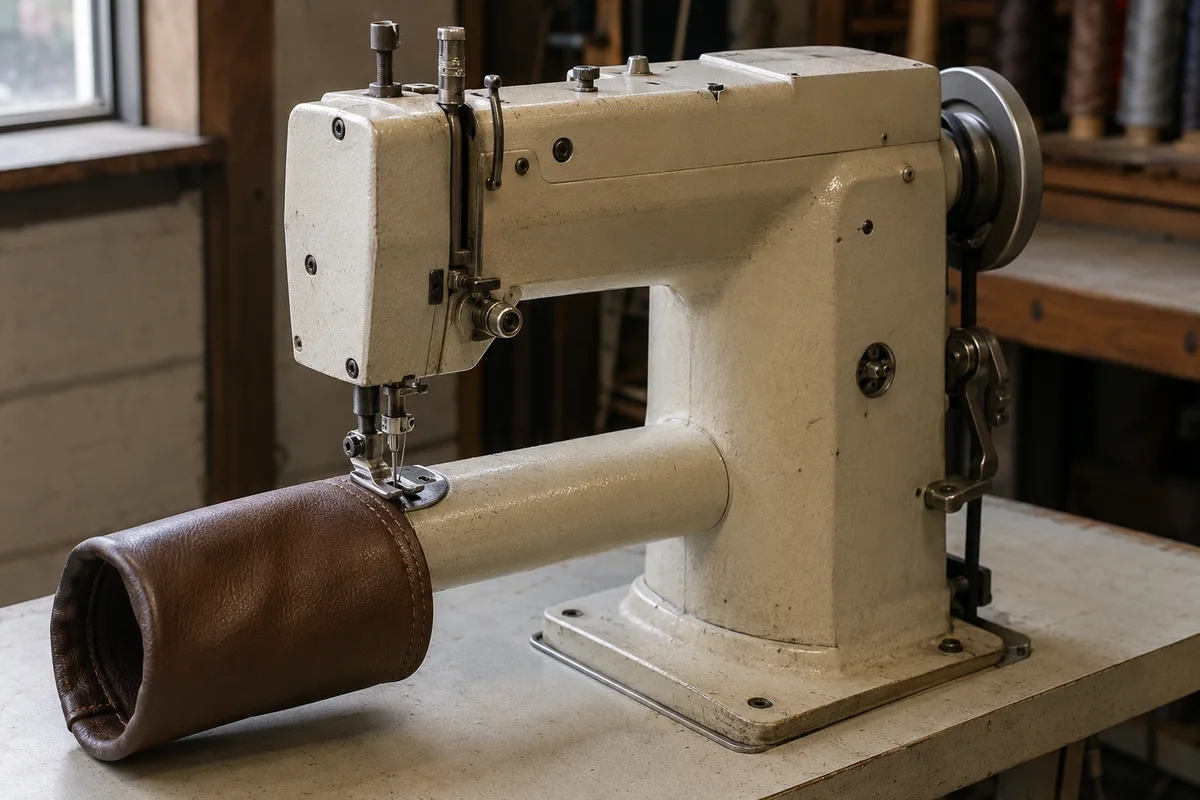
An industrial sewing machine with a narrow cylindrical work surface beneath and around the needle area.

A compact industrial cylinder-bed sewing machine stitching a brown leather tube wrapped around its narrow cylindrical arm
A cylinder-bed machine sewing tubular leather. The narrow raised bed leaves open space around the work surface, allowing bags, cuffs and other shaped pieces to wrap around it while the seam passes beneath the presser foot.
01

Why the bed shape matters

Unlike a broad flat bed, the narrow cylinder can enter bags, cuffs, footwear, cases, and other closed or three-dimensional items so a difficult seam remains accessible.

02

Diameter changes access

A smaller cylinder reaches tighter curves and narrower tubes, while larger designs may provide different hook capacity, strength, or work support. Published diameter should be compared with the real product.

03

Machine class still matters

Cylinder bed describes shape, not stitch or feed alone. Models may use lockstitch or chainstitch and bottom, needle, walking, roller, or compound feed for different materials.

Useful distinction

Free arm and cylinder bed are not equivalent

A domestic free arm helps with garment tubes, but an industrial cylinder-bed machine is built around a narrower specialised work surface and a defined production operation.

Practical guide

Choose bed shape together with feed, cylinder size, and operation

Cylinder access is valuable only when its diameter and length fit the three-dimensional work. Feed system, hook type, presser feet, table support, and the direction a product can rotate around the bed are equally important.

Map the actual sewing operation

Identify whether the machine must enter a closed bag, rotate a cuff, sew around footwear, bind an edge, or topstitch a shaped panel. Measure the smallest opening and deepest reach on a representative piece, including seam allowances and hardware.

Compare cylinder dimensions

A narrower cylinder reaches smaller tubes but may limit hook size, rigidity, or available mechanisms. Diameter alone is incomplete; note cylinder length, clearance around the head, needle position, and obstructions that prevent the product from turning through a full seam.

Select feed and stitch formation separately

Cylinder-bed describes shape, not feeding action. Models may use drop feed, roller feed, needle feed, compound feed, lockstitch, or chainstitch systems. Match these to surface marking, layer control, thread size, curve handling, and seam appearance.

Support flat and heavy work

A removable flat-work table can extend the bed for panels, while stands and guides can support bags or straps. Keep product weight from hanging against the needle. Test access with the intended feet, binder, folder, or edge guide installed because attachments reduce working clearance.

Avoidable mistakes

Why the narrowest cylinder is not automatically the best machine

  • Bed shape does not guarantee compound feed or heavy-thread capacity.
  • Quoted diameter may not describe usable clearance near the needle.
  • A flat table helps panels but may obstruct rotation of a closed product.
  • Buying before testing the real operation can leave hardware or seams unable to pass the head.

Common questions

Cylinder-Bed Sewing Machine FAQs

What projects suit a cylinder-bed machine?

Bags, shoes, wallets, leather goods, cuffs, caps, upholstery details, and other tubular or shaped assemblies are common applications.

Can it sew ordinary flat panels?

Often yes with technique or a removable table, but a flat-bed machine may support large flat work more naturally.

Does every cylinder-bed machine have compound feed?

No. Bed shape and feed system are separate specifications; verify both for the exact model.

Is the smallest cylinder always best?

No. Access must be balanced with hook capacity, material range, stability, attachments, maintenance, and the seams actually produced.