
← Sewing glossary

Industrial feeding system

Compound Feed

An industrial feeding system in which multiple moving components advance the material together during stitch formation.

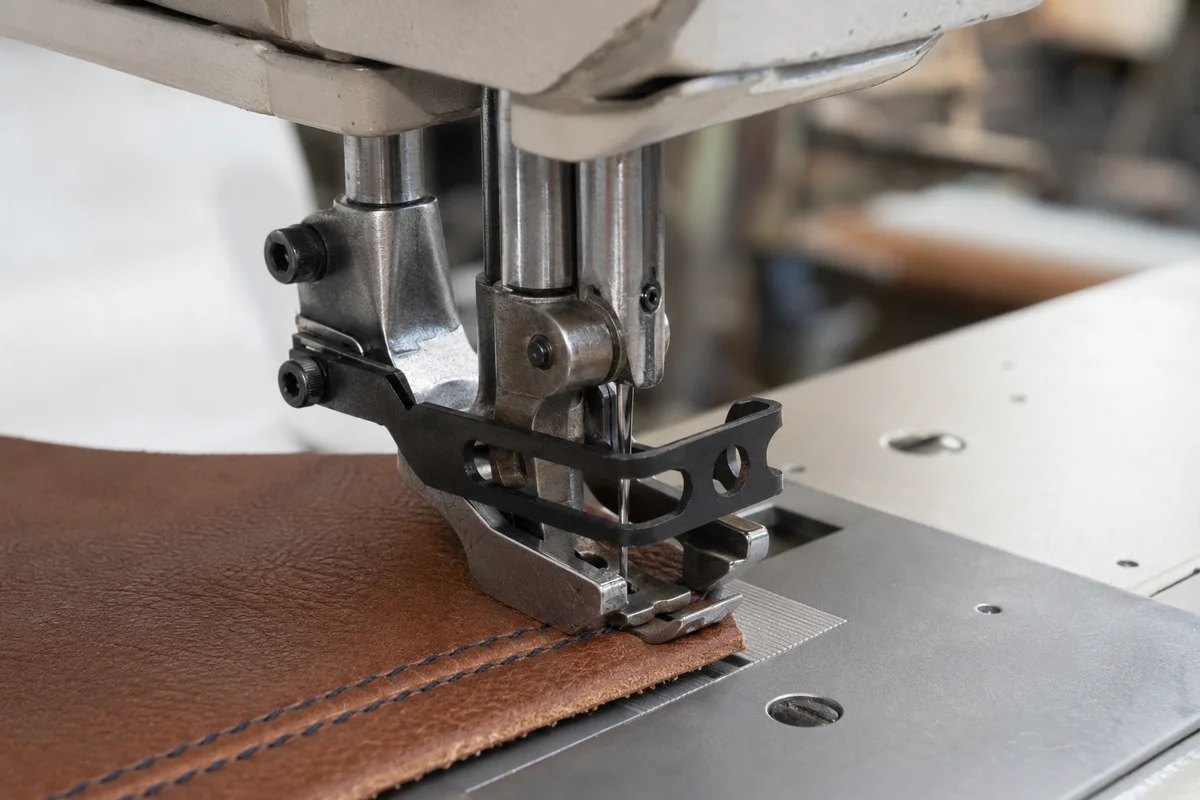
A nested industrial compound-feed walking-foot assembly guiding layered brown leather beneath a single threaded needle
A compound-feed walking-foot assembly on layered leather. The inner needle foot, outer walking foot and lower feed dog advance the material along the same stitch path. Their coordinated motion helps keep thick or layered work from shifting.
01

Three actions work together

The feed dogs advance from below, the needle may travel with the material while embedded, and an inner walking foot moves in coordination as the outer foot alternately holds the work. Designs vary by model.

02

Where it is most useful

Compound feed helps control leather, upholstery, canvas, webbing, bags, cushions, and layered assemblies that may creep or stall under a bottom-feed machine.

03

What it cannot correct

It does not make every thickness sewable. Needle system, thread capacity, foot lift, hook size, motor control, machine clearance, and material preparation must all match the job.

Useful distinction

Walking foot is an incomplete description

Some sellers use walking foot broadly. Compound or unison feed describes a more coordinated system than a top walking attachment alone, so verify the mechanism rather than relying on a label.

Practical guide

Match the feeding system to the seam, not just the material label

Compound feed improves layer control by coordinating several moving parts, but machines sold under similar terms can use different mechanisms. The exact feed action, presser-foot lift, hook capacity, and attachments determine suitability.

Verify what moves during the stitch

In many unison-feed machines, the feed dogs, needle, and alternating feet advance the work together for part of the cycle. Other machines described as walking foot may omit needle feed. Watch a handwheel cycle and confirm the manufacturer specification before comparing models.

Use it for controlled layered work

Upholstery, bags, canvas, webbing, and leather assemblies benefit when upper and lower layers resist creeping. The system does not make every thickness sewable. Needle system, thread range, lift, hook capacity, motor torque, and maximum rated material still set limits.

Adjust without masking another fault

Foot pressure, alternating-foot height, feed timing, stitch length, and thread tension interact. Begin from the manual setting and test the complete seam stack. Excess pressure can mark surfaces, while too little can allow lifting and skipped stitches.

Plan turns and edge access

Bulky feet can limit visibility and the distance available near hardware or raised edges. Stop with the needle down only when the design permits, lift the feet, pivot without forcing the needle, and choose feet, guides, and bed style for the operation.

Avoidable mistakes

What compound feed cannot correct by itself

  • It cannot compensate for a needle or thread outside the machine’s rated range.
  • Aggressive feed teeth may mark a finished leather surface.
  • Pulling at a corner can deflect a moving needle and disturb feed timing.
  • Assuming every walking-foot machine has needle feed leads to misleading comparisons.

Common questions

Compound Feed FAQs

Is compound feed the same as a domestic walking foot?

No. A domestic attachment assists the upper layer; an industrial compound-feed machine coordinates built-in feed components throughout the stitch cycle.

Does the needle move with the material?

On many compound or unison-feed designs, yes. Check the model specification because terminology and mechanisms vary.

Can compound feed sew lightweight fabric?

Some machines can after careful adjustment, but their feet, teeth, needle system, and tension are usually optimised for medium or heavy work.

Why do layers still shift on a compound-feed machine?

Incorrect foot timing, pressure, feed balance, handling, a difficult seam transition, or a setup outside the machine’s range can still cause movement.