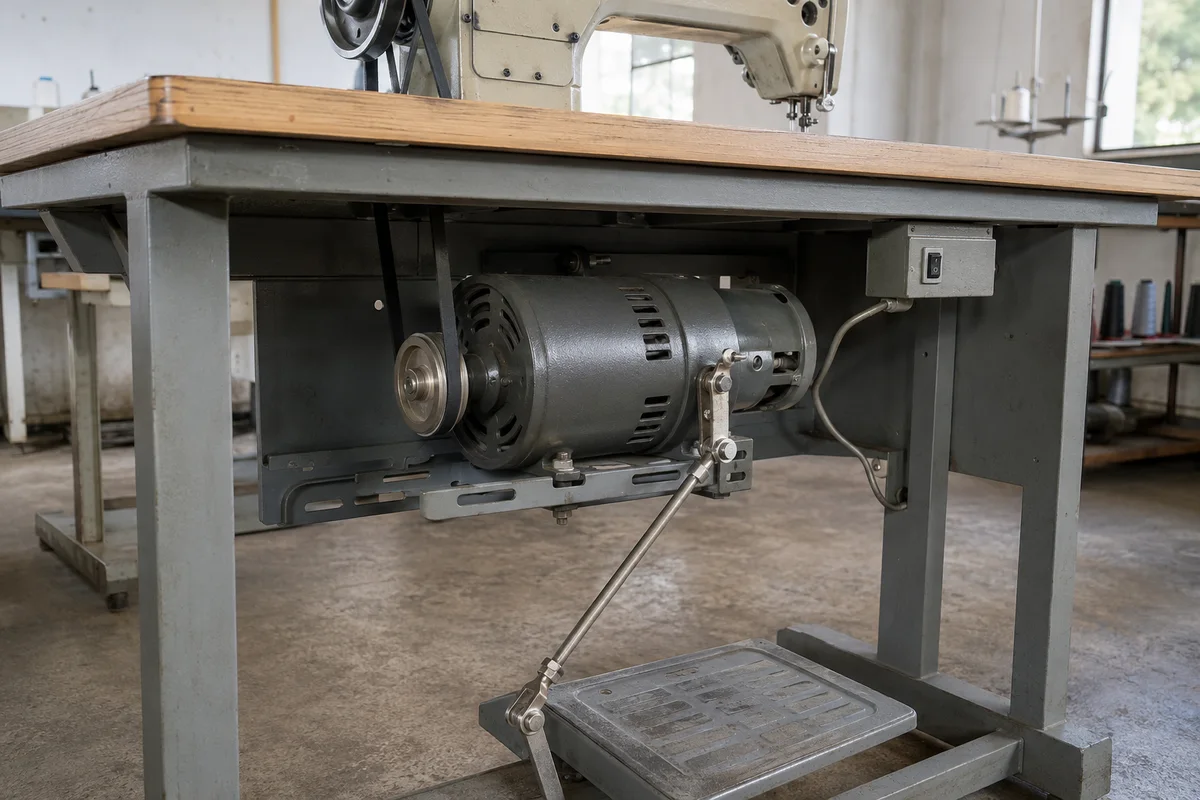
A table-mounted industrial motor that runs continuously and transfers power to the sewing machine when its mechanical clutch is engaged.
A traditional under-table industrial clutch motor. The continuously running motor transfers power through its pulley and belt. Pressing the treadle moves the linkage that engages the clutch and controls how much power reaches the machine.
01
How power reaches the machine
The motor reaches operating speed after it is switched on, while the machine head remains still until the treadle engages the clutch. Greater treadle movement increases the connection and sewing speed.
02
Why control feels different
A clutch motor delivers strong momentum but can start abruptly, especially for an inexperienced operator. Pulley size, clutch adjustment, machine condition, and practice all affect low-speed control.
03
Clutch motor versus servo motor
A servo motor generally draws power mainly while sewing and offers easier speed limiting. A clutch motor is mechanically simple and familiar in older production setups, but it runs and produces sound whenever switched on.
Useful distinction
Motor type does not define stitch quality
A well-adjusted clutch motor can drive excellent work. Feed system, machine setup, needle, thread, material, and operator control still determine the seam.
Practical guide
Understand the drive before deciding whether to keep or replace it
A clutch motor stores energy in a continuously spinning flywheel and transfers it mechanically to the machine. Its fast response suits production, but control, noise, energy use, pulley size, and safe installation matter in a small workshop.
How treadle movement becomes machine speed
The motor reaches operating speed after switch-on. Pressing the treadle engages clutch surfaces and transfers torque through the belt. A small movement can deliver substantial power, so smooth low-speed sewing depends on linkage adjustment, clutch condition, operator practice, and pulley ratio.
Compare it fairly with a servo motor
A servo generally draws little power while idle, runs only on demand, and commonly offers easier low-speed control. A clutch motor can be durable and familiar in production settings. The better choice depends on operation speed, material load, noise limits, operator experience, and retrofit cost.
Account for pulley and belt setup
A smaller motor pulley usually reduces machine speed and can improve control, but belt length, guard clearance, torque behaviour, and manufacturer limits must still be checked. Disconnect power before measuring, tensioning, aligning, or touching any drive component.
Plan a safe conversion
A servo retrofit must match supply voltage, table mounting, rotation direction, belt alignment, machine load, and control linkage. The heavy motor requires supported handling. Electrical connection, grounding, and local compliance should be handled by a qualified person where required.
Avoidable mistakes
Workshop risks hidden by a simple motor swap
A motor can remain hazardous while its flywheel is coasting after switch-off.
Removing a belt guard exposes clothing and hands to the drive.
Overtight belt tension loads motor and machine bearings.
Choosing only by wattage ignores control range, pulley ratio, and the actual sewing load.
Common questions
Clutch Motor FAQs
Why does a clutch motor hum while the needle is stopped?
Its motor and flywheel continue running whenever power is on; the clutch separates that motion from the machine head until the treadle is pressed.
Can a clutch motor sew slowly?
Yes, but fine control can require practice and careful adjustment. A smaller motor pulley may reduce maximum speed when professionally fitted.
Is a servo motor always a direct replacement?
Not automatically. Mounting holes, belt alignment, pulley size, rotation, voltage, power, and any synchronizer must suit the table and machine.
Should the belt be adjusted while the motor is on?
No. Disconnect power and wait for all motion to stop before inspecting the belt, pulley, guard, or clutch linkage.