
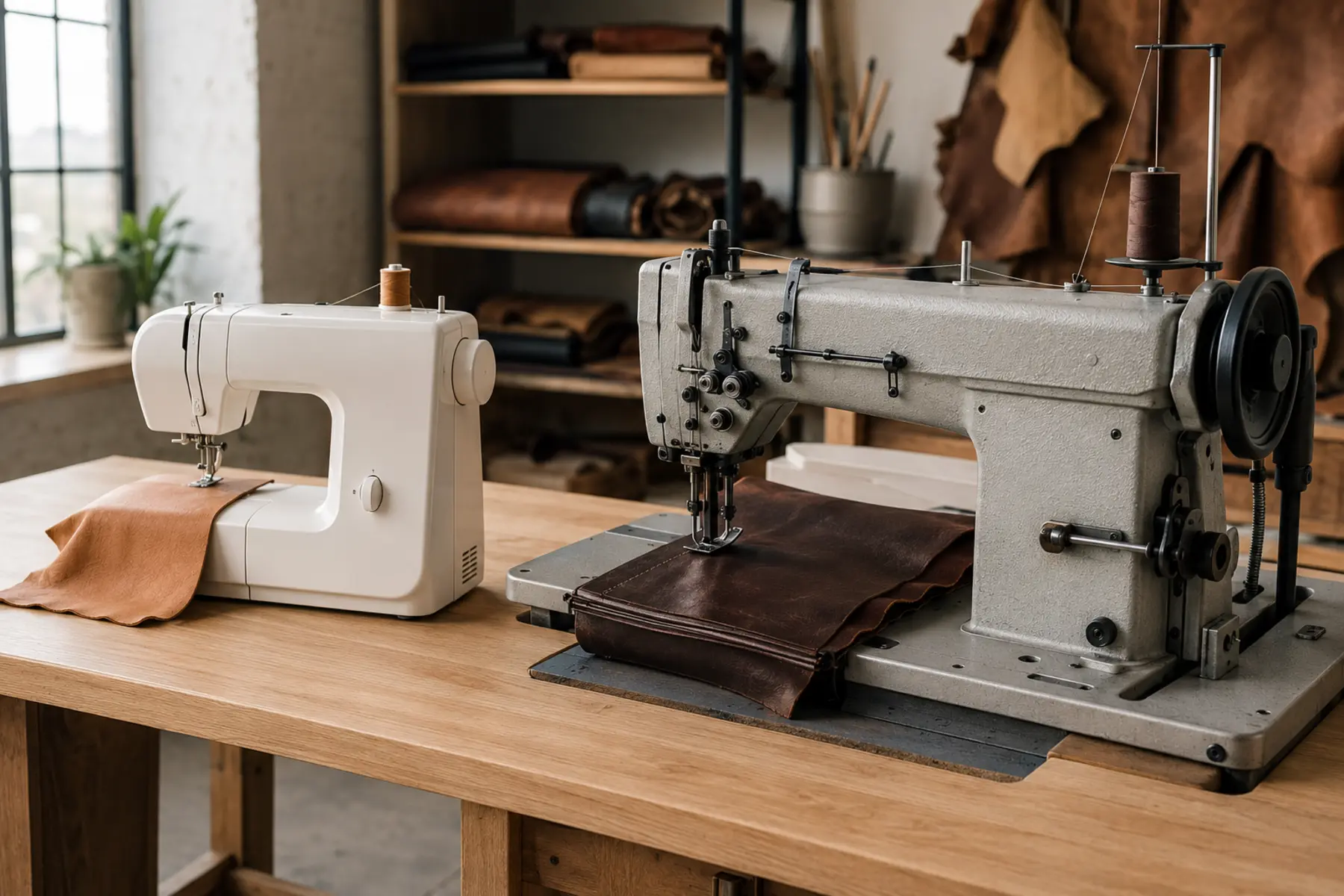
A domestic sewing machine can handle some leather, but that does not make it a leather sewing machine. The practical difference is not simply that an industrial machine is faster or more powerful. A suitable industrial machine can feed, penetrate, and stitch demanding leather assemblies more consistently, especially when a project includes bulky seams, binding, reinforcement, or thick thread.
This is a capacity and workload comparison, not a product ranking. The aim is to help you decide which machine class fits your leather, thickest assembled seam, project shape, frequency of use, workspace, and budget.
Domestic vs industrial leather sewing machines at a glance
Can you sew leather with a domestic sewing machine?
Yes, a domestic machine can sew certain leathers, particularly when the material is soft, flexible, and not excessively thick. Garment-weight leather, lambskin, thin faux leather, and some lightweight upholstery leather may be realistic if the machine manufacturer allows the material and the setup is appropriate.
The machine must handle the complete seam rather than one flat test piece. A domestic machine may stitch two scraps successfully and then struggle at a folded edge, strap attachment, zipper end, boxed corner, or overlapping seam. Those areas may combine several layers of leather with lining, interfacing, adhesive, foam, webbing, or stabiliser.
A domestic machine is most practical when the leather bends easily, bulky intersections are limited, domestic-size needles and moderate thread are sufficient, and leather projects are occasional rather than the machine’s main workload.
What makes an industrial machine better for leather?
An industrial machine intended for leather is generally better at maintaining material feed, needle penetration, and stitch consistency through difficult assemblies. The difference becomes clearer when multiple layers must travel together without shifting or when a seam changes thickness abruptly.
More controlled material feeding
Most domestic machines rely mainly on feed dogs beneath the material. Leather may drag against the presser foot while the lower layer continues moving. That can create misaligned edges, changing stitch length, or one layer creeping ahead of another.
Leather-capable industrial machines may use roller feed, needle feed, alternating presser feet, or compound feed. In a compound-feed system, coordinated movement from the needle, feed dog, and presser-foot mechanism helps layered assemblies advance together.
A domestic walking-foot attachment can improve layer control, but it does not change the machine’s motor, needle system, presser-foot lift, hook capacity, or internal construction. See how domestic and industrial walking-foot systems differ for a focused explanation.
Better performance across changing thickness
The thickness of a leather hide does not describe the complete sewing job. Folded edges, piping, reinforcement, lining, and strap ends can create a much thicker stack. A suitable industrial machine is more likely to maintain feeding pressure and stitch length as it climbs onto and leaves these sections.
Compatibility with heavier thread
Thread contributes to both the appearance and construction of leather goods. Domestic machines are normally limited by the thread that can pass reliably through their needle, tension path, and hook area. Industrial leather machines may accommodate heavier thread, but the supported range differs substantially by model.
Repeated, sustained work
Industrial machines are built to perform a specialised operation repeatedly. If you make leather products for sale, predictable feeding and stitch formation may be more valuable than the decorative stitches and broader versatility of a domestic machine.
Does “industrial” automatically mean suitable for leather?
No. An industrial machine may be designed for high-speed sewing of shirts, lightweight garments, knitted fabric, or another specialised operation. It can be faster and more durable than a domestic machine while still lacking the feeding system, clearance, needle range, or thread capacity required for your leather project.
Industrial leather machines also cover very different levels of work:
Flat-bed, cylinder-arm, or post-bed: which is better?
Power is only one part of the decision. The shape of the machine bed determines whether an assembled item can be positioned, supported, and rotated beneath the needle.
A more powerful flat-bed machine is not necessarily more useful if the completed item cannot be positioned under its presser foot.
When is a domestic machine enough for leather?
A domestic machine may be enough for soft leather garments, simple pouches, lightweight accessories, and fabric projects that use small amounts of thin leather. It is also a reasonable starting point when you already own a suitable machine and are still deciding whether leatherwork will become a regular hobby.
Before starting the project, test:
The thickest complete seam, including lining, interfacing, adhesive, and reinforcement.
Forward and reverse sewing if the construction requires backstitching.
Corner turning and slow stitching without skipped stitches.
Stitch appearance and tension on both sides of the leather.
Whether the presser foot or feed dogs leave unacceptable marks.
Whether the machine starts slowly without stalling or needle deflection.
If the handwheel becomes unusually difficult to turn, the needle deflects, the motor strains, or stitches repeatedly skip, stop. A stronger needle alone does not increase the overall capacity of the machine.
How to set up a domestic machine for light leather
Use a compatible leather needle
A leather needle uses a cutting point to penetrate non-woven material. Check compatibility with your machine and test the hole size on a scrap before sewing. Needle holes in leather are permanent, so an unnecessarily large needle can visibly mark or weaken the seam. Use the sewing machine needle guide for the wider sizing and compatibility process.
Choose the presser foot for the actual feeding problem
A non-stick or roller foot can reduce surface drag. A walking-foot attachment may improve alignment when layers creep. These accessories address feeding behaviour; they do not turn a domestic machine into a heavy industrial leather stitcher.
Test a longer stitch
Very short stitches place holes close together and can weaken leather along the seam line. Test a moderately longer stitch using the actual leather, thread, and seam construction rather than relying on one universal setting.
Use clips instead of pins
Pins create permanent holes. Sewing clips, temporary leather tape, or a suitable adhesive can hold layers in position. Keep adhesive residue away from the stitching path when it collects on the needle or interferes with stitch formation.
Sew slowly and avoid corrections
Leather offers little opportunity for unpicking because the original holes remain visible. Slow sewing improves control around corners and thickness changes. Support the project’s weight so it does not pull against the needle.
When should you upgrade to an industrial leather machine?
Consider an industrial machine when the domestic setup limits the projects you actually want to make, not simply because an industrial machine appears more professional.
You sew leather every week or produce items for customers.
Your seams regularly contain folds, reinforcement, piping, webbing, or several layers.
You need heavier thread than the domestic machine can form reliably.
Stitch length changes when the foot reaches bulky intersections.
Layers shift despite suitable setup and handling.
The machine frequently stalls, skips stitches, or breaks needles.
You need a cylinder arm or post bed to reach assembled seams.
For products made for sale, consistency matters as much as maximum capacity. A machine that completes one sample but struggles across repeated items can slow production and waste leather.
What else changes when you move to an industrial machine?
Dedicated space
Most industrial heads are installed in a table with a motor and stand. Measure the complete setup, access around it, and the path through which it must be delivered. The machine is less convenient to pack away between projects.
Speed control
Traditional clutch motors can start quickly. A servo motor normally offers more controllable low-speed operation, which is useful for corners, short seams, and visible topstitching. Some leather setups also use a speed reducer for further control.
Setup and maintenance
Industrial ownership involves learning the threading path, bobbin system, upper and lower tension, compatible needle and thread combinations, presser-foot pressure, lubrication, and routine adjustments. Dealer support, parts availability, and a demonstration with your material can therefore matter as much as the initial price.
Specialisation
A dedicated industrial machine may perform one stitch exceptionally well but will not replace the zigzag, buttonhole, stretch, and decorative functions of a domestic machine. Many leather workers retain a domestic machine for fabric work.
Which machine should you choose for your leather projects?
Frequently Asked Questions
Domestic and industrial leather machine questions
Can a regular sewing machine sew real leather?
A regular sewing machine can sew some thin, soft real leathers when the manufacturer permits it and the complete seam remains within the machine’s capacity. A leather needle and suitable presser foot can help, but they cannot compensate for insufficient feeding, clearance, thread capacity, or piercing power.
Is a heavy-duty domestic machine the same as an industrial machine?
No. A heavy-duty domestic model remains a domestic machine. An industrial machine is normally designed around a specialised operation and may use a different feeding system, motor, needle system, hook, stand, and table-mounted construction.
Do I need a walking foot to sew leather?
Not for every leather project. A non-stick or roller foot may help with surface drag on light leather. A walking foot becomes more useful when layers shift, but a domestic attachment does not provide the full feeding, clearance, thread capacity, or construction of an industrial compound-feed machine.
What type of industrial sewing machine is best for leather bags?
Many leather bag makers use a medium-weight compound-feed machine. A cylinder arm can improve access to curved and enclosed bag seams, while a flat-bed machine supports panels and flatter construction. The right choice still depends on leather weight, thread size, seam thickness, and assembly method.
Can one industrial machine sew every type of leather?
No. A machine intended for garment leather may not handle heavy belts, while a heavy leather stitcher may make holes or feed marks that are excessive for delicate leather. The machine class must match the material, seam structure, and thread.
Can a vintage domestic machine sew thick leather?
Some vintage machines have sturdy metal construction, but age, weight, and metal parts do not prove leather capacity. Feeding, needle and thread range, presser-foot clearance, motor, hook design, condition, and the thickest assembled seam still determine what the machine can sew safely.
Choose for the finished seam, not the machine label
A domestic machine is the practical choice for occasional, lightweight leatherwork when the complete seam stays within its limits. It offers versatility, takes up less room, and avoids the cost of a dedicated industrial setup.
An industrial machine is the better choice when you need reliable feeding, heavier thread, repeated production, or access to thick and three-dimensional seams. However, “industrial” is not a complete specification. Match the feed system, machine bed, needle and thread capacity, and intended material range to the products you plan to make.
Do not ask only how thick a machine can sew. Ask whether it can sew your thickest assembled seam with the chosen thread, at a controllable speed, without marking, shifting, or damaging the leather.